L10.1 Instrumentation: Particle Interaction with Matter
TL;DR
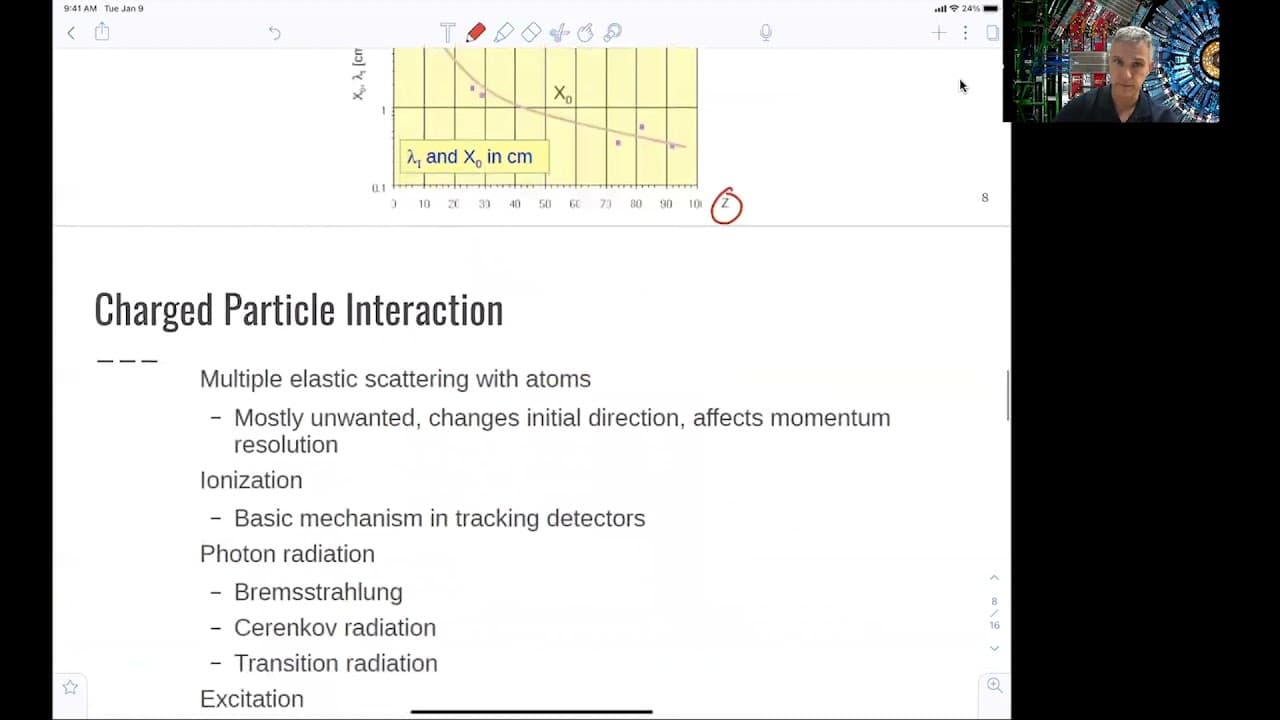
This content discusses the interaction of particles with matter in the context of instrumentation and detection, covering topics such as photon interactions, radiation lengths, electromagnetic and hadronic showers, ionization, Cerenkov radiation, and transition radiation.
Transcript
[SQUEAKING] [RUSTLING] [CLICKING] PROFESSOR: Welcome back to 8.701. We are starting a new chapter on instrumentation. And in this first section, we'll discuss the interaction of particles with matter. So what happens when particles traverse through a piece of material? The underlying principle of detection is that we do have to have some sort of in... Read More
Key Insights
- 🥺 Particle detection relies on the interaction of particles with detector materials, leading to energy transfer that can be measured.
- ❓ Only stable particles can be directly identified, as unstable particles decay before interacting with the detector.
- 🧡 Photon interactions with matter involve the photo effect, Compton scattering, and pair production, which have different energy thresholds and dominate at different energy ranges.
- 💨 Radiation lengths, like the electromagnetic radiation length, provide a convenient way to estimate energy loss in materials and guide detector design.
- 🛀 Electromagnetic showers and nuclear showers have distinct characteristics and involve particles such as electrons, positrons, hadrons, and photons.
Install to Summarize YouTube Videos and Get Transcripts
Explore YouTube Video Summarizer or Get YouTube Transcript Extractor
Questions & Answers
Q: How do photons interact with detector materials?
Photons interact with detector materials through the photo effect, where a photon kicks out an electron, Compton scattering, where the energy of the scattered electron can be measured, and pair production, which is dominant at high energies and initiates electromagnetic showers.
Q: What is the significance of radiation lengths in detector design?
Radiation lengths, such as the electromagnetic radiation length, are used to characterize materials in terms of their energy loss properties. Detector concepts like ATLAS and CMS aim for low radiation lengths in tracking detectors and high radiation lengths in calorimeters.
Q: How do electromagnetic showers and nuclear showers differ?
Electromagnetic showers involve the cascade of particles, such as electrons and positrons, produced by photons or electrons in calorimeters. Nuclear showers, involving hadrons like protons and neutrons, have clusters of energy due to fewer interactions and can produce photons through neutral pion decays.
Q: What are the key interaction mechanisms for charged particles in detectors?
The key interaction mechanisms for charged particles include multiple scattering, ionization, photon radiation (through bremsstrahlung and Cerenkov radiation), and scintillation in scintillators.
Summary & Key Takeaways
-
Particles interacting with a detector's material transfer energy, which can be detected and measured.
-
Different particles can be identified, but only stable particles can be directly identified.
-
Photon interactions with matter involve the photo effect, Compton scattering, and pair production, which are important for photo multiplier tubes and calorimeters.
Read in Other Languages (beta)
Share This Summary 📚
Summarize YouTube Videos and Get Video Transcripts with 1-Click
Try YouTube Summary with ChatGPT & Claude or YouTube Transcript Generator
Explore More Summaries from MIT OpenCourseWare 📚


Summarize YouTube Videos and Get Video Transcripts with 1-Click
Try YouTube Summary with ChatGPT & Claude or YouTube Transcript Generator