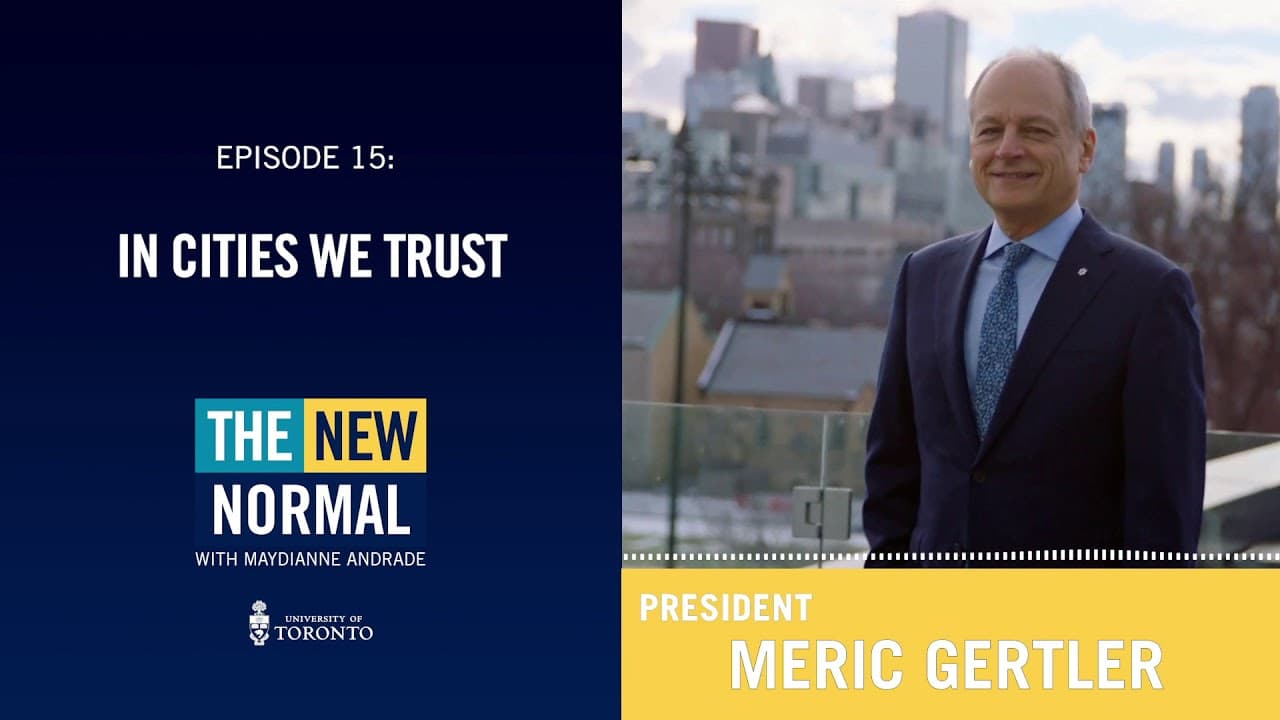
The New Normal with Maydianne Andrade (Ep. 15): In Cities We Trust
TL;DR
Cities can recover from crises by adapting quickly, retaining useful innovations, and sharing the experience-based knowledge that helps institutions succeed. In Toronto, pandemic responses included expanded sidewalks, restaurant patios, bicycle lanes, weekend street closures, express bus lanes, and new uses for remote teaching across the University of Toronto’s three campuses. Read on to understand which changes Meric Gertler believes cities and universities should preserve.
Transcript
[Maydianne Andrade] We are used to thinking of cities as static, solid entities and yet they aren't. They contract, they grow and they evolve. [Meric Gertler] Cities have faced these challenges in the past, right? Spanish flu. Bubonic plague. They've always come back bigger and better than ever and I think they will, again. [Andrade] I am Maydianne... Read More
Key Insights
- 💗 Cities are dynamic and can adapt and grow in response to challenges and crises.
- 🍉 Innovations and changes brought about by the pandemic, such as remote teaching and outdoor seating for restaurants, have the potential to create long-term positive impacts.
- 🏙️ Tacit knowledge, acquired through experience and observation, is crucial for success in institutions and cities.
- 🧔 The pandemic has intensified existing inequalities in cities, with marginalized communities bearing the brunt of the risks and challenges.
- 🖐️ Universities play a vital role in addressing these inequalities and devising policy tools to tackle them effectively.
- ✋ Access to higher education is essential to bridge socioeconomic gaps and ensure equal opportunities for all.
- 🌐 The pandemic has underscored the importance of global mutual understanding and the need for travel as a means to foster cultural and political connections.
Install to Summarize YouTube Videos and Get Transcripts
Explore YouTube Video Summarizer or Get YouTube Transcript Extractor
Questions & Answers
Q: Why does Meric Gertler trust cities to recover from major crises?
Gertler argues that cities are not static: they contract, grow, and evolve. He points to their recovery from the Spanish flu and bubonic plague as reasons to believe they can return from current challenges bigger and better than before.
Q: How did Toronto adapt its streets and public spaces during the pandemic?
Toronto expanded sidewalks for pedestrians and outdoor restaurant seating, reassigned car lanes to bicycles, and closed major thoroughfares on weekends. Gertler emphasizes that these changes happened with a speed many people had not thought possible.
Q: How did Toronto restaurants respond to pandemic conditions?
Restaurant owners rapidly expanded patios across the city. They also developed more extensive takeout and delivery options to operate under the new conditions.
Q: Why were express bus lanes introduced in some Toronto neighborhoods?
Express bus lanes were rolled out in neighborhoods where residents still had to commute to work each day. Public transit quality and frequency there had been below standard, pushing people onto overcrowded buses and imperiling their health.
Q: How did the pandemic change teaching at the University of Toronto?
The university had to make remote teaching tools work across all three campuses. It then began considering how those tools could continue changing teaching even after students and instructors returned to classrooms.
Q: What is tacit knowledge?
Gertler defines tacit knowledge as knowledge that is difficult to express in written or symbolic form, partly because people may not recognize everything they know. It is often described as know-how acquired through experience or observation.
Q: Why is tacit knowledge best shared locally and in person?
Tacit knowledge often requires demonstration, imitation, trial and error, and real-time correction rather than written instructions alone. Gertler illustrates this with swimming, which is more effectively demonstrated in person than taught by sending someone instructions and asking them to jump into the deep end.
Q: Who is Meric Gertler in The New Normal with Maydianne Andrade Episode 15?
Meric Gertler is an economic geographer and the 16th president of the University of Toronto. He is also a fellow of the Royal Society of Canada and an appointee to the Order of Canada.
Summary & Key Takeaways
-
President Gertler discusses the dynamic nature of cities, highlighting Toronto's transformation into a diverse and culturally rich world city due to immigration.
-
The pandemic has forced businesses and institutions, including universities, to rethink and innovate, leading to new ways of teaching, working, and utilizing public spaces.
-
Tacit knowledge, acquired through experience and observation, plays a vital role in institution building and city successes, while innovation benefits from knowledge sharing and collaboration.
Read in Other Languages (beta)
Share This Summary 📚
Summarize YouTube Videos and Get Video Transcripts with 1-Click
Try YouTube Summary with ChatGPT & Claude or YouTube Transcript Generator
Explore More Summaries from University of Toronto 📚
Summarize YouTube Videos and Get Video Transcripts with 1-Click
Try YouTube Summary with ChatGPT & Claude or YouTube Transcript Generator