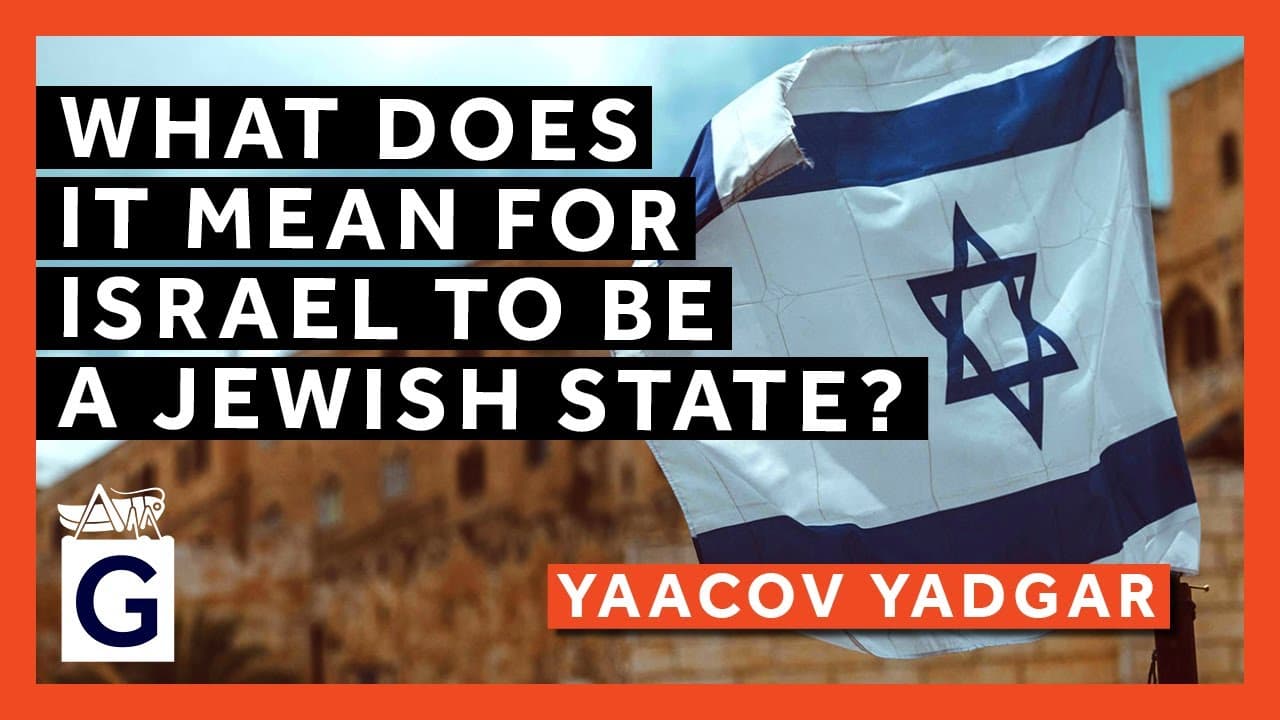
What Does It Mean For Israel To Be A Jewish State?
TL;DR
The discussion explores the complex and contested nature of Israel's identity as a Jewish state, highlighting the tension between a political nation-state approach and a normative understanding of Jewishness. It emphasizes the unresolved identity crisis in Israel and its implications for Middle Eastern politics.
Transcript
- So let me start by posing this simple or rather naive question, which is now the title of my talk. What do we mean when we refer to Israel as the Jewish state? What does the designation "Jewish" amount to in the context of this sovereign nation state? What does it mean for the politics of the state to be identified as Jewish? And how does all of ... Read More
Key Insights
- 🥺 The designation of Israel as a Jewish state is vague, leading to conflicting interpretations among Israelis and outsiders.
- 🌍 Israeli politics is characterized by the tension between a political nation-state approach and a normative understanding of Jewishness, both of which shape policies and ideologies.
- 🖐️ Israeli militarism, influenced by the concept of a Jewish state, has played a significant role in shaping the country's politics and conflicts.
- 🇦🇪 The inclusion of non-Jews, such as the United Arab List, in Israeli politics reflects pragmatism but does not resolve the deeper issues surrounding Jewish identity.
Install to Summarize YouTube Videos and Get Transcripts
Explore YouTube Video Summarizer or Get YouTube Transcript Extractor
Questions & Answers
Q: How has the concept of a Jewish state influenced Israeli politics?
The concept of a Jewish state has shaped Israeli politics by guiding policies and decisions. It has fueled a militaristic approach and led to an emphasis on demographic calculations, particularly the maintenance of a Jewish majority. This has influenced issues such as territorial expansion and conflict with neighboring states.
Q: Is there evidence in the Bible to support Israel's claim to the land?
The Bible can be interpreted in various ways, and its significance as evidence for Israel's claim to the land is subject to differing viewpoints. While some argue that the Bible supports Israel's ownership, others emphasize the ethical and covenantal aspects and view the relationship between the Jewish people and the land as conditional.
Q: How does pragmatism impact the tensions surrounding Jewish identity in Israel?
Pragmatism can play a role in addressing these tensions, as seen in the inclusion of the United Arab List in the government coalition. However, pragmatism alone cannot fully resolve the deeper ideological and cultural conflicts in Israeli society. It may preserve common interests but does not necessarily lead to long-term solutions.
Q: Could non-Jews be considered part of the Jewish nation in the future?
It is highly unlikely that non-Jews would be considered part of the Jewish nation in the future because the foundations of Jewish identity in Israel are deeply rooted in historical, religious, and cultural dimensions. However, political contexts can change over time, and new approaches to inclusivity and identity may emerge.
Q: Is the higher birth rate of Orthodox Jews seen as a threat to the character of Israel?
The higher birth rate of Orthodox Jews is perceived as a threat by some non-Orthodox Jews who are concerned about the growing influence of the Ultra-Orthodox minority. This tension reflects a larger culture war within Israeli society and impacts political dynamics. However, the demographic considerations of maintaining a Jewish majority often outweigh concerns about the Orthodox birth rate.
Summary & Key Takeaways
-
Israel's designation as a Jewish state is inherently vague and open to multiple interpretations, leading to misunderstanding and conflict.
-
There are two contesting political projects in Israel: an understanding of the state as a polity of Jews (based on demographic factors) and a normative understanding of a Jewish state (based on Jewish principles and practice).
-
Israeli politics is characterized by an uneasy balance between these two outlooks, often resulting in conflicting policies and ideologies.
-
The recent inclusion of the United Arab List in the governning coalition illustrates the pragmatic approach of including non-Jewish groups, but does not address the deeper tensions surrounding Jewish identity in the state.
Read in Other Languages (beta)
Share This Summary 📚
Summarize YouTube Videos and Get Video Transcripts with 1-Click
Try YouTube Summary with ChatGPT & Claude or YouTube Transcript Generator
Explore More Summaries from Gresham College 📚


Summarize YouTube Videos and Get Video Transcripts with 1-Click
Try YouTube Summary with ChatGPT & Claude or YouTube Transcript Generator