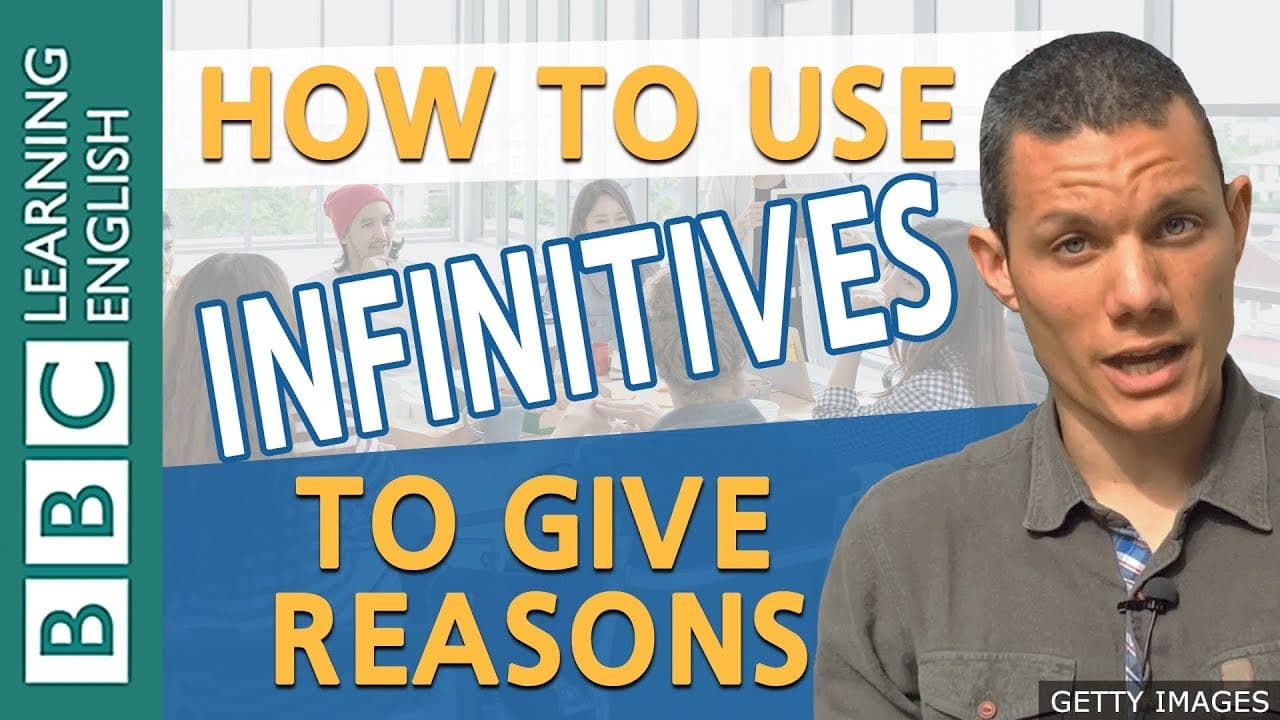
How to Use Infinitive Verbs to Explain Purpose
TL;DR
Infinitive verbs are used to clarify the reasons behind actions, such as 'to get better at speaking English.' They can also follow the structure 'for + somebody' to indicate actions performed on behalf of others. For formal expressions, use 'in order to' or 'so as to,' and avoid combining 'not' with 'to + infinitive' for negative meanings.
Transcript
Hi guys, Dan for BBC Learning English here. In this masterclass we'll be taking a look at infinitives of purpose. Are you ready? Here we go. So, in English we use the infinitive of purpose to explain why we're doing a particular action. For example, you're watching this video to get better at speaking English. Am I right? Of course I'm right. Now, ... Read More
Key Insights
- Infinitives of purpose are used to explain why an action is performed, such as 'to get better at speaking English.'
- Using 'for + somebody' can indicate actions done on behalf of others, e.g., 'I make these videos for you.'
- To express formality, 'in order to' or 'so as to' can replace simple infinitives, enhancing the sentence's tone.
- Negative expressions with infinitives use 'not' with 'so as to' or 'in order to', e.g., 'in order not to go to prison.'
- Avoid using 'to + infinitive' with 'not'; instead, use alternative verbs like 'to avoid watching TV' for negative expressions.
- Contrasts can be expressed using 'not' with infinitives, like 'I went to bed not to sleep, but to watch TV.'
- Infinitives can follow nouns or pronouns to indicate purpose, e.g., 'I want a house to live in.'
- Avoid adding object pronouns after infinitives following nouns, as in 'do you have any more food to cook it?' which is incorrect.
Install to Summarize YouTube Videos and Get Transcripts
Explore YouTube Video Summarizer or Get YouTube Transcript Extractor
Questions & Answers
Q: What is an infinitive of purpose?
An infinitive of purpose is a grammatical structure used to explain the reason behind an action. It typically follows a clause and indicates the purpose of the action, such as 'to get better at speaking English.' This helps clarify why someone is performing a particular action.
Q: How can infinitives of purpose be used formally?
To use infinitives of purpose formally, one can replace the simple infinitive with phrases like 'in order to' or 'so as to.' This adds a level of formality to the sentence, making it sound more polished. For instance, 'The government raised taxes in order to fund the NHS' is more formal than using just 'to fund.'
Q: How are negative expressions formed with infinitives?
Negative expressions with infinitives are formed by using 'not' with phrases like 'so as to' or 'in order to.' For example, 'He paid the fine in order not to go to prison.' This structure allows the speaker to express a negative purpose or outcome without directly using 'to + infinitive' with 'not.'
Q: Why should 'to + infinitive' not be used with 'not'?
The structure 'to + infinitive' should not be used with 'not' because it can create confusion and is not grammatically correct. Instead, alternative verbs should be used to express the negative, such as 'to avoid.' For example, instead of saying 'I went to bed not to watch TV,' one should say 'I went to bed to avoid watching TV.'
Q: How can infinitives be used after nouns and pronouns?
Infinitives can follow nouns, pronouns, or indefinite pronouns to express the purpose or intention related to them. For example, 'I want a house to live in' uses the infinitive 'to live in' to explain the purpose of wanting a house. However, object pronouns should not follow these infinitives, as this would be incorrect.
Q: What is the rule about using object pronouns with infinitives?
When using infinitives after nouns, it is important not to follow them with object pronouns. For example, saying 'do you have any more food to cook it?' is incorrect. The correct form is 'do you have any more food to cook?' The object pronoun 'it' should be omitted to maintain grammatical correctness.
Q: How can contrasts be expressed using infinitives?
Contrasts can be effectively expressed using 'not' with infinitives. This involves structuring the sentence to highlight the contrast in purpose, such as 'I went to bed not to sleep, but to watch TV.' This clarifies the intended action against the expected or assumed action, enhancing the sentence's clarity.
Q: What is the benefit of using 'for + somebody' with infinitives?
Using 'for + somebody' with infinitives allows the speaker to indicate that an action is performed on behalf of someone else. This structure provides clarity about who benefits from or is intended to benefit from the action. For example, 'I make these videos for you to get better at English' shows the action is for the audience's benefit.
Summary & Key Takeaways
-
Infinitives of purpose explain the reasons behind actions in English, such as 'to get better at English.' They follow the action they explain and can be used with 'for + somebody' to indicate actions done for others.
-
To formalize expressions, 'in order to' or 'so as to' can replace simple infinitives. Negative expressions use 'not' with 'so as to' or 'in order to,' avoiding 'to + infinitive' with 'not.'
-
Infinitives can follow nouns or pronouns to indicate purpose, but object pronouns should not follow them. Contrasts can be expressed with 'not' and infinitives, providing clarity in purpose.
Read in Other Languages (beta)
Share This Summary 📚
Summarize YouTube Videos and Get Video Transcripts with 1-Click
Try YouTube Summary with ChatGPT & Claude or YouTube Transcript Generator
Explore More Summaries from BBC Learning English 📚

Summarize YouTube Videos and Get Video Transcripts with 1-Click
Try YouTube Summary with ChatGPT & Claude or YouTube Transcript Generator