Unit 7: Drivers of Flexibility, Video 3: How Do Discount Rates and Learning Promote Flexible Capacity?
TL;DR
Discount rates and learning can make phased capacity investments more attractive than building one large plant upfront. Deferring an addition for three years may reduce its present value by roughly 30% at a 10% discount rate or 25% at 8%, while repeated production can lower the cost of later modules. Read on to see how these effects counterbalance economies of scale.
Transcript
[SQUEAKING] [RUSTLING] [CLICKING] RICHARD DE NEUFVILLE: I want to tie all this in with the discount rate here. Now, when the demand for capacity is growing, say, for electricity, you have two choices. You can build a big plant now for many years ahead. But I'm going to, I'm going to build a plant for the next 20 years. My father had this experience... Read More
Key Insights
- 🇦🇪 Building large capacity plants for future demand may be cheaper per unit, but delaying investments and factoring in the discount rate can counterbalance this advantage.
- ⏳ Learning and technological improvements can lead to lower unit costs over time by repeating the same production processes.
- 💄 Competitive gaming involves making commitments in advance to signal dominance and deter competitors.
Install to Summarize YouTube Videos and Get Transcripts
Explore YouTube Video Summarizer or Get YouTube Transcript Extractor
Questions & Answers
Q: How do discount rates and learning promote flexible capacity investment?
A discount rate lowers the present value of capacity additions that are deferred until demand requires them. Learning can also make later standardized modules cheaper as teams improve production methods and designs, strengthening the case for phased investment.
Q: What are the two approaches to meeting growing electricity capacity demand?
One approach is to build a large plant now with enough capacity for many years. The other is to build a small unit now and add more small units later as market demand grows.
Q: How does the discount rate counterbalance economies of scale?
A large plant may be cheaper per unit because of economies of scale, but phased additions are paid for later and therefore have lower present values. This discounting can counterbalance the initial cost advantage of building large.
Q: How much can deferring an investment for three years reduce its present value?
The lecture estimates that a three-year deferral could make the present value roughly 30% lower with a 10% discount rate. With an 8% discount rate, it could be about 25% lower.
Q: Why might the technically cheapest capacity design be economically unattractive?
An engineering design may favor a large plant because it delivers capacity at a low technical cost per unit. Economically, however, that analysis may overlook how delaying later additions discounts their costs and reduces the value of building all capacity immediately.
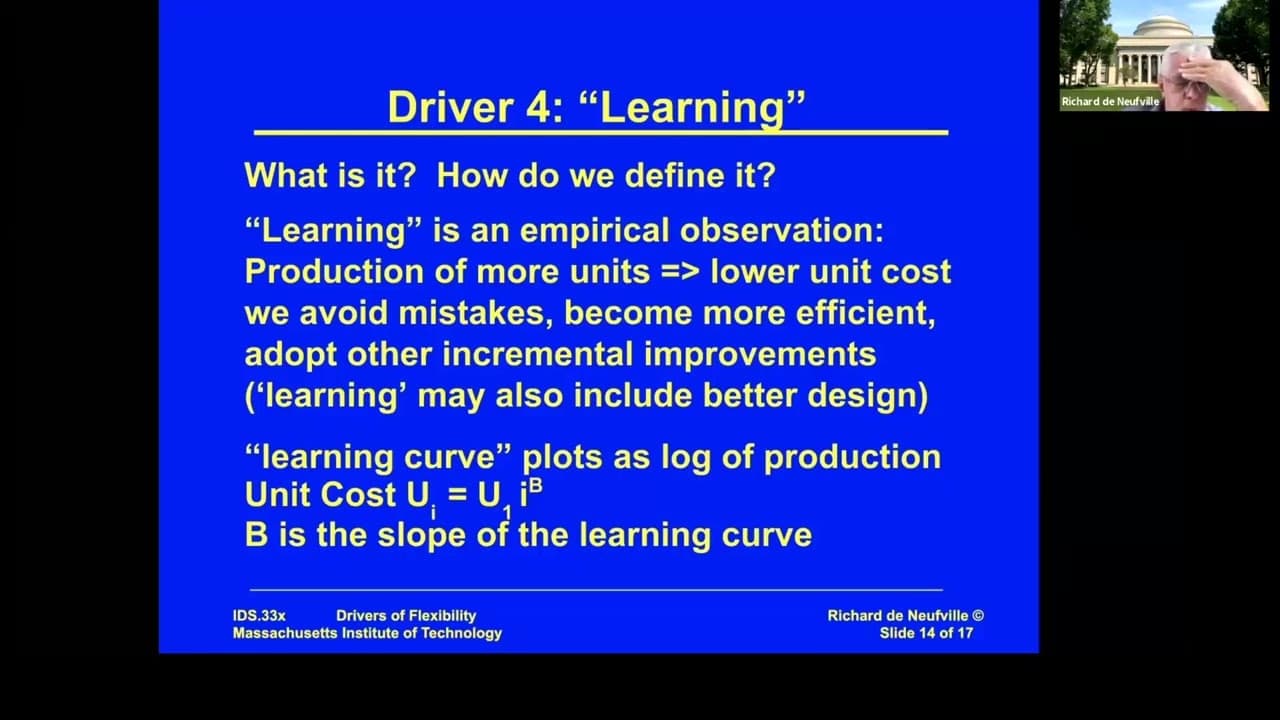
Q: What does learning mean in production?
Learning is the observed tendency for unit costs to fall as more copies of the same product are produced. Repetition helps teams work faster and improve how they sequence labor, materials, and assembly.
Q: Does the learning phenomenon include design improvements?
Yes. The lecture uses “learning” collectively for both greater production experience and technological or design improvements, such as discovering that a component does not need to be as thick.
Q: What did BP learn from building three similar platforms in Azerbaijan?
BP implemented three platforms that were copies of one another rather than using bespoke designs for each location. The later platforms produced large savings because teams better understood how to sequence labor and materials, time the work, and assemble the pieces.
Summary & Key Takeaways
-
Building a large capacity plant upfront is based on economies of scale, while building smaller units over time allows for flexibility in meeting market demand.
-
Delaying investments and factoring in the discount rate can counterbalance the advantages of economies of scale.
-
Learning, or the production of more units leading to lower unit costs, can make future investments cheaper.
-
Competitive gaming, or making a commitment in advance, can signal to competitors and establish dominance.
Read in Other Languages (beta)
Share This Summary 📚
Summarize YouTube Videos and Get Video Transcripts with 1-Click
Try YouTube Summary with ChatGPT & Claude or YouTube Transcript Generator
Explore More Summaries from MIT OpenCourseWare 📚


Summarize YouTube Videos and Get Video Transcripts with 1-Click
Try YouTube Summary with ChatGPT & Claude or YouTube Transcript Generator