Code generation Algorithm
TL;DR
This content discusses the process of generating code for assignment statements, including the steps involved and the use of address descriptors and resistors.
Transcript
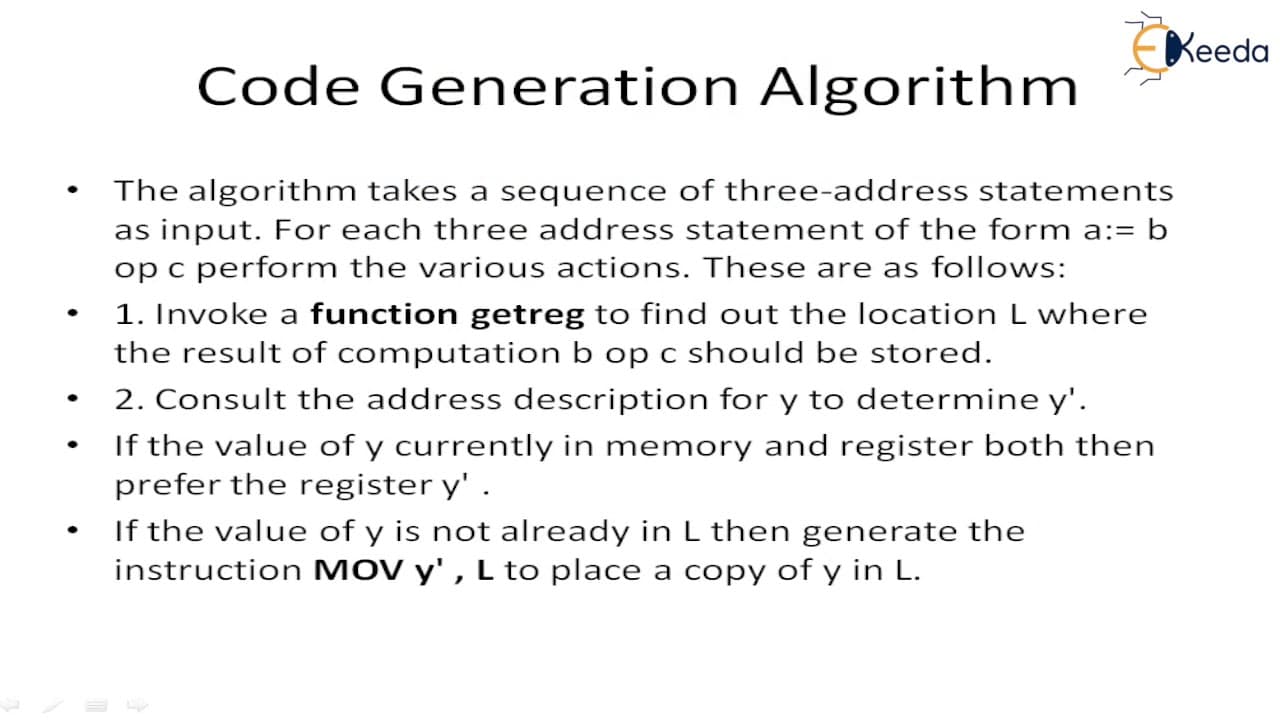
I love them students will go in to study the topic or generation so cogeneration algorithm which takes the sequence of the tree address statement as an input from each tree a tree statement of the form a is equal to B operator C but from the various action the actions are first the more information unbelieva can remove the function of gate register... Read More
Key Insights
- 👨💻 Code generation for assignment statements involves four steps: function invocation, resistor value calculation, instruction generation, and finding the current value of the resistor.
- 🖐️ Address descriptors play a crucial role in determining where computation results should be stored.
- 👨💻 Resistors serve as temporary variables and store intermediate values during the code generation process.
- ❓ Efficient memory usage is achieved by utilizing address descriptors.
- 👨💻 The example provided illustrates the step-by-step process of code generation for an assignment statement.
- 👨💻 Code generation involves generating instructions based on the operations performed on variables.
- 👨💻 Resistors are updated and descriptors modified as the code generation process progresses.
Install to Summarize YouTube Videos and Get Transcripts
Explore YouTube Video Summarizer or Get YouTube Transcript Extractor
Questions & Answers
Q: What are the four steps involved in code generation for assignment statements?
The four steps are function invocation, resistor value calculation, instruction generation, and finding the current value of the resistor. These steps help generate the necessary code for the assignment statement.
Q: How are address descriptors and resistors utilized in code generation?
Address descriptors are used to determine where the computation results should be stored. Resistors, on the other hand, store intermediate values during the code generation process. They serve as temporary variables for executing the necessary operations.
Q: Can you explain the example provided for code generation of an assignment statement?
In the example, the assignment statement "A = B - C" is used. The code generation process involves assigning a resistor to store the value of A, performing the subtraction operation, and generating the corresponding instruction. The resistors and address descriptors are updated accordingly.
Q: What is the significance of address descriptors and resistors in code generation?
Address descriptors help in determining the location where computation results should be stored, ensuring efficient memory usage. Resistors are temporary variables that store intermediate values, allowing for the execution of complex operations and calculations.
Summary & Key Takeaways
-
The content explains the process of code generation for assignment statements, which involves four steps: function invocation, resistor value calculation, instruction generation, and finding the current value of the resistor.
-
It emphasizes the use of address descriptors to determine the location of computation results and resistors to store intermediate values.
-
An example is provided, showcasing the code generation process for a specific assignment statement.
Read in Other Languages (beta)
Share This Summary 📚
Summarize YouTube Videos and Get Video Transcripts with 1-Click
Try YouTube Summary with ChatGPT & Claude or YouTube Transcript Generator
Explore More Summaries from Ekeeda 📚






Summarize YouTube Videos and Get Video Transcripts with 1-Click
Try YouTube Summary with ChatGPT & Claude or YouTube Transcript Generator