Coding Challenge 170: The Monty Hall Problem
TL;DR
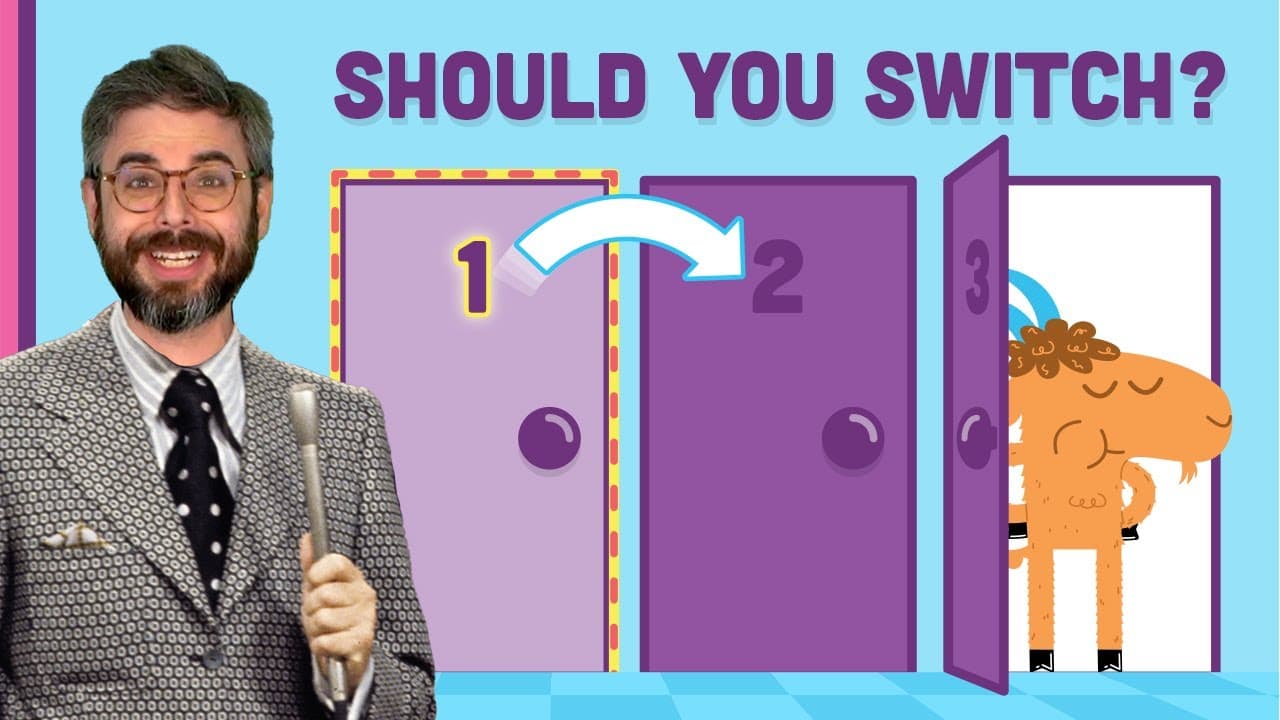
In the Monty Hall problem, contestants choose one door out of three, and then Monty Hall reveals a goat behind one of the remaining doors. Contestants are given the option to switch doors, and the probability of winning increases if they switch.
Transcript
[MUSIC PLAYING] Hello, and welcome to Let's Make A Deal. Behind one of these three doors is today's prize, a trip on the coding train express. Behind the other two doors is a goat. It's up to you to pick one of these doors. Which one will you pick? I can hear the people of the internet shouting out to me, door number 3. But before I reveal what's b... Read More
Key Insights
- 🧩 The Monty Hall problem is a famous probability puzzle that challenges intuition.
- 😉 Switching doors after the host reveals a goat increases the probability of winning.
- ❓ Bayes' theorem can be used to demonstrate the logic behind the optimal strategy.
Install to Summarize YouTube Videos and Get Transcripts
Explore YouTube Video Summarizer or Get YouTube Transcript Extractor
Questions & Answers
Q: What is the Monty Hall problem?
The Monty Hall problem is a probability puzzle where contestants choose one door out of three, with the chance of winning a prize. The host then reveals a door with a goat behind it, and contestants are given the option to switch doors.
Q: What is the optimal strategy in the Monty Hall problem?
The optimal strategy is to always switch doors after the host reveals a goat. This increases the probability of winning the prize.
Q: Why does switching doors increase the probability of winning?
Switching doors increases the probability of winning because when the host reveals a door with a goat, it provides valuable information. Switching ensures that contestants switch to the door with the higher probability of hiding the prize.
Q: How does Bayes' theorem relate to the Monty Hall problem?
Bayes' theorem is a probability theory used to calculate the probability of an event occurring given prior information. In the Monty Hall problem, Bayes' theorem can be applied to explain the logic behind the higher probability of winning when switching doors.
Summary & Key Takeaways
-
The Monty Hall problem is a probability puzzle where contestants are presented with three doors, one hiding a prize and the others hiding goats.
-
The host, Monty Hall, reveals one of the doors with a goat behind it, and contestants are given the choice to switch to the remaining door or stay.
-
Contrary to intuition, contestants have a higher probability of winning if they switch doors.
-
The problem can be explained through Bayes' theorem, showcasing the logic behind the optimal strategy.
Read in Other Languages (beta)
Share This Summary 📚
Summarize YouTube Videos and Get Video Transcripts with 1-Click
Try YouTube Summary with ChatGPT & Claude or YouTube Transcript Generator
Explore More Summaries from The Coding Train 📚



Summarize YouTube Videos and Get Video Transcripts with 1-Click
Try YouTube Summary with ChatGPT & Claude or YouTube Transcript Generator