How Countries Are Run - Modi's Economic Advisor Explains In 16 Minutes
TL;DR
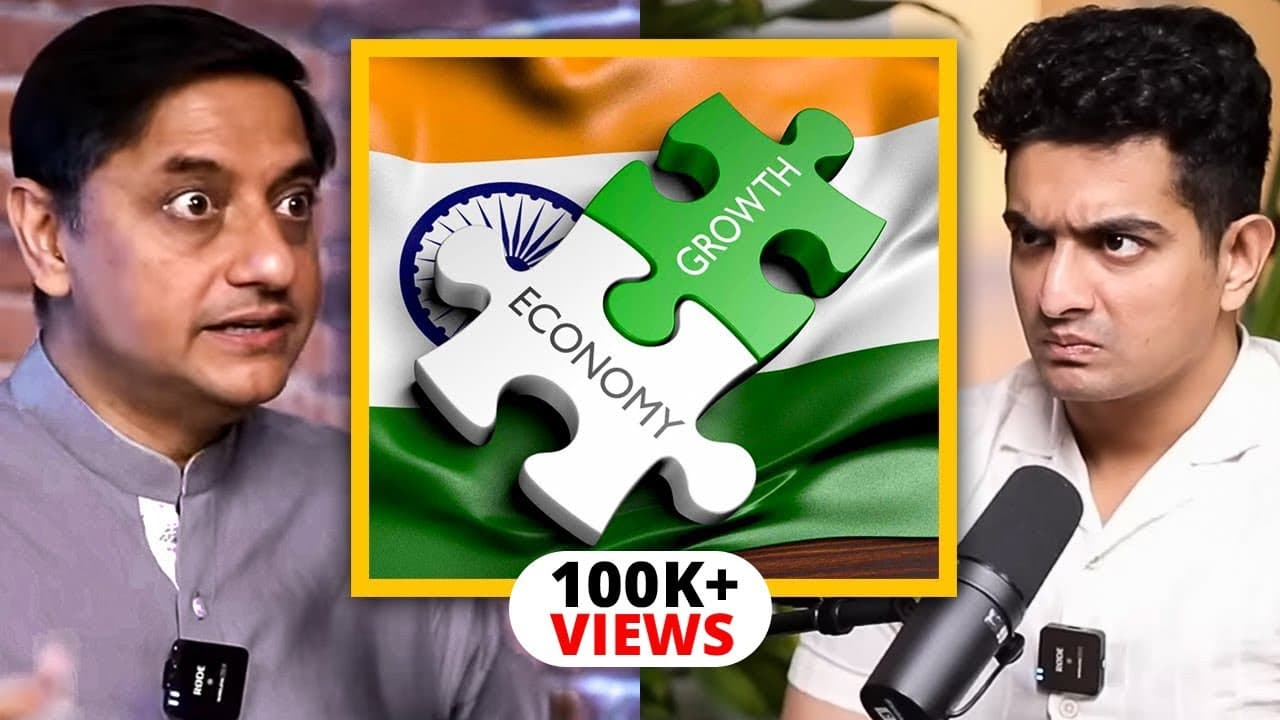
The current government is perceived as essential for India's economic growth amidst global turmoil.
Transcript
binge watch and learn on DRS Clips what's up with the government what are you guys thinking about in terms of the future of the country and I'm going to give you a very rudimentary angle based on what I have learned through the podcast okay um the general consensus after speaking of like all the Indians that I've had on the show is that everyone fe... Read More
Key Insights
- 🙈 The current Indian government is generally seen as effective in addressing complex geopolitical issues affecting the country.
- 👨💼 Fostering an entrepreneurial ecosystem is paramount for economic growth, with the government emphasizing infrastructure and regulatory support over direct involvement in business operations.
- 💉 Successful economies are characterized by a balance between various sectors, highlighting the need for interdependence among education, health, and business.
- 👻 The transition from centralized planning to a market-driven economy allows for diverse entrepreneurial innovation, making the economy resilient and adaptive.
- 🉑 Embracing a culture that accepts entrepreneurial failure supports continuous economic evolution and creativity, reducing the stigma associated with bankruptcy.
- 🌍 The competition between nations like India, Singapore, and Dubai emphasizes the need for ongoing improvements in domestic policies to retain startups.
- 🎙️ The podcast stresses the role of informed dialogues in shaping public understanding of economic policies and entrepreneurial challenges within India.
Install to Summarize YouTube Videos and Get Transcripts
Explore YouTube Video Summarizer or Get YouTube Transcript Extractor
Questions & Answers
Q: What is the general consensus about the current government among many Indians?
Many Indians believe that the current government is particularly well-suited to deal with the present global turmoil. This viewpoint, however, does not go unchallenged, especially by urban elites who might have differing opinions. The consensus signifies an overarching belief that the government is effectively managing the complexities of today's geopolitical landscape.
Q: How does the government aim to support entrepreneurship?
The government's approach to supporting entrepreneurship is to establish a stable economic climate characterized by controlled inflation and reasonable regulations. By focusing on physical infrastructure and regulatory frameworks, the government seeks to create an environment where entrepreneurs and innovators can operate freely and efficiently, facilitating their growth and success.
Q: What is the significance of having a balanced economy?
A balanced economy is vital because it ensures that various sectors support one another, contributing to holistic growth. Investment in one area, such as education or health, alone is insufficient for success. A failing sector can negatively impact others, leading to economic inefficiencies, which illustrates the interdependent nature of economic components.
Q: How does the podcast differentiate between hard power and soft power?
Hard power relates to a nation's economic strength and wealth, which translates into geopolitical influence. In contrast, soft power is about a country's cultural and ideological appeal. The content argues that economic growth enhances both hard and soft power, with successful nations historically having leveraged their wealth for greater international influence.
Q: Why do some Indian startups choose to incorporate abroad?
Indian startups often opt for incorporations in countries like Singapore or Dubai due to perceived advantages regarding taxes and regulatory environments. Selling a startup often incurs heavy taxes in India, prompting entrepreneurs to seek more favorable conditions overseas, pointing to the need for improved local frameworks.
Q: How does the government view the failures of businesses?
The government recognizes that failures are a natural part of the economic landscape, promoting a cultural shift where bankruptcy does not carry stigma. Failure is seen as a critical aspect of creative destruction, allowing new companies to emerge, and the government has established frameworks to manage bankruptcy efficiently.
Summary & Key Takeaways
-
The general sentiment among many Indians is that the present government is well-suited to navigate current global challenges, indicating a consensus despite some dissenting voices predominantly from urban elites.
-
The discussion emphasizes that the government's role is to create a stable environment for entrepreneurs to flourish, focusing on infrastructure and regulatory frameworks rather than directly managing businesses.
-
The importance of a diverse economy is highlighted, arguing that multiple sectors must thrive together to ensure sustainable growth, reinforcing the need for balance in areas like education, health, and financial regulation.
Read in Other Languages (beta)
Share This Summary 📚
Summarize YouTube Videos and Get Video Transcripts with 1-Click
Try YouTube Summary with ChatGPT & Claude or YouTube Transcript Generator
Explore More Summaries from TRS Clips 📚





Summarize YouTube Videos and Get Video Transcripts with 1-Click
Try YouTube Summary with ChatGPT & Claude or YouTube Transcript Generator