Mapping the Unknown, Part 1: Kenny Broad and Blue Holes | Nat Geo Live
TL;DR
This content explores the similarities and differences between studying blue holes in the underwater underworld and exploring the far distant galaxies, highlighting the significance of these invisible worlds.
Transcript
um you know we had a little bit of time before uh this evening to to talk about some of the similarities and differences and between our work and certainly at the most basic level I think we're we're both interested in explor exploring the invisible in the case of Adam it's exploring the far distant G galaxies light years away for me it's uh what's... Read More
Key Insights
- 👾 Blue holes and deep space exploration both involve delving into unknown and mysterious realms.
- 🥳 Blue holes act as modern-day analogies for studying ancient oceans and the evolution of microbial life.
- 💙 The oxygen production by cyan bacteria in blue holes is crucial for the evolution and sustainability of life on Earth.
- 💁 Blue holes provide a glimpse into deep time and the origins of the Earth, with valuable information about the early forms of life.
- 🩵 The study of blue holes can shed light on the sensitivity of the climate system and land change.
- 🥹 Blue holes hold significant amounts of fresh groundwater, emphasizing its finite nature and the importance of its conservation.
- 💙 Studying blue holes can provide insights into the connection between dust deposition and climate changes.
Install to Summarize YouTube Videos and Get Transcripts
Explore YouTube Video Summarizer or Get YouTube Transcript Extractor
Questions & Answers
Q: What are the similarities between studying blue holes and exploring far distant galaxies?
Both blue holes and deep space exploration involve exploring the "invisible" worlds, with researchers delving into mysterious and unknown territories. While one explores the underground underworld, the other focuses on galaxies light years away.
Q: How do blue holes serve as modern-day analogies for studying ancient oceans?
Blue holes provide insights into the early forms of life that evolved out of the cyan bacteria's oxygen production. By studying the life forms and microbial ecosystems present in blue holes, researchers can understand what life might have been like billions of years ago.
Q: What are the main features of blue holes and their formation?
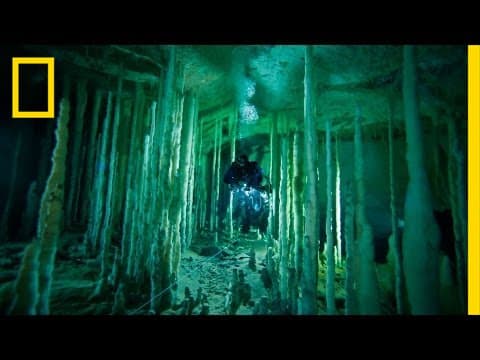
Blue holes are formed when rainwater, which picks up carbon dioxide, becomes slightly acidic and eats away at the limestone, forming reservoirs of freshwater. The interaction between freshwater and saltwater creates cave formations, which act as modern-day analogies for ancient oceans.
Q: What scientific questions were addressed during the expedition to blue holes?
The expedition aimed to uncover the natural history of the Caribbean by studying preserved fossils and extracting DNA. It also explored the sensitivity of the climate system by examining stalagmites and stalactites, which provide records of temperature, precipitation, and sea level changes.
Summary & Key Takeaways
-
The speaker highlights the similarities between their work and Adam's, focusing on exploring the invisible world, whether it be the far distant galaxies or the underground underworld.
-
Blue Holes are modern-day analogies for studying the earliest forms of life, providing insights into the origin of the Earth and the evolution of microbial life.
-
Blue holes act as time capsules, allowing researchers to study the early forms of life that didn't leave a fossil record and understand the significance of the cyan bacteria in oxygen production.
Read in Other Languages (beta)
Share This Summary 📚
Summarize YouTube Videos and Get Video Transcripts with 1-Click
Try YouTube Summary with ChatGPT & Claude or YouTube Transcript Generator
Explore More Summaries from National Geographic 📚



Summarize YouTube Videos and Get Video Transcripts with 1-Click
Try YouTube Summary with ChatGPT & Claude or YouTube Transcript Generator