How to Maximize Profit in Competitive Markets
TL;DR
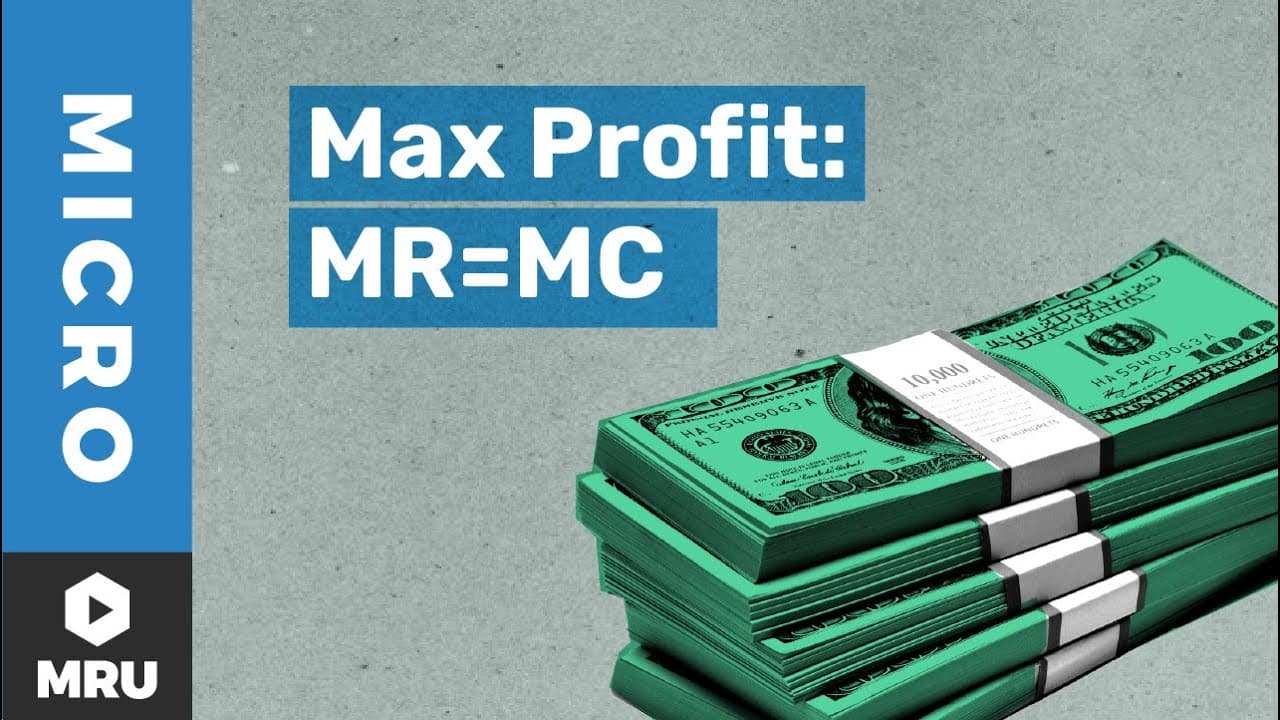
A competitive firm maximizes profit by choosing the quantity where marginal revenue equals marginal cost. Because the firm must accept the market price, its key decision is how much to produce. Profit equals total revenue minus total cost, with total cost comprising fixed and variable costs. Read on to see why producing more or less outside this point can improve profit.
Transcript
♪ [music] ♪ - [Alex] We learned last time that a firm in a competitive market doesn't have much control over it's price. It must accept the market price. So its decision about profit maximization turns into a decision about what quantity to choose, and that's what we're going to be focusing on now. So what is profit? Profit is total revenue minus t... Read More
Key Insights
- Profit is total revenue minus total cost, including both fixed and variable costs.
- Fixed costs do not change with output; they include expenses like rent.
- Variable costs vary with output, such as electricity and transportation costs.
- Marginal revenue is the additional revenue from selling one more unit.
- Marginal cost is the additional cost of producing one more unit.
- Profit maximization occurs when marginal revenue equals marginal cost.
- In competitive markets, marginal revenue equals the market price.
- Firms adjust output to maintain profit maximization as market prices change.
- "The economic notion of profit includes opportunity costs." (1:58)
- "Marginal revenue is the addition to total revenue from selling an additional unit of output." (4:52)
- "Marginal cost is the addition to total cost from producing an additional unit of output." (5:00)
- "Profits are maximized at the level of output where marginal revenue is equal to marginal cost." (5:06)
Install to Summarize YouTube Videos and Get Transcripts
Explore YouTube Video Summarizer or Get YouTube Transcript Extractor
Questions & Answers
Q: How does a firm maximize profit in a competitive market?
A firm chooses the quantity where marginal revenue equals marginal cost. At that output level, the additional revenue from another unit matches the additional cost of producing it.
Q: Why does a competitive firm focus on quantity rather than price?
A firm in a competitive market does not have much control over its price and must accept the market price. Its profit-maximization decision therefore becomes a choice about how much output to produce.
Q: How is profit calculated?
Profit is total revenue minus total cost. Total revenue is price multiplied by the quantity sold.
Q: What is included in total cost?
Total cost equals fixed costs plus variable costs. Fixed costs do not vary with output, while variable costs do vary with output.
Q: What are examples of fixed and variable costs?
Rent for the land beneath an oil well is a fixed cost because it must be paid regardless of production. Electricity used to pump oil and the cost of transporting oil are variable costs because they change with output.
Q: What is marginal revenue?
Marginal revenue is the addition to total revenue from selling an additional unit of output. In calculus terms, it is the derivative of total revenue with respect to quantity.
Q: What is marginal cost?
Marginal cost is the addition to total cost from producing an additional unit of output. In calculus terms, it is the derivative of total cost with respect to quantity.
Q: What should a firm do when marginal revenue and marginal cost are unequal?
If marginal revenue is greater than marginal cost, producing more adds to profit. If marginal revenue is less than marginal cost, producing less increases profit because costs fall by more than revenues fall.
Summary & Key Takeaways
-
Profit is calculated as total revenue minus total cost. Total revenue is determined by the market price and the quantity sold, whereas total cost includes both fixed and variable costs. Fixed costs remain constant regardless of output, while variable costs increase with production volume.
-
Profit maximization involves finding the output level where marginal revenue equals marginal cost. Marginal revenue is the additional income from selling an extra unit, while marginal cost is the extra cost of producing it. In competitive markets, marginal revenue equals market price.
-
Firms adjust their production levels to ensure that marginal revenue equals marginal cost, thus maximizing profit. Changes in market price lead to adjustments in output along the marginal cost curve to maintain this equilibrium, ensuring optimal profit levels.
Read in Other Languages (beta)
Share This Summary 📚
Summarize YouTube Videos and Get Video Transcripts with 1-Click
Try YouTube Summary with ChatGPT & Claude or YouTube Transcript Generator
Explore More Summaries from Marginal Revolution University 📚


Summarize YouTube Videos and Get Video Transcripts with 1-Click
Try YouTube Summary with ChatGPT & Claude or YouTube Transcript Generator