Coding Challenge #81.2: Circle Morphing - Part 2
TL;DR
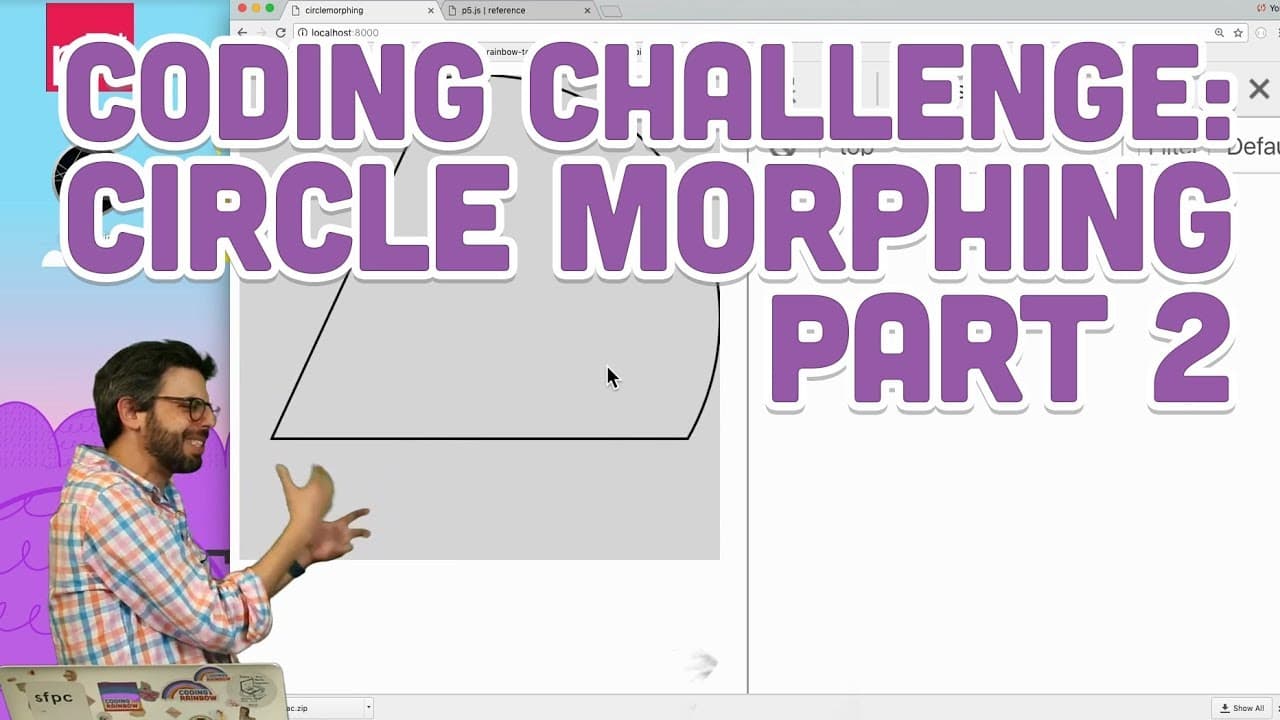
The video tutorial explores a simpler method for converting a circle into a triangle using random point deletion and filtering.
Transcript
oh hi again if you made it through the previous coding challenge on circle morphing Wow I'm I'm amazed if you didn't that makes a lot of sense to me you could be here anyway this is gonna be much simpler famous last words this is probably gonna be like really complicated and I don't know check the time maybe this video is like three and a half hour... Read More
Key Insights
- 👈 Deleting points randomly from an array can lead to index-related difficulties when maintaining the desired shape.
- ☢️ By adding an "active" property to vector objects in the array, it becomes easier to filter out and work with only the active points.
- 🎮 Using filtering instead of deletion enables a more controlled transformation process from a circle to a triangle.
- 🦸 The tutorial encourages further exploration of alternative methods, such as using the super ellipse formula or treating it as a rounded rectangle.
- 👨💻 The code for the circle morphing sketch and other related methods can be found on the GitHub repository linked in the video description.
- 🫵 Viewers are encouraged to share their own circle morphing sketches with the creator through a pull request on the GitHub repository.
Install to Summarize YouTube Videos and Get Transcripts
Explore YouTube Video Summarizer or Get YouTube Transcript Extractor
Questions & Answers
Q: How does the tutorial simplify the process of converting a circle into a triangle?
The tutorial introduces the concept of randomly deleting points from the circle path array, which gradually transforms the circle into a triangle.
Q: Why is randomly deleting points not an effective solution?
Randomly deleting points causes problems as the index values of the remaining points change, making it difficult to maintain the integrity of the triangle shape.
Q: What alternative solution does the tutorial present?
The tutorial suggests adding an "active" property to each vector object in the array and filtering out the active and fixed points, effectively creating a new array for the active points.
Q: How does selecting points from the active list lead to the transformation into a triangle?
By picking points only from the active list, which excludes fixed points, the sketch gradually morphs into the shape of a triangle.
Summary & Key Takeaways
-
The video demonstrates a simple sketch with an array called "circle path" and a function to convert polar coordinates into Cartesian coordinates.
-
The goal is to transform the circle into a triangle by deleting points from the array.
-
Different approaches are explored, including random point deletion and filtering, to achieve the desired transformation.
Read in Other Languages (beta)
Share This Summary 📚
Summarize YouTube Videos and Get Video Transcripts with 1-Click
Try YouTube Summary with ChatGPT & Claude or YouTube Transcript Generator
Explore More Summaries from The Coding Train 📚



Summarize YouTube Videos and Get Video Transcripts with 1-Click
Try YouTube Summary with ChatGPT & Claude or YouTube Transcript Generator