98 Siamese networks
TL;DR
Using Siamese Networks, a model is trained to identify if two signatures belong to the same person or not, even with limited training data.
Transcript
foreign just confirm if everything is working as expected we'll get started in a couple of minutes oh cool cool again on the screen you can see the list of topics we have planned for today we'll try and cover as much as possible these will be simple given all the complex stuff that we already learned so let's wait till 902 and then we'll get starte... Read More
Key Insights
- 🧩 Few-shot learning is a practical approach for training models with limited data points per class, using pairs of similar and dissimilar examples to create an efficient training set.
- 🔍 Siamese Networks, in which two identical CNNs are joined at the end, are popular for few-shot learning. They take in pairs of images and output a similarity score.
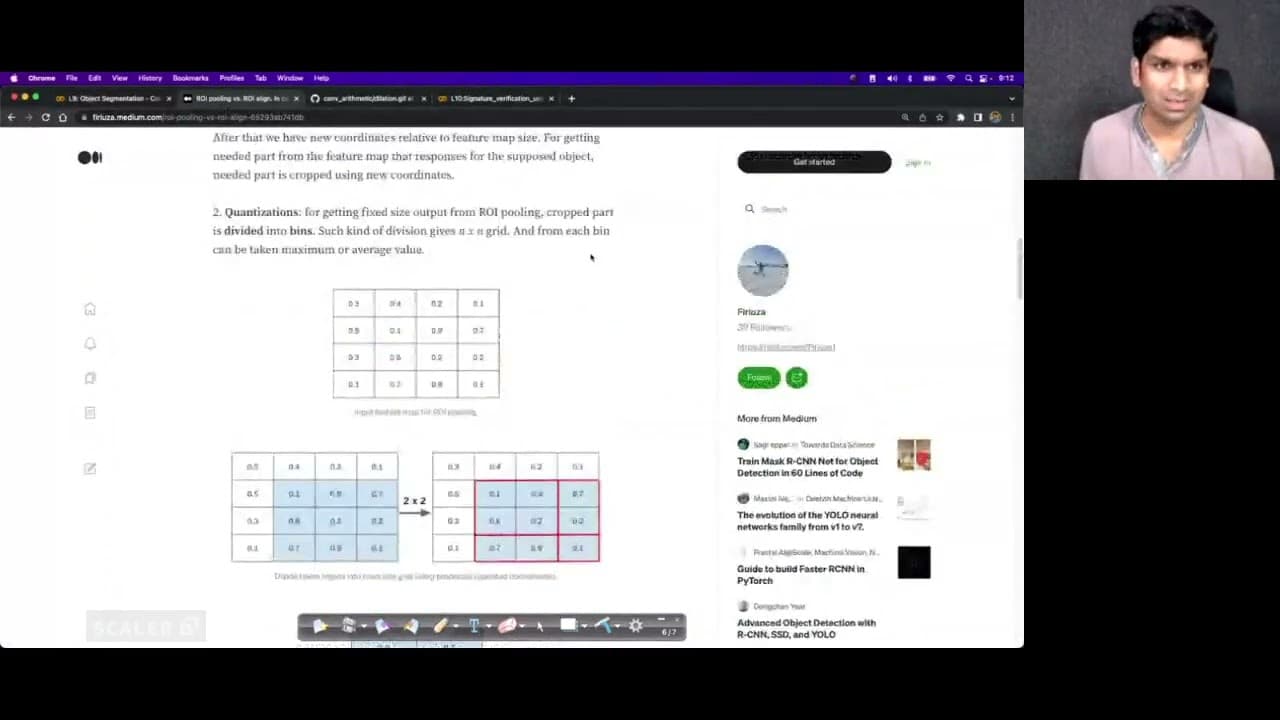
- 🏞️ Mask RCNN is an algorithm for object detection that extends the Fast/er RCNN models to also output a segmentation mask for each detected object.
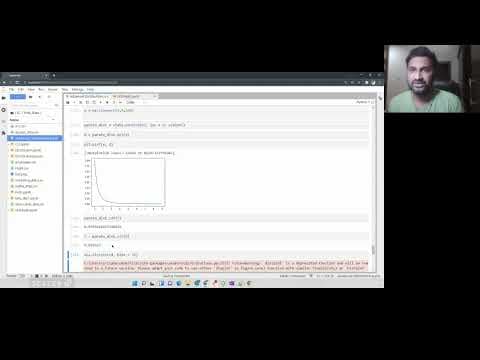
- ➕ Dilated convolutions, also known as atrous convolutions, provide an effective way to increase the receptive field of a convolutional layer without adding more parameters.
- 🔬 DeepLab V3 is an advanced segmentation algorithm that utilizes dilated convolutions and other techniques for achieving state-of-the-art results in image segmentation tasks.
- 🔍 The key advantage of dilated convolutions is that they allow for larger receptive fields and more global context to be captured by CNNs, leading to improved performance on segmentation tasks.
- 📝 The siamese network approach is used to create a robust model for signature verification, where few data points per class pose a challenge. By creating pairs of similar and dissimilar signatures, the model can be trained to determine whether two signatures belong to the same person.
- 🧩 By using siamese networks, we can effectively achieve few-shot learning for signature verification without requiring a large amount of training data.
- ⚙️ In siamese networks, the two images are passed through identical CNNs, creating vector representations (embeddings) of each signature. The embeddings are then compared using similarity metrics, such as Euclidean distance, to determine if the signatures match. ⏩ Siamese networks allow for efficient and fast prediction at runtime by comparing embeddings directly, rather than training a separate classifier for each class.
Install to Summarize YouTube Videos and Get Transcripts
Explore YouTube Video Summarizer or Get YouTube Transcript Extractor
Questions & Answers
Q: What is the purpose of using Siamese Networks for signature verification?
Siamese Networks are used in this context to perform few-shot learning, where the model can make accurate predictions with only a small number of training samples per class. In the case of signature verification, this is important because it is impractical to obtain a large number of signature samples for each person.
Q: How does the Siamese Network architecture work?
The Siamese Network architecture consists of two identical convolutional neural networks (CNNs) joined together at the end. Each CNN encodes the input signature image into a vector representation. The outputs of the two CNNs are then compared using a distance metric, such as the Euclidean distance, to determine if the signatures belong to the same person or not.
Q: What loss functions can be used to train the Siamese Network?
Two common loss functions for training Siamese Networks are contrastive loss and triplet loss. Contrastive loss penalizes similar pairs when they are too far apart and dissimilar pairs when they are too close. Triplet loss enforces a margin between an anchor image and a positive image (from the same class) compared to a negative image (from a different class).
Q: How can the Siamese Network be used for signature verification at runtime?
At runtime, the trained Siamese Network can take a query signature image and compute its vector representation. This vector representation can be compared with the vector representations of the known signatures using a distance metric. The known signature with the closest distance to the query signature is considered the most likely match.
Q: How does the number of training samples per class affect the performance of the Siamese Network?
With a larger number of training samples per class, the Siamese Network can learn more accurate representations and make better predictions. More training samples allow for better discrimination between similar and dissimilar pairs, leading to improved performance in signature verification. However, even with a limited number of training samples, Siamese Networks can still achieve reasonable results through few-shot learning techniques.
Summary & Key Takeaways
-
Siamese Networks are used to solve the problem of few-shot learning for signature verification.
-
The network consists of two identical convolutional neural networks (CNNs) joined together at the end, sharing the same weights.
-
Pairwise comparisons are made between signature images to determine if they belong to the same person or not.
-
The model is trained using contrastive loss or triplet loss, and the weights of both CNNs are updated simultaneously.
Read in Other Languages (beta)
Share This Summary 📚
Summarize YouTube Videos and Get Video Transcripts with 1-Click
Try YouTube Summary with ChatGPT & Claude or YouTube Transcript Generator
Explore More Summaries from James McCarty 📚
Summarize YouTube Videos and Get Video Transcripts with 1-Click
Try YouTube Summary with ChatGPT & Claude or YouTube Transcript Generator