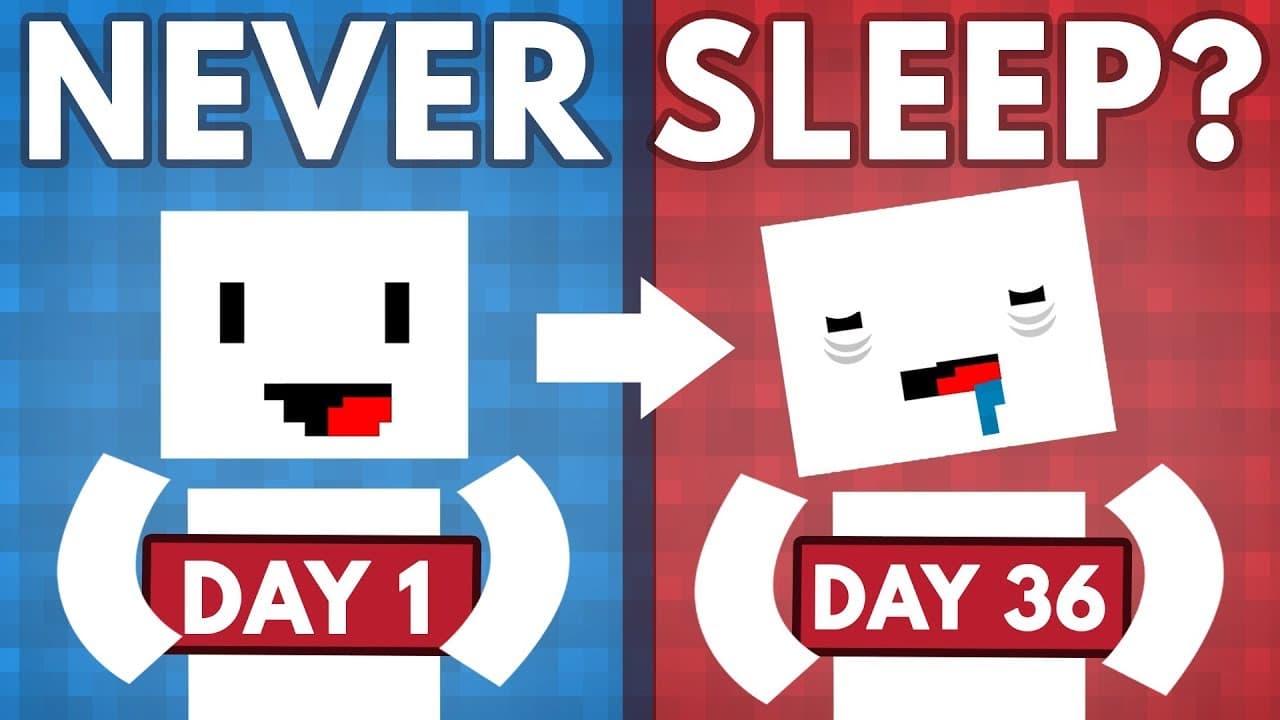
What Happens If You Don't Sleep for a Week?
TL;DR
Going without sleep for a week can result in severe physical and mental health effects, including altered perception of time, emotional instability, memory lapses, weakened immune function, and increased accident risk. In extreme cases, individuals may experience hallucinations due to sleep deprivation. Prioritizing sleep is crucial for overall well-being.
Transcript
HEY THERE! WELCOME TO LIFE NOGGIN! BLOCKO: We’ve talked before about the importance of sleep and just how much you should try and get every night, but we haven’t seen what it would be like if you didn’t sleep at all. Obviously please don’t try this. It’s just hypothetical. james: AHHH! Blocko: ...uh… James: Where am I and why am i so pointy!? Block... Read More
Key Insights
- 🙅 Going without sleep for a week can have various negative effects on a person's physical and mental health.
- 😪 Sleep deprivation can lead to an altered sense of time, emotional instability, memory issues, decreased alertness, weakened immune system, and increased accident risks.
- 😪 Medical conditions such as exploding head syndrome and fatal familial insomnia can further disrupt sleep and have serious consequences.
- 🛄 Some individuals claim to have experienced hallucinations after staying up for extended periods, although there is still skepticism surrounding this phenomenon.
- 😪 Recent research suggests that sleep deprivation may have rapid antidepressant effects for some individuals.
- 😪 Sleep is important for overall brain health and well-being, and individuals should try to prioritize getting enough rest.
- 💅 Exploring and understanding conditions like fatal familial insomnia can help develop effective treatments and potentially find a cure.
Install to Summarize YouTube Videos and Get Transcripts
Explore YouTube Video Summarizer or Get YouTube Transcript Extractor
Questions & Answers
Q: What are the immediate effects of going without sleep for 24 hours?
After 24 hours without sleep, you may experience an altered sense of time, increased sensitivity to light, and potential difficulty concentrating or staying alert.
Q: Can staying up for extended periods of time cause hallucinations?
While some individuals claim to have experienced hallucinations, there is still some skepticism surrounding this phenomenon.
Q: Are there medical conditions that make it difficult for people to sleep?
Yes, conditions such as exploding head syndrome and fatal familial insomnia can disrupt sleep and have serious consequences on a person's overall health and well-being.
Q: Can sleep deprivation have any positive effects?
Recent research suggests that sleep deprivation may have rapid antidepressant effects for some individuals, reducing symptoms of depression.
Summary & Key Takeaways
-
Randy Garner stayed awake for 11 days, highlighting the upper limits of the human body's ability to go without sleep.
-
Lack of sleep causes an altered sense of time, sensitivity to light, emotional instability, memory issues, decreased alertness, weakened immune system, and increased accident risks.
-
Medical conditions such as exploding head syndrome and fatal familial insomnia can further disrupt sleep and have serious consequences.
Read in Other Languages (beta)
Share This Summary 📚
Summarize YouTube Videos and Get Video Transcripts with 1-Click
Try YouTube Summary with ChatGPT & Claude or YouTube Transcript Generator
Explore More Summaries from Life Noggin 📚


Summarize YouTube Videos and Get Video Transcripts with 1-Click
Try YouTube Summary with ChatGPT & Claude or YouTube Transcript Generator