How to Combine Knowledge Graphs and Agents? (Emory, Stanford)
TL;DR
Multi-agent systems enhance AI with knowledge graphs for precise medical predictions.
Transcript
Read and summarize the transcript of this video on Glasp Reader (beta).
Key Insights
- The integration of large language models (LLMs) with knowledge graphs significantly improves AI's reasoning capabilities, especially in domains like healthcare.
- Emory and Stanford Universities developed a multi-agent architecture that enhances diagnosis prediction through knowledge graph-enhanced reasoning.
- LLMs face challenges such as hallucinations and lack of structured reasoning, which are mitigated by integrating structured knowledge from graphs.
- The proposed system uses a three-agent configuration: a link agent, a retrieval agent, and a prediction agent, to improve accuracy in medical diagnosis.
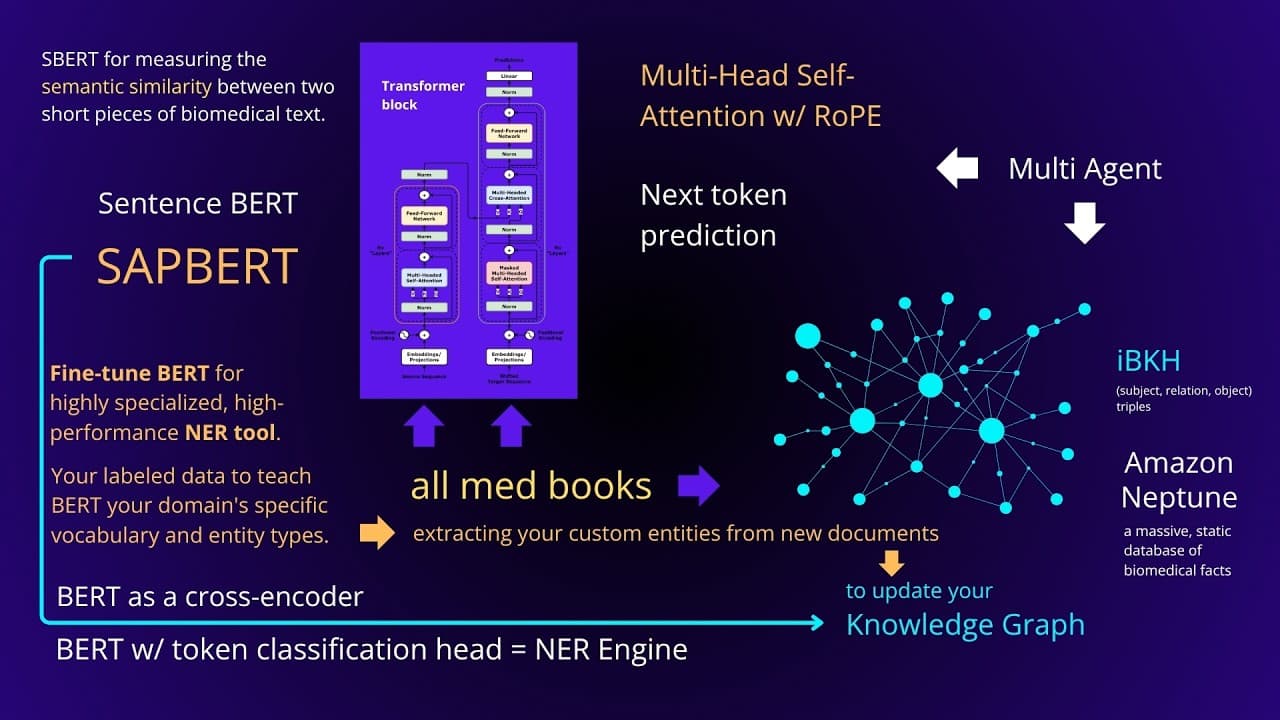
- The knowledge graph is continuously updated using a fine-tuned Sentence BERT system, ensuring the inclusion of the latest domain-specific knowledge.
- The approach allows for zero-shot diagnosis prediction, meaning it can make predictions without prior examples of the specific case.
- The system is more costly in terms of token usage but offers superior accuracy compared to traditional methods.
- This framework demonstrates the potential of combining LLMs with structured knowledge for safety-critical tasks in clinical environments.
Install to Summarize YouTube Videos and Get Transcripts
Explore YouTube Video Summarizer or Get YouTube Transcript Extractor
Questions & Answers
Q: What are the key components of the multi-agent architecture?
The multi-agent architecture consists of three main components: the link agent, the retrieval agent, and the prediction agent. The link agent connects medical entities to the knowledge graph, the retrieval agent gathers relevant information from the graph, and the prediction agent uses this information to make accurate medical predictions.
Q: How does the system address the limitations of LLMs?
The system addresses LLM limitations by integrating structured knowledge from knowledge graphs, which enhances reasoning capabilities and reduces hallucinations. This structured approach allows the AI to process and infer relationships between medical concepts more effectively, aligning with human clinical decision-making processes.
Q: What role does the knowledge graph play in this system?
The knowledge graph serves as a repository of structured domain-specific knowledge, which is crucial for enhancing the AI's reasoning capabilities. It is continuously updated with the latest information using a fine-tuned Sentence BERT, ensuring that the AI has access to current and accurate data for making predictions.
Q: Why is the system considered more costly compared to other methods?
The system is considered more costly due to its complex architecture involving three interacting agents and the extensive use of tokens for data processing and reasoning. The high-dimensional vector operations and the need for continuous updates to the knowledge graph also contribute to the increased computational cost.
Q: What is the significance of zero-shot diagnosis prediction in this system?
Zero-shot diagnosis prediction allows the system to make accurate medical predictions without prior examples of the specific case. This capability is significant because it enables the AI to handle novel situations and make informed decisions based on the structured knowledge from the graph, improving its applicability in clinical settings.
Q: How does the system ensure the accuracy of its predictions?
The system ensures accuracy through a multi-stage reasoning process, where the prediction agent uses both positive and negative knowledge extracted from the graph. This approach helps refine predictions and align them with the ground truth, reducing the likelihood of errors and improving diagnostic reliability.
Q: What advancements does this system bring to AI in healthcare?
This system advances AI in healthcare by demonstrating how multi-agent architectures and knowledge graphs can enhance the accuracy and reliability of medical predictions. It provides a framework for integrating structured knowledge with LLMs, offering a more robust solution for safety-critical tasks in clinical environments.
Q: How does the system update its knowledge graph?
The system updates its knowledge graph using a fine-tuned Sentence BERT, which extracts new entities and relationships from recent publications and domain-specific texts. This continuous update process ensures that the graph remains current and relevant, providing the AI with the latest information for making accurate predictions.
Summary & Key Takeaways
-
Emory and Stanford Universities present a multi-agent AI system that combines LLMs with knowledge graphs to enhance medical diagnosis predictions. The system addresses challenges faced by LLMs, such as hallucinations, by integrating structured knowledge, resulting in improved accuracy and reliability.
-
The architecture consists of three agents: a link agent, a retrieval agent, and a prediction agent. Each plays a crucial role in linking medical data to knowledge graphs, retrieving relevant information, and predicting future health risks based on patient data.
-
By updating the knowledge graph with a fine-tuned Sentence BERT, the system maintains up-to-date and accurate domain-specific knowledge. This approach not only improves diagnostic accuracy but also demonstrates the potential of AI in clinical applications.
Read in Other Languages (beta)
Share This Summary 📚
Summarize YouTube Videos and Get Video Transcripts with 1-Click
Try YouTube Summary with ChatGPT & Claude or YouTube Transcript Generator
Explore More Summaries from Discover AI 📚



Summarize YouTube Videos and Get Video Transcripts with 1-Click
Try YouTube Summary with ChatGPT & Claude or YouTube Transcript Generator