Problems On Context Free GrammarsPart 4
TL;DR
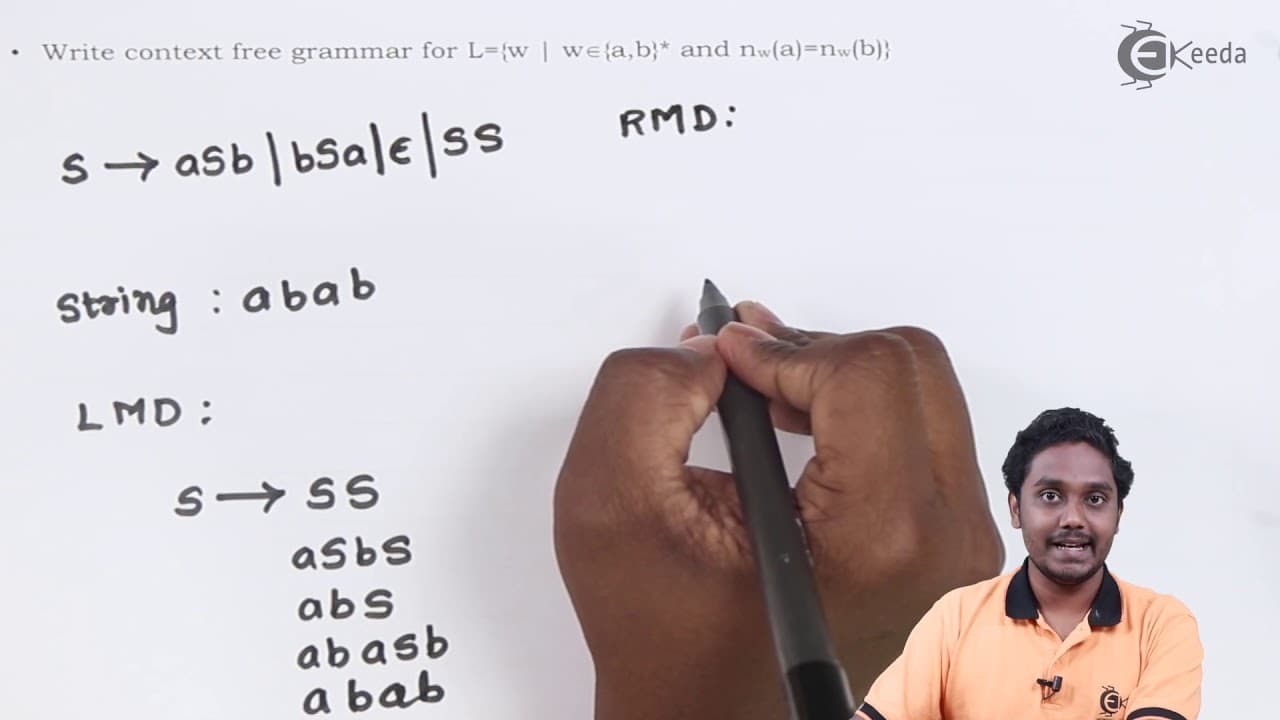
Learn how to construct a context-free grammar by comparing the number of A's with the number of B's in a given string.
Transcript
click the bell icon to get latest videos from equator hello friends let us try to solve one more question of constructing context-free grammar here we are trying to compare the number of A's with number of peas in the given string and if they are equal that particular string belong to the language otherwise it does not that'ss n of a must be equal ... Read More
Key Insights
- 🥶 Context-free grammar can be used to generate a language by defining productions and comparing counts of specific elements in a string.
- 🚱 Leftmost derivation focuses on replacing the leftmost non-terminal, while rightmost derivation focuses on replacing the rightmost non-terminal.
- 🌲 Parse trees provide a visual representation of how the productions in a grammar generate a specific string.
- 🚱 Epsilon productions can be used to nullify non-terminals and derive strings.
- 🥶 The position of elements in a string can be anywhere when comparing counts in a context-free grammar.
- 🥶 Step-by-step examples and explanations help understand the process of constructing context-free grammars.
- 🥺 Leftmost and rightmost derivations can lead to the same final string but follow different paths.
Install to Summarize YouTube Videos and Get Transcripts
Explore YouTube Video Summarizer or Get YouTube Transcript Extractor
Questions & Answers
Q: How can a context-free grammar be constructed by comparing the count of A's and B's in a string?
A context-free grammar can be constructed by defining productions that generate an equal number of A's and B's. Comparisons are made by comparing the powers of A and B, and the position of A's and B's can be anywhere in the string.
Q: What are the different types of derivations used in constructing context-free grammar?
Two types of derivations used in constructing context-free grammar are leftmost derivations and rightmost derivations. Leftmost derivation focuses on replacing the leftmost non-terminal, while rightmost derivation focuses on replacing the rightmost non-terminal.
Q: How is a leftmost derivation used to derive a specific string?
In a leftmost derivation, the leftmost non-terminal is always replaced, following the productions defined in the grammar. By repeatedly applying leftmost derivations, the desired string can be derived.
Q: How is a parse tree constructed for a given string using the defined context-free grammar?
To construct a parse tree, start with the root labeled as the start symbol, then follow the productions to generate tree branches and leaves. Each branch represents a non-terminal, and the leaves represent the input string.
Summary & Key Takeaways
-
This video tutorial teaches how to construct a context-free grammar by comparing the count of A's with the count of B's in a string.
-
The position of A's and B's can be anywhere in the string, and the powers need to be compared.
-
The tutorial provides step-by-step explanations and examples of leftmost derivation, rightmost derivation, and parse tree construction.
Read in Other Languages (beta)
Share This Summary 📚
Summarize YouTube Videos and Get Video Transcripts with 1-Click
Try YouTube Summary with ChatGPT & Claude or YouTube Transcript Generator
Explore More Summaries from Ekeeda 📚

Summarize YouTube Videos and Get Video Transcripts with 1-Click
Try YouTube Summary with ChatGPT & Claude or YouTube Transcript Generator