22.2 Path Dependence - Friction
TL;DR
The work done by the friction force is not path independent, as it depends on the specific path taken.
Transcript
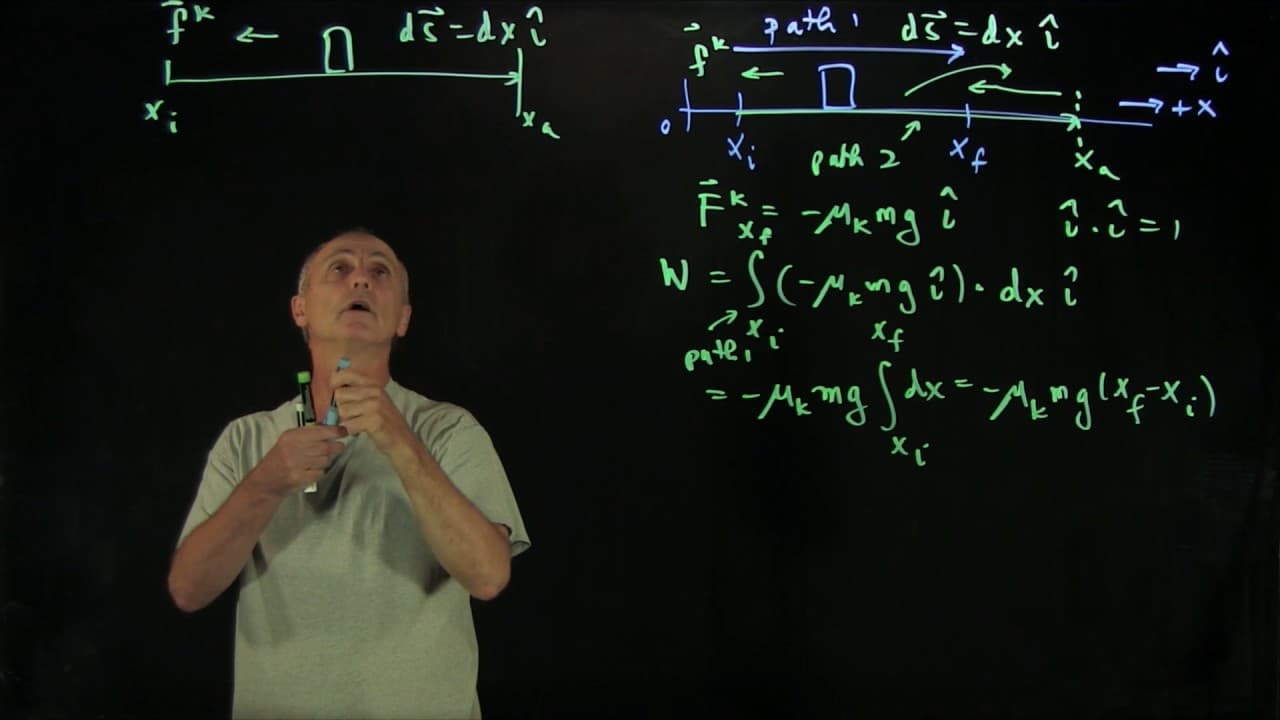
Let's now explore an example of a force in which the work done it is not path independent. And the classic example is the friction force. So let's consider the following setup. Suppose we have a horizontal surface with friction and we have an object. And we're moving this object. So let's choose an origin. We'll call this plus x, our i hat directio... Read More
Key Insights
- 💦 Friction force provides an example of a force with a path-dependent work done.
- 💦 The work done by the friction force depends on the direction and magnitude of the force, which can vary based on the specific path taken.
- 🫥 Path 1 involves a straight line movement, while Path 2 has two legs and requires considering separate integrals.
- 😑 The integral calculations for both paths result in different expressions and signs of the work done.
Install to Summarize YouTube Videos and Get Transcripts
Explore YouTube Video Summarizer or Get YouTube Transcript Extractor
Questions & Answers
Q: Why is the work done by the friction force not path independent?
The work done by the friction force depends on the specific path taken because the force opposes the motion, and the direction and magnitude of the force may differ based on the path.
Q: What is the equation for the kinetic friction force in path 1?
In path 1, the equation for the kinetic friction force is -mu k mg in the i-hat direction, where mu k is the coefficient of kinetic friction and mg is the weight of the object.
Q: How do the integrals differ in path 2?
In path 2, there are two separate integrals. The first integral represents the movement from x initial to xa, where the friction force opposes the motion. The second integral represents the movement back from xa to x final, where the friction force changes direction.
Q: What determines the sign of the integrals?
The sign of the integrals is determined by the direction of the force and the endpoints of the integral. For example, a positive friction force will result in a positive integral, while a negative friction force will result in a negative integral.
Summary & Key Takeaways
-
Friction force, specifically kinetic friction, is used as an example to demonstrate how the work done is not path independent.
-
Path 1 involves moving an object directly from the initial to the final state in a straight line.
-
Path 2 involves moving the object to a point xa and then back to the final point.
Read in Other Languages (beta)
Share This Summary 📚
Summarize YouTube Videos and Get Video Transcripts with 1-Click
Try YouTube Summary with ChatGPT & Claude or YouTube Transcript Generator
Explore More Summaries from MIT OpenCourseWare 📚



Summarize YouTube Videos and Get Video Transcripts with 1-Click
Try YouTube Summary with ChatGPT & Claude or YouTube Transcript Generator