Linearization at Critical Points
TL;DR
Understanding stability in linear and non-linear equations by examining critical points and linearization.
Transcript
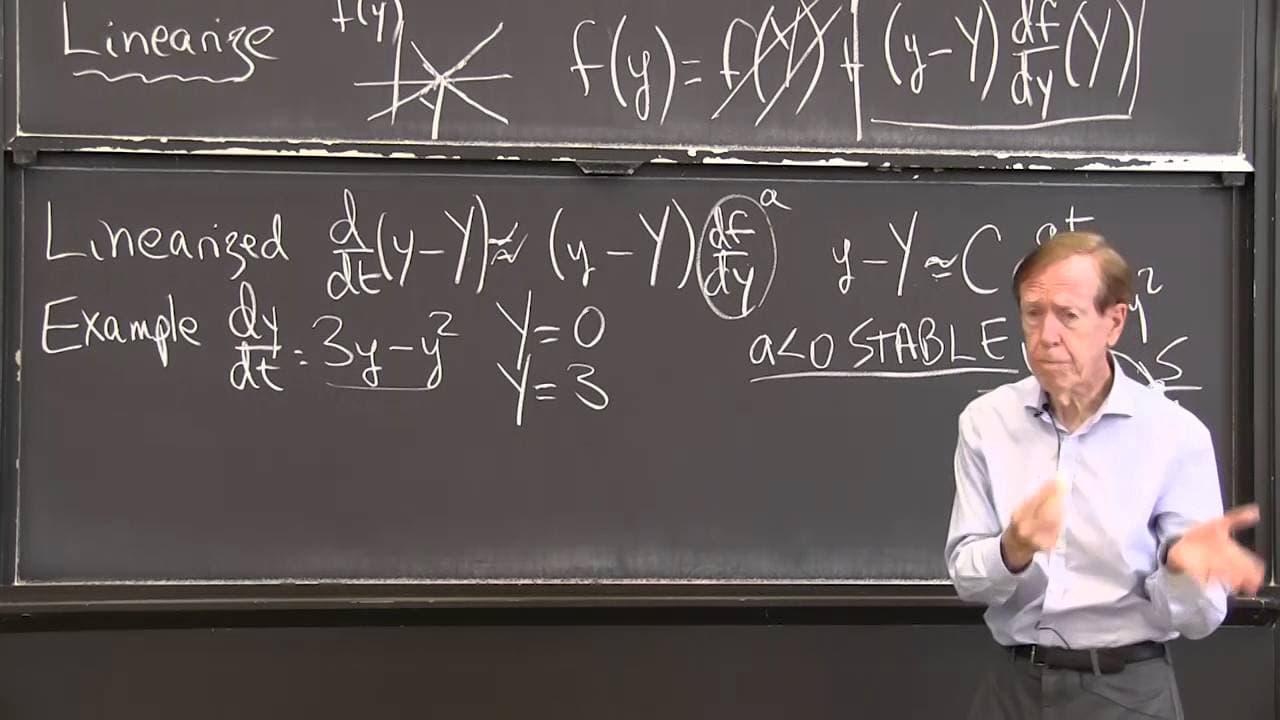
GILBERT STRANG: OK. I'm concentrating now on the key question of stability. Do the solutions approach 0 in the case of linear equations? Do they approach some constant, some steady state in the case of non-linear equations? So today is the beginning of non-linear. I'll start with one equation. dy dt is some function of y, not a linear function prob... Read More
Key Insights
- 0️⃣ Stability in equations is determined by whether solutions approach zero or a steady state.
- 👉 Critical points are special points where the right-hand side of the equation is zero.
- 🤑 Linearization enables the approximation of non-linear equations with linear ones near critical points.
- 🫥 Stability is assessed by examining the slope of the tangent line near the critical point.
- 🚱 Non-linear equations can exhibit both stable and unstable behavior.
- ❓ Linearization is a fundamental concept in calculus.
- 👀 The process of linearization involves zooming in and looking at functions through a microscope.
Install to Summarize YouTube Videos and Get Transcripts
Explore YouTube Video Summarizer or Get YouTube Transcript Extractor
Questions & Answers
Q: What is a critical point in the context of differential equations?
A critical point is a point where the right-hand side of the equation is zero, indicating a steady state. At a critical point, the solution is constant and the derivative of the function is zero.
Q: How do we determine if a critical point is stable or unstable?
To determine the stability of a critical point, we need to look at the behavior of the equation near the critical point. By linearizing the equation, we can examine the slope of the tangent line and determine if it is positive (unstable) or negative (stable).
Q: What does it mean to linearize an equation?
Linearization is the process of approximating a non-linear equation with a linear one near a critical point. This allows us to study the behavior of the equation by simplifying it to a linear form. It is done by taking the derivative of the equation and substituting the critical point.
Q: Are non-linear equations always unstable?
No, not all non-linear equations are unstable. Depending on the slope of the tangent line near the critical point, a non-linear equation can have stable or unstable behavior. It varies based on the specific equation.
Summary & Key Takeaways
-
The video discusses the concept of stability in linear and non-linear equations.
-
A critical point or steady state is where the right-hand side of the equation is zero.
-
Linearization is the process of approximating a non-linear equation with a linear one near a critical point.
Read in Other Languages (beta)
Share This Summary 📚
Summarize YouTube Videos and Get Video Transcripts with 1-Click
Try YouTube Summary with ChatGPT & Claude or YouTube Transcript Generator
Explore More Summaries from MIT OpenCourseWare 📚



Summarize YouTube Videos and Get Video Transcripts with 1-Click
Try YouTube Summary with ChatGPT & Claude or YouTube Transcript Generator