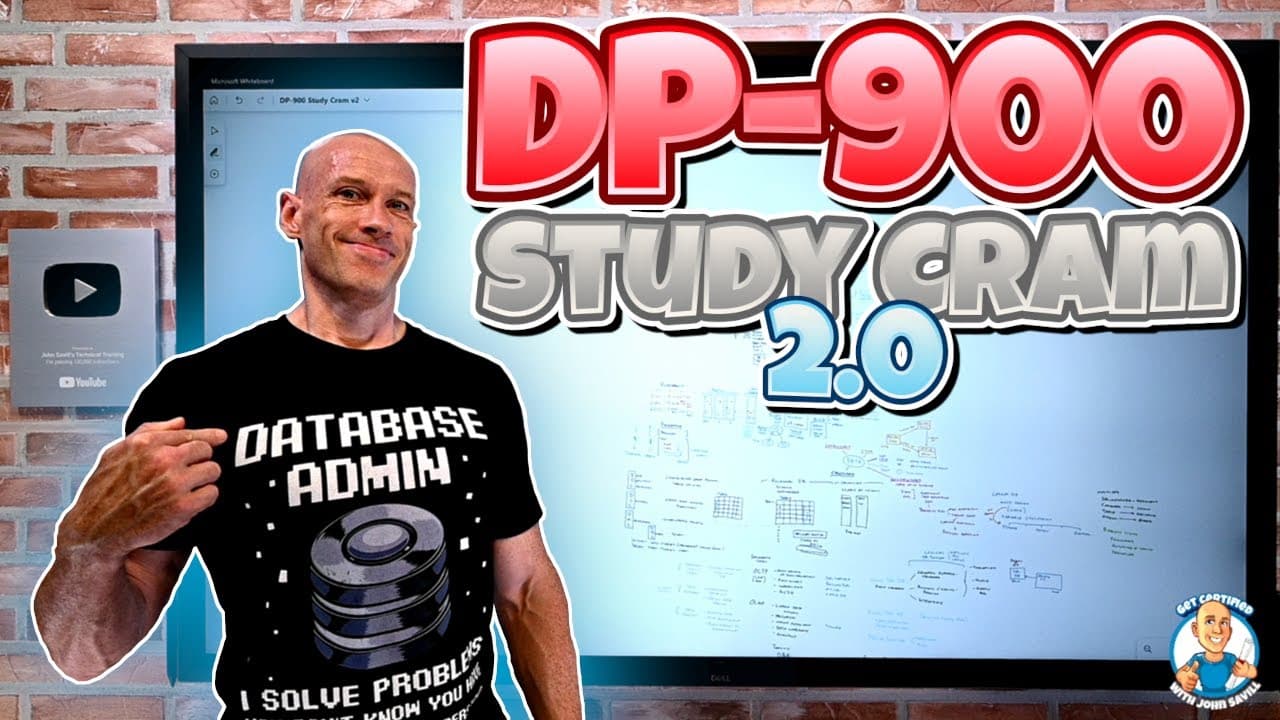
DP-900 Data Fundamentals Study Cram v2
TL;DR
Comprehensive guide to Azure data fundamentals certification exam.
Transcript
Read and summarize the transcript of this video on Glasp Reader (beta).
Key Insights
- Azure Data Fundamentals certification covers a broad range of topics without requiring deep expertise in any single area, focusing on core skills and exam preparation.
- Azure services interaction can be done through various methods like the Azure portal, PowerShell, CLI, and templates, with Azure Resource Manager as the central API.
- The certification emphasizes understanding structured, semi-structured, and unstructured data, each requiring different storage and management approaches.
- Azure offers a range of database services including SQL Database, Cosmos DB, and Synapse Analytics, each tailored for specific data and workload types.
- Different roles like database administrators, data engineers, and data analysts are crucial in managing, processing, and deriving insights from data.
- Azure Data Factory and Azure Synapse Analytics are key services for orchestrating data workflows, supporting both ETL and ELT processes.
- Azure Purview provides data governance and classification across various data sources, ensuring compliance and data management.
- Understanding Azure's pricing models, including request units in Cosmos DB and storage tiers, is essential for optimizing costs and performance.
Install to Summarize YouTube Videos and Get Transcripts
Explore YouTube Video Summarizer or Get YouTube Transcript Extractor
Questions & Answers
Q: What is the focus of the Azure DP-900 certification?
The Azure DP-900 certification focuses on providing a foundational understanding of Azure data services and concepts. It covers a broad range of topics, including data types, Azure services, and data management strategies, without requiring deep expertise in any specific area. The exam aims to equip candidates with the core skills needed to understand and work with Azure data solutions effectively.
Q: How can one interact with Azure services?
Azure services can be interacted with through various methods, including the Azure portal for intuitive and graphical interaction, PowerShell and CLI for automation and scripting, and templates for declarative resource management. The Azure Resource Manager acts as the central API, facilitating consistent and secure interaction with Azure resources. These tools allow users to manage and automate tasks in Azure environments efficiently.
Q: What are the different types of data discussed in the certification?
The certification discusses three primary types of data: structured, semi-structured, and unstructured. Structured data is highly organized and typically stored in relational databases. Semi-structured data, like JSON or XML, has a loose schema and is often self-describing. Unstructured data includes files like images or videos, with no inherent structure. Each data type requires different storage solutions and management approaches in Azure.
Q: What are the roles of database administrators, data engineers, and data analysts?
Database administrators are responsible for the design, implementation, and maintenance of databases, ensuring optimal performance and security. Data engineers focus on understanding data workloads and designing data pipelines for efficient data ingestion, transformation, and storage. Data analysts explore data to find relationships and build models that provide business insights. Each role is crucial in the data lifecycle, from storage to analysis.
Q: What is Azure Purview and its purpose?
Azure Purview is a data governance service that provides data discovery, classification, and management across various data sources, including Azure, on-premises, and other cloud environments. It helps organizations understand and manage their data estate, ensuring compliance with regulations and internal policies. Azure Purview enables data classification, lineage tracking, and risk management, facilitating better data governance and decision-making.
Q: How do Azure Data Factory and Synapse Analytics support data workflows?
Azure Data Factory and Synapse Analytics support data workflows by orchestrating data movement and transformation processes. Data Factory provides control flow for calling various data operations, while Synapse Analytics integrates data storage, processing, and analysis capabilities. They support both ETL and ELT processes, enabling efficient data ingestion, transformation, and storage, ultimately facilitating comprehensive data analysis and insights.
Q: What are request units in Cosmos DB and their significance?
Request units (RUs) in Cosmos DB are a measure of throughput and performance, representing the cost of operations like reads and writes. They provide a standardized way to manage and scale database performance. Users can provision RUs based on expected workload, with options for autoscale to dynamically adjust to varying demands. Understanding RUs is crucial for optimizing performance and cost in Cosmos DB environments.
Q: What pricing models are available for Azure storage accounts?
Azure storage accounts offer different pricing models based on performance tiers: premium, hot, cool, and archive. Premium provides low latency and high performance at a higher cost, while hot, cool, and archive offer decreasing storage costs with increasing transaction costs. Lifecycle management can automate tier transitions based on data access patterns. Understanding these models helps in optimizing costs and performance for different storage needs.
Summary & Key Takeaways
-
The Azure DP-900 certification focuses on data fundamentals, covering various Azure services and data types without requiring in-depth expertise.
-
Key Azure services include SQL Database, Cosmos DB, and Synapse Analytics, each designed for specific data types and processing needs.
-
Azure Purview and Data Factory play significant roles in data governance and orchestration, ensuring efficient data management and compliance.
Read in Other Languages (beta)
Share This Summary 📚
Summarize YouTube Videos and Get Video Transcripts with 1-Click
Try YouTube Summary with ChatGPT & Claude or YouTube Transcript Generator
Explore More Summaries from John Savill's Technical Training 📚
Summarize YouTube Videos and Get Video Transcripts with 1-Click
Try YouTube Summary with ChatGPT & Claude or YouTube Transcript Generator