Who Are You? 🙇♂️ | Greetings | Learn European Portuguese
TL;DR
Learn formal and informal Portuguese greetings and introductions.
Transcript
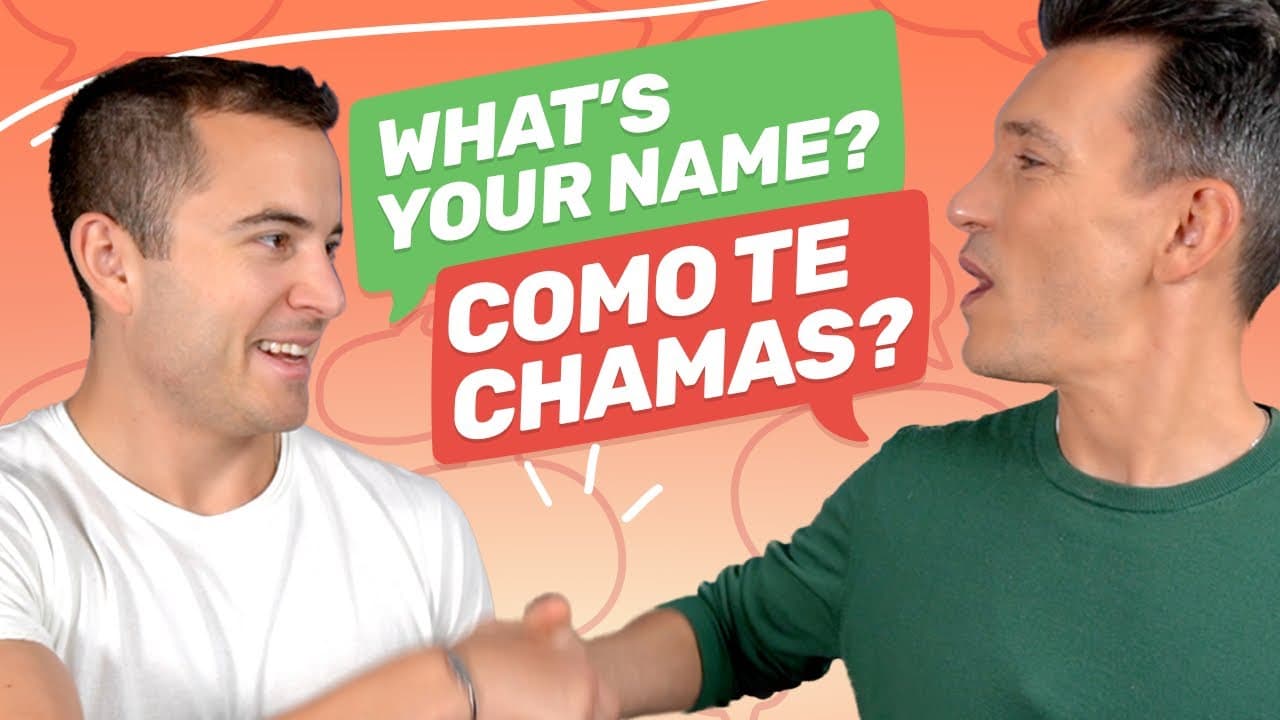
R: That's the informal. Como te chamas? J: Yeah, 'How do you call yourself?' R: Como te chamas? If it's formal... J: Then I would say 'Como se chama?' R: So, 'se' instead of 'te' and the 's' at the end drops. J: It's probably better to learn the formal version because if you don't know somebody's name already, chances are you're going to be treatin... Read More
Key Insights
- The difference between formal and informal greetings in Portuguese is crucial, with 'Como te chamas?' being informal and 'Como se chama?' formal.
- Using the formal version of greetings is generally safer when meeting someone new unless in a casual setting like a party.
- Portuguese uses articles 'o' and 'a' to denote 'the' for masculine and feminine nouns, respectively, in introductions.
- The phrase 'Muito prazer' translates to 'a lot of pleasure' and is commonly used to express pleasure in meeting someone.
- Pronunciation is key in Portuguese, with specific sounds like the flicked 'R' in 'prazer' being important for correct speech.
- Practical vocabulary is more beneficial than specialized vocabulary, especially for adults learning a new language.
- Real-life application of language skills enhances memory retention and practical usage in conversations.
- PracticePortuguese.com offers a variety of resources to learn Portuguese, including interactive lessons and realistic conversation practice.
Install to Summarize YouTube Videos and Get Transcripts
Explore YouTube Video Summarizer or Get YouTube Transcript Extractor
Questions & Answers
Q: What are the differences between formal and informal greetings in Portuguese?
In Portuguese, 'Como te chamas?' is used for informal greetings, while 'Como se chama?' is the formal version. The formal version is typically used when meeting someone for the first time, especially if they are older or in a professional setting. The informal version may be used in casual situations with peers or younger individuals.
Q: Why is it recommended to learn the formal version of greetings first?
Learning the formal version of greetings first is recommended because it is generally safer to use when meeting someone new. In most situations, using formal language shows respect, especially if the other person is older or in a higher professional position. This approach minimizes the risk of offending someone inadvertently.
Q: How is the article 'the' used in Portuguese introductions?
In Portuguese, the article 'the' is represented by 'o' for masculine nouns and 'a' for feminine nouns. When introducing oneself, one might say 'Eu sou o [Name]' for males or 'Eu sou a [Name]' for females. This usage adds a formal touch to introductions and is a notable feature of the language.
Q: What is the significance of pronunciation in learning Portuguese?
Pronunciation is crucial in Portuguese, as certain sounds, like the flicked 'R' in 'prazer,' differ significantly from English. Proper pronunciation ensures clear communication and helps learners be understood by native speakers. Mastering these sounds is essential for fluency and confidence in speaking the language.
Q: Why should learners focus on practical vocabulary?
Focusing on practical vocabulary is beneficial because it directly applies to everyday conversations and situations. Unlike children, adults typically have less time to learn a language, so prioritizing vocabulary that will be used frequently helps in quicker and more effective language acquisition.
Q: How can real-life application of language skills enhance learning?
Real-life application of language skills enhances learning by providing context and relevance, making it easier to remember vocabulary and phrases. When learners use the language in practical situations, it reinforces their understanding and retention, leading to improved fluency and confidence in speaking.
Q: What resources does PracticePortuguese.com offer for language learners?
PracticePortuguese.com offers a variety of resources, including interactive lessons for all learning levels, audio 'Shorties' for realistic conversation practice, and spaced repetition flashcards. These tools are designed to help learners master vocabulary and expressions, preparing them for real conversations in Portuguese.
Q: How does spaced repetition aid in language learning?
Spaced repetition aids in language learning by systematically reviewing vocabulary and expressions at increasing intervals, which enhances long-term retention. This method helps learners reinforce what they have learned, making it easier to recall information during conversations and improving overall language proficiency.
Summary & Key Takeaways
-
Rui and Joel discuss the nuances of formal and informal greetings in Portuguese, emphasizing the importance of context in choosing the appropriate form. The conversation highlights the use of articles in introductions and the significance of pronunciation in mastering the language.
-
They suggest focusing on practical vocabulary relevant to daily life rather than specialized terms unless necessary. This approach aids in more efficient language learning, especially for adults without the extended learning time available to children.
-
PracticePortuguese.com provides resources such as interactive lessons and audio clips to support learners in mastering Portuguese. The platform uses spaced repetition flashcards to help users retain vocabulary and expressions for real conversations.
Read in Other Languages (beta)
Share This Summary 📚
Summarize YouTube Videos and Get Video Transcripts with 1-Click
Try YouTube Summary with ChatGPT & Claude or YouTube Transcript Generator
Explore More Summaries from Practice Portuguese 📚


Summarize YouTube Videos and Get Video Transcripts with 1-Click
Try YouTube Summary with ChatGPT & Claude or YouTube Transcript Generator