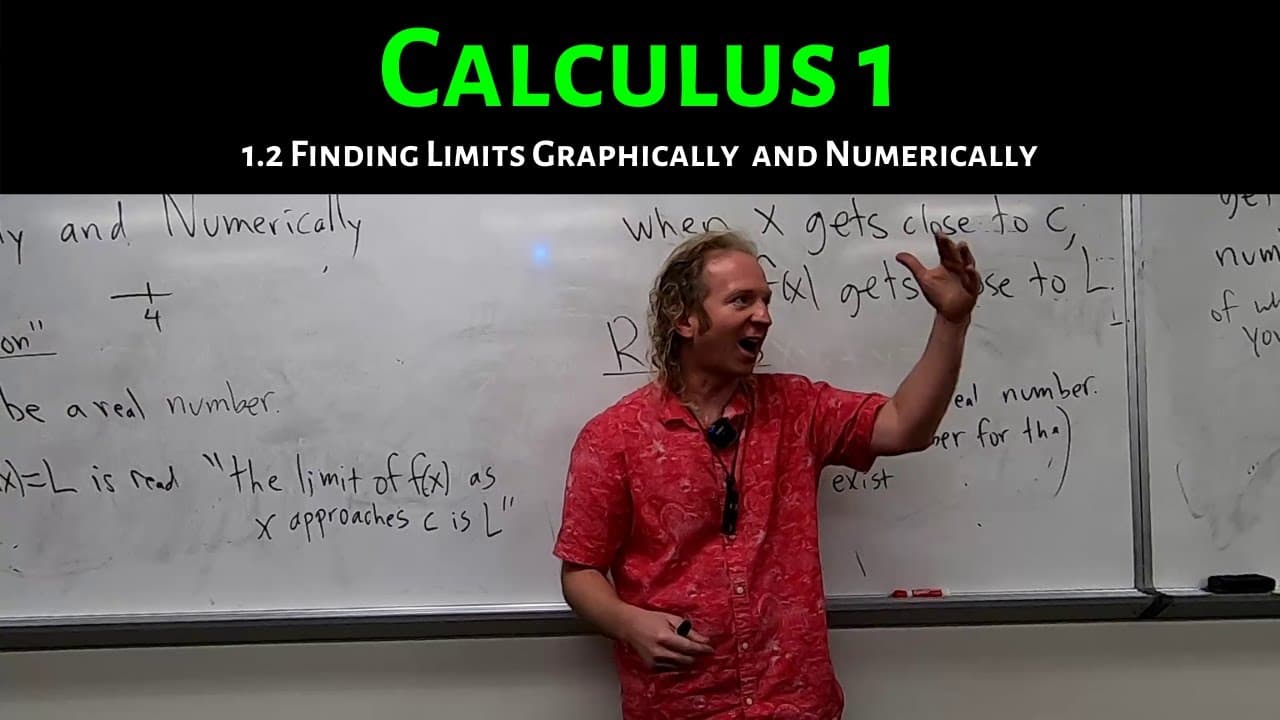
Calculus 1: Lecture 1.2 Finding Limits Graphically and Numerically
TL;DR
Limits in calculus determine the behavior of a function as it approaches a specific value.
Transcript
so this is the informal definition I was going to put definition and put it in quotes this is the informal definition of of a limit of a limits we're going to find limit so let so capital L be a real number so be a real number so capital L is going to be the limit right that's what we use L for variable right so L has to be a real number right so l... Read More
Key Insights
- ⛔ The limit of a function defines its behavior as the input value approaches a specific value.
- ⛔ The limit is denoted as the input value approaches a certain value and the output value approaches a specific value.
- ♾️ A limit is always a real number and can be positive infinity, negative infinity, or does not exist.
Install to Summarize YouTube Videos and Get Transcripts
Explore YouTube Video Summarizer or Get YouTube Transcript Extractor
Questions & Answers
Q: How is the limit of a function defined in calculus?
The limit of a function is defined as the output value of the function as the input value approaches a specific value. It represents the behavior of the function as it gets closer to a certain point.
Q: What is the significance of the limit in calculus?
The limit allows us to understand the behavior of a function near a particular point and helps us analyze the function's value as the input value gets arbitrarily close to a specific value.
Q: How do we determine if a limit exists?
A limit exists if the output value of the function approaches a particular value as the input value gets arbitrarily close to a specific value. If the function does not approach a specific value, or approaches positive or negative infinity, the limit is said to not exist.
Q: Can a limit be any real number, including positive or negative infinity?
No, a limit can only be a real number. If the limit approaches positive or negative infinity, it is said to not exist.
Summary & Key Takeaways
-
Limits in calculus determine the behavior of a function as the input value approaches a particular value.
-
The limit of a function is denoted as the input approaches a certain value and the output approaches a specific value.
-
The limit is always a real number and can be positive infinity, negative infinity, or does not exist.
Read in Other Languages (beta)
Share This Summary 📚
Summarize YouTube Videos and Get Video Transcripts with 1-Click
Try YouTube Summary with ChatGPT & Claude or YouTube Transcript Generator
Explore More Summaries from The Math Sorcerer 📚



Summarize YouTube Videos and Get Video Transcripts with 1-Click
Try YouTube Summary with ChatGPT & Claude or YouTube Transcript Generator