What Are the Conditions for Continuity of a Function?
TL;DR
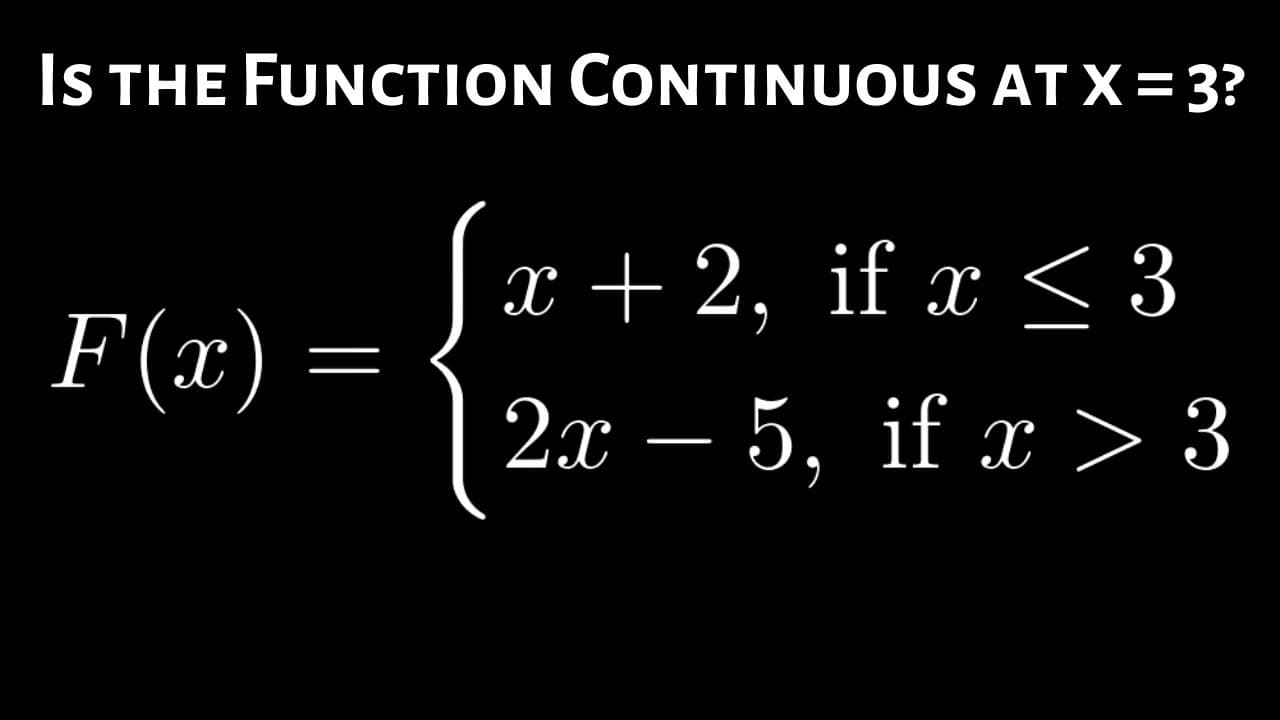
For a function to be continuous at x equals three, it must satisfy three conditions: f(3) is defined, the limit as x approaches three exists, and the limit equals f(3). In this case, the function fails the second condition since the left-hand limit (5) does not equal the right-hand limit (1), indicating the function is not continuous at x equals three.
Transcript
is the function big f of x continuous at x equals three why or why not so in order to check this we'll just go basically through the definition of continuity so we say f is continuous at x equals c in this case c is going to be three if and there are three conditions so the first condition is that f of c is defined so what that basically means is t... Read More
Key Insights
- 👈 Continuity of a function at a specific point is determined by three conditions: f(c) is defined, the limit as x approaches c exists, and the limit as x approaches c of f(x) equals f(c).
- 😆 If any of the three conditions for continuity are not satisfied, the function is not continuous at the given point.
- ☺️ In this case, the function f(x) = x + 2 for x less than or equal to 3, and f(x) = 2x - 5 for x greater than 3 is not continuous at x equals 3 because the second condition fails.
- 👈 The limit as x approaches 3 from the left is 5, while the limit as x approaches 3 from the right is 1, indicating that the overall limit does not exist.
Install to Summarize YouTube Videos and Get Transcripts
Explore YouTube Video Summarizer or Get YouTube Transcript Extractor
Questions & Answers
Q: What are the three conditions for continuity of a function?
The three conditions for continuity are: 1) f(c) is defined, 2) the limit as x approaches c exists, and 3) the limit as x approaches c of f(x) equals f(c).
Q: Why is it important to check if f(c) is defined?
It is important to check if f(c) is defined because for a function to be continuous at x equals c, plugging in c into the function should yield a defined value.
Q: How are the limits as x approaches 3 from the left and right calculated?
The limit as x approaches 3 from the left is calculated by replacing f(x) with x + 2 and evaluating the expression when x approaches 3. The limit as x approaches 3 from the right is calculated by replacing f(x) with 2x - 5 and evaluating the expression when x approaches 3.
Q: Why does the function fail the second condition for continuity?
The function fails the second condition for continuity because the limits as x approaches 3 from the left and right are not equal. The left limit is 5 and the right limit is 1, indicating that the overall limit as x approaches 3 does not exist.
Summary & Key Takeaways
-
The function f(x) is checked for continuity using the three conditions of continuity: f(c) is defined, the limit as x approaches c exists, and the limit as x approaches c of f(x) equals f(c).
-
The value of f(3) is calculated and found to be 5, satisfying the first condition of continuity.
-
The limits as x approaches 3 from the left and right are calculated and found to be 5 and 1, respectively, indicating that the limit as x approaches 3 does not exist.
-
Therefore, the function is not continuous at x equals three.
Read in Other Languages (beta)
Share This Summary 📚
Summarize YouTube Videos and Get Video Transcripts with 1-Click
Try YouTube Summary with ChatGPT & Claude or YouTube Transcript Generator
Explore More Summaries from The Math Sorcerer 📚
Summarize YouTube Videos and Get Video Transcripts with 1-Click
Try YouTube Summary with ChatGPT & Claude or YouTube Transcript Generator