Denoising Autoencoders | Deep Learning Animated
TL;DR
Denoising autoencoders transform noisy images into clean ones using deep learning techniques.
Transcript
Read and summarize the transcript of this video on Glasp Reader (beta).
Key Insights
- Diffusion models are crucial for AI-generated content, trained to remove noise from images step by step.
- Noise in images, such as Gaussian and Poisson, can arise from various sources, affecting image quality.
- Denoising autoencoders use a deep learning structure to transform noisy inputs into cleaner outputs.
- The training process involves minimizing the Euclidean distance between the autoencoder's output and the clean image.
- The manifold hypothesis suggests that meaningful images occupy a tiny fraction of the vast space of all possible images.
- The denoising autoencoder projects noisy images back onto the manifold, learning the structure of meaningful images.
- The minimum mean squared error (MMSE) estimator is tied to the posterior distribution and helps optimize the model.
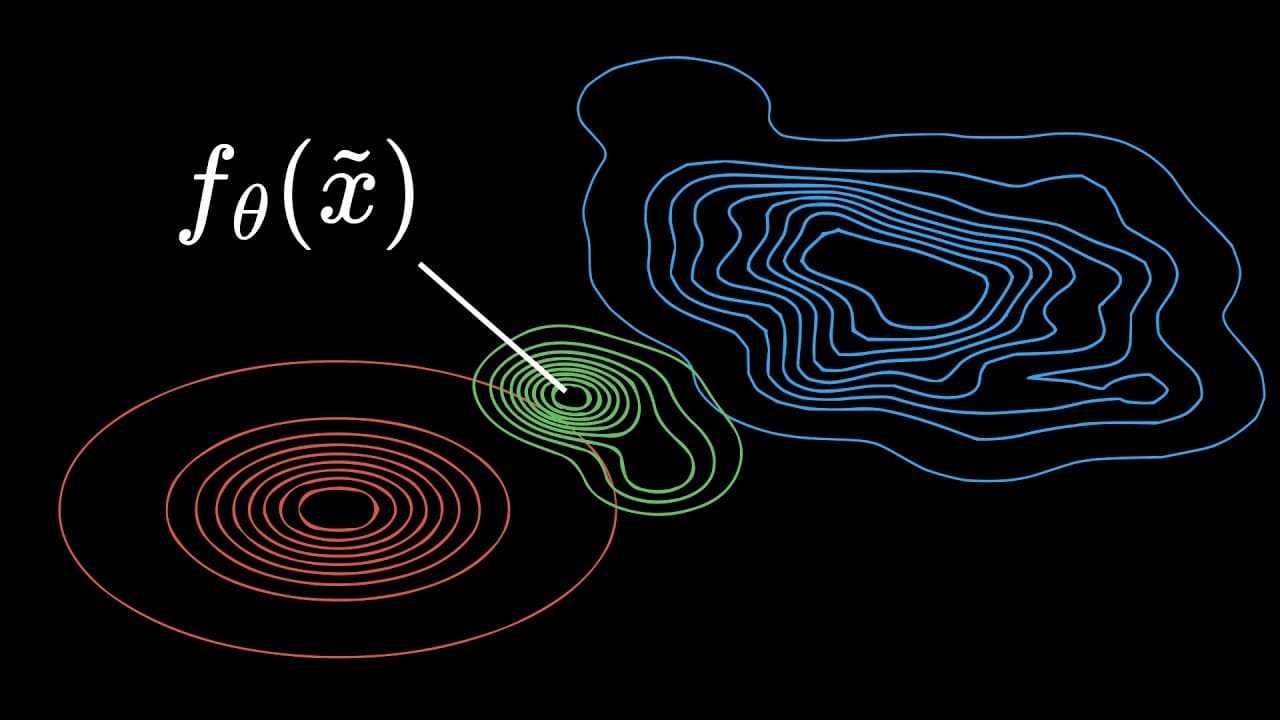
- Tweedie's formula connects neural networks to the score of noisy data distributions, smoothing data closer to high-density regions.
Install to Summarize YouTube Videos and Get Transcripts
Explore YouTube Video Summarizer or Get YouTube Transcript Extractor
Questions & Answers
Q: What are diffusion models used for?
Diffusion models are used for generating AI content by transforming noisy images into high-quality outputs. They are trained to remove noise from images step by step, a process integral to creating stunning, high-definition images from initially corrupted inputs. This technique is foundational in modern AI-generated content.
Q: How do denoising autoencoders work?
Denoising autoencoders work by taking noisy inputs and transforming them into cleaner outputs through a deep learning structure. The process involves an encoder, a low-dimensional latent space, and a decoder. The training aims to minimize the Euclidean distance between the autoencoder's output and the clean image, effectively learning to remove noise.
Q: What is the manifold hypothesis?
The manifold hypothesis posits that meaningful images occupy only a small fraction of the vast space of all possible images. This means that among all conceivable pixel arrangements, only a small subset can represent coherent and readable images. Denoising autoencoders learn to map noisy images back onto this manifold of meaningful images.
Q: What is the minimum mean squared error estimator?
The minimum mean squared error (MMSE) estimator is a function that provides the best average reconstructions in terms of minimizing the squared error. In the context of denoising autoencoders, it helps optimize the model to provide the best average estimate of clean images, conditioned on noisy inputs, by approximating the posterior mean.
Q: How does Tweedie's formula relate to neural networks?
Tweedie's formula connects neural networks to the score of noisy data distributions. It suggests that neural networks approximate the posterior mean, which is tied to the score of the smoothed data distribution. This means the network moves inputs closer to regions of the original data distribution with higher density, akin to projecting noisy data onto a manifold.
Q: What is the significance of Gaussian noise in image processing?
Gaussian noise is significant in image processing due to its additive nature, meaning it can be added to pixel values uniformly across an image. It follows a normal distribution, which is widely studied for its mathematical properties. Controlling the standard deviation of Gaussian noise allows for managing the amount of noise present in an image.
Q: Why is the manifold hypothesis important in AI?
The manifold hypothesis is important in AI because it provides a conceptual framework for understanding how meaningful data, such as images, can be represented in a lower-dimensional space within a larger space of all possible data configurations. It helps in designing models like denoising autoencoders to effectively map and reconstruct data by focusing on meaningful patterns.
Q: What role does the mean squared error play in training autoencoders?
The mean squared error (MSE) plays a crucial role in training autoencoders by serving as the loss function that needs to be minimized. It measures the squared difference between the clean image and the autoencoder's output. Minimizing MSE ensures that the autoencoder learns to produce outputs that are as close as possible to the original clean images, effectively reducing noise.
Summary & Key Takeaways
-
Denoising autoencoders are explored as a method to clean noisy images using deep learning. The video delves into the basics of noise, types like Gaussian and Poisson, and how these affect image quality. Techniques to remove noise using autoencoders are discussed, emphasizing the importance of training with clean and noisy image pairs.
-
The manifold hypothesis is introduced, explaining that meaningful images occupy a small fraction of possible image space. The video highlights how denoising autoencoders map noisy images back onto the manifold, learning patterns and features of meaningful images. This process involves optimizing the model using the minimum mean squared error estimator.
-
Tweedie's formula, an influential yet obscure concept, is explained as linking neural networks to the score of noisy data distributions. The video concludes by discussing how neural networks approximate the posterior mean, smoothing data closer to high-density regions, akin to projecting noisy data onto a manifold of clean images.
Read in Other Languages (beta)
Share This Summary 📚
Summarize YouTube Videos and Get Video Transcripts with 1-Click
Try YouTube Summary with ChatGPT & Claude or YouTube Transcript Generator
Explore More Summaries from Deepia 📚
Summarize YouTube Videos and Get Video Transcripts with 1-Click
Try YouTube Summary with ChatGPT & Claude or YouTube Transcript Generator