How do Mach-Zehnder Interferometers Work?
TL;DR
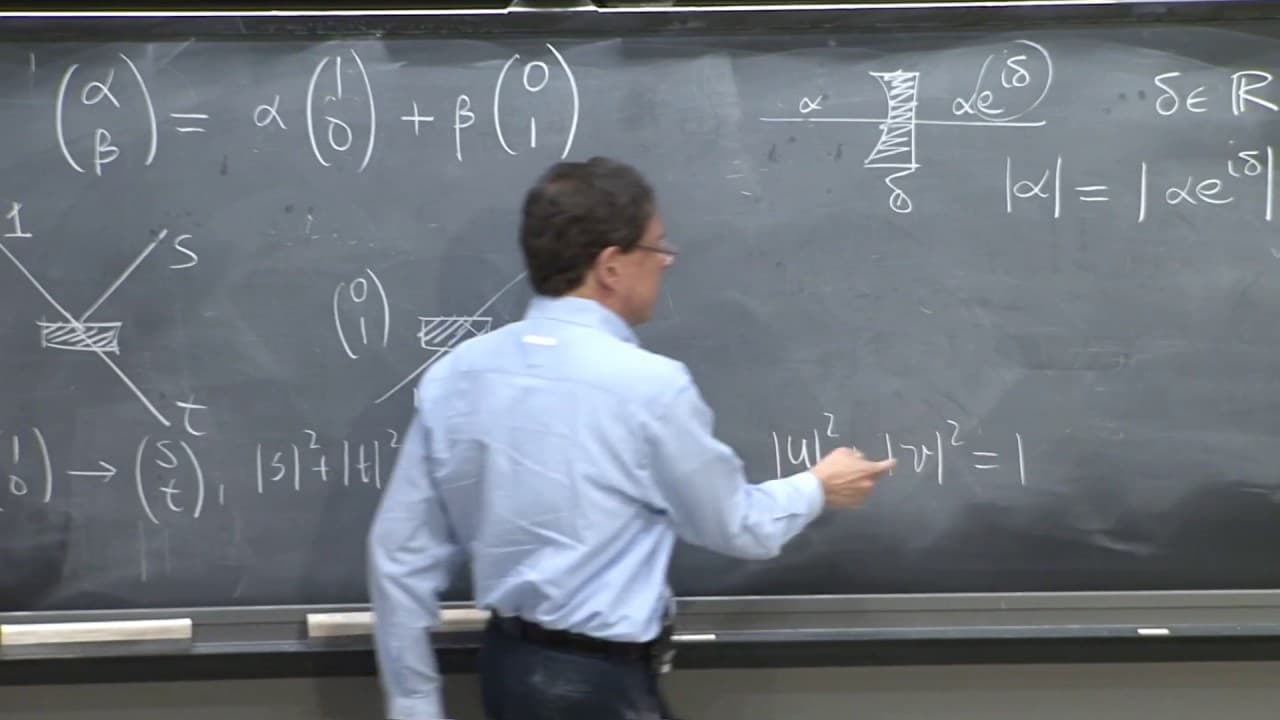
Mach-Zehnder interferometers utilize beam splitters and mirrors to manipulate photons along two distinct paths. The behavior of a photon can be described by a wave function and represented as a column vector containing complex numbers, allowing for superposition and interference effects. Beam splitters are characterized by four parameters that dictate their interactions with incoming photon states.
Transcript
PROFESSOR: Mach-Zehnder-- interferometers. And we have a beam splitter. And the beam coming in, it splits into 2. A mirror-- another mirror. The beams are recombined into another beam splitter. And then, 2 beams come out. One to a detector d0-- and a detector d1. We could put here any kind of devices in between. We could put a little piece of glass... Read More
Key Insights
- 😁 Mach-Zehnder interferometers consist of beam splitters, mirrors, and phase shifters to manipulate the behavior of photons in different paths.
- 👋 The behavior of photons in a Mach-Zehnder interferometer can be described using a wave function and represented by complex numbers in a column vector.
- 😁 Beam splitters in Mach-Zehnder interferometers split a beam of light and can be characterized by four numbers (s, t, u, v) that determine their effect on photon states.
- 😁 Balanced beam splitters, where s² + t² = 1 and u² + v² = 1, simplify the determination of beam splitter matrices.
Install to Summarize YouTube Videos and Get Transcripts
Explore YouTube Video Summarizer or Get YouTube Transcript Extractor
Questions & Answers
Q: How can a photon's behavior in a Mach-Zehnder interferometer be described mathematically?
A photon's behavior can be described using a wave function represented by a column vector with two complex numbers, which represent the probability amplitudes for the photon to be in a specific location within the interferometer.
Q: What is the purpose of a beam splitter in a Mach-Zehnder interferometer?
A beam splitter splits a beam of light into two separate paths - one reflected and one transmitted - and interacts with the photon states. It can be used to control the behavior of photons within the interferometer.
Q: What are the constraints for the numbers (s, t, u, v) characterizing a beam splitter?
The numbers (s, t, u, v) need to satisfy the conditions of probability conservation and intensity preservation. Specifically, s² + t² = 1 and u² + v² = 1 to ensure that the probabilities of photon presence are preserved.
Q: Can a beam splitter matrix be determined by any arbitrary numbers?
No, the numbers in the beam splitter matrix need to satisfy the conditions of probability conservation and intensity preservation. They should result in a normalized photon state after the beam splitter action.
Summary & Key Takeaways
-
Mach-Zehnder interferometers are composed of a beam splitter, mirrors, and a phase shifter, and can split a beam of light into two separate paths.
-
A photon's behavior in a Mach-Zehnder interferometer can be described using a wave function and represented by a column vector with two complex numbers.
-
Beam splitters, characterized by four numbers (s, t, u, v), act on photon states and produce a matrix operation on them.
Read in Other Languages (beta)
Share This Summary 📚
Summarize YouTube Videos and Get Video Transcripts with 1-Click
Try YouTube Summary with ChatGPT & Claude or YouTube Transcript Generator
Explore More Summaries from MIT OpenCourseWare 📚


Summarize YouTube Videos and Get Video Transcripts with 1-Click
Try YouTube Summary with ChatGPT & Claude or YouTube Transcript Generator