Circular Wave Guide | Dominant mode | Microwave Engineering | Lec-37
TL;DR
This video explains dominant modes and their significance in circular waveguides.
Transcript
hi everyone in this video let us learn about dominant mode in the circular waveguide so what do you mean by dominant mode what do you mean by dominant mode what are the different types of modes when a wave is being traveled inside the circular waveguide or a rectangular in depth of wave guide when a wave is being traveled it will be traveled in dif... Read More
Key Insights
- 📡 Waveguides support various propagation modes, primarily TE and TM, which have distinct characteristics for signal transmission.
- ✋ The dominant mode has the highest cutoff wavelength, making it critical for effective waveguide design and operation.
- 👋 Mathematical equations for cutoff wavelengths differ for TE and TM modes, highlighting the complexity of wave behavior in physical structures.
- 🇲🇰 The properties of modes depend on specific values of M and N variables, which directly influence their mathematical representation.
- ❓ Understanding the relationship between the waveguide's radius and the cutoff wavelength is vital for optimizing performance.
- 🚰 The dominant mode can be identified through comparative analysis of values derived from established experimental tables.
- 🎨 Efficient waveguide design relies on understanding both dominant and degenerative modes to ensure effective signal propagation across frequencies.
Install to Summarize YouTube Videos and Get Transcripts
Explore YouTube Video Summarizer or Get YouTube Transcript Extractor
Questions & Answers
Q: What is a wave mode in the context of waveguides?
A wave mode in waveguides refers to the specific patterns or configurations that electromagnetic waves can adopt as they propagate within the guide. Modes can be categorized into transverse electric (TE) and transverse magnetic (TM) types, depending on whether the electric or magnetic field is oriented in the direction of propagation. These modes influence how effectively the waveguide transmits signals.
Q: How do you define the dominant mode in a waveguide?
The dominant mode in a waveguide is defined as the mode with the highest cutoff wavelength. This wavelength represents the lowest frequency at which the mode can propagate through the guide. For a circular waveguide, understanding the dominant mode is essential for optimizing the design and functioning of the waveguide.
Q: Can you explain the cutoff wavelength and its significance?
The cutoff wavelength is the specific wavelength beyond which a mode cannot propagate in a waveguide. It is crucial because it determines the operational bandwidth of the waveguide. For different modes, the cutoff wavelength varies; identifying the lowest cutoff wavelength is essential for maximizing waveguide performance, especially when one is determining the dominant mode.
Q: How are TE and TM cutoff wavelengths calculated for circular waveguides?
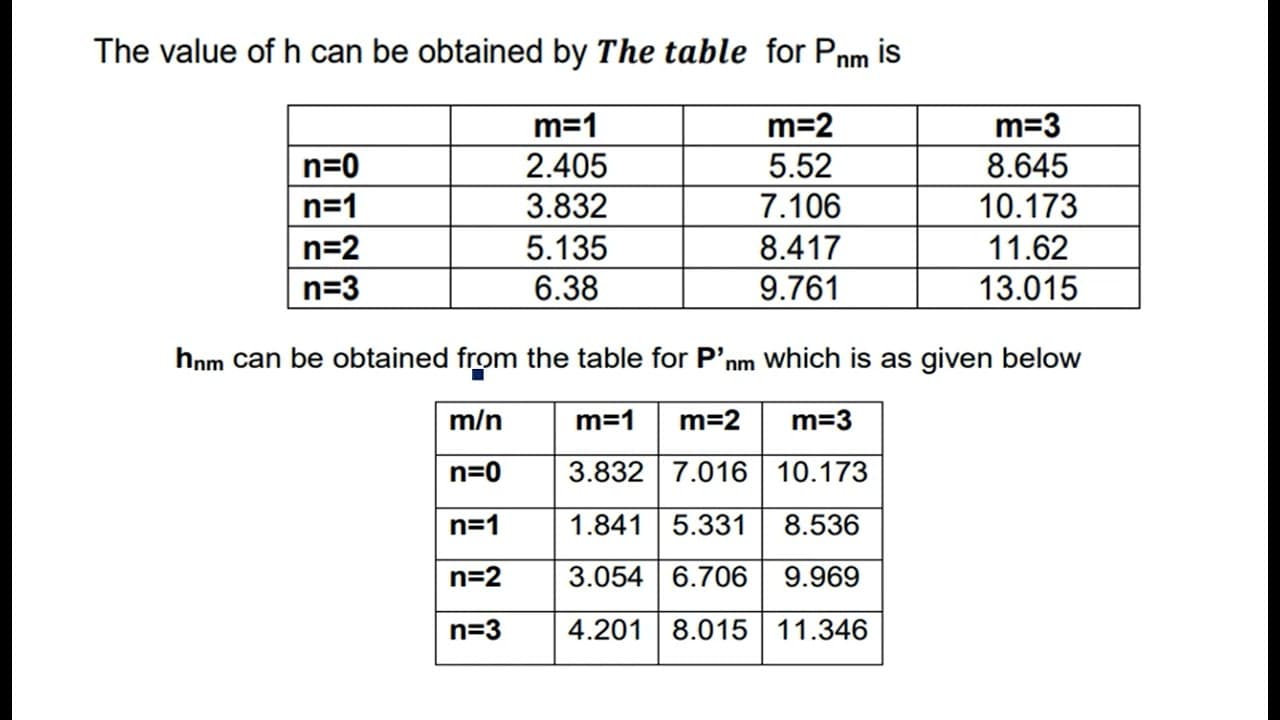
For circular waveguides, the cutoff wavelengths for the transverse electric (TE) mode and transverse magnetic (TM) mode are calculated using specific equations: Lambda_C (TE) = Pi * a / P_dash (NM) and Lambda_C (TM) = 2 * Pi * a / P (NM). Here, 'a' is the radius of the waveguide, and the P values relate to specific modes, influencing the propagation characteristics.
Q: What criteria are used to determine the dominant mode?
The dominant mode is determined by identifying which mode possesses the highest cutoff wavelength. In the context of circular waveguides, it involves analyzing values from tables that elaborate on P values for each mode. The mode with the smallest denominator results in the highest cutoff wavelength, thereby defining the dominant mode.
Q: Why do different modes exist within a waveguide?
Different modes exist within a waveguide due to the varying configurations of electric and magnetic fields. Each mode can support different frequencies, and they are influenced by the waveguide’s physical dimensions. By allowing multiple modes, waveguides can be utilized for various applications and enhance signal fidelity over long distances.
Q: What is the significance of using experimental tables for mode determination?
Experimental tables provide empirically derived values essential for understanding waveguide behavior. These tables, derived from theoretical functions, allow engineers and scientists to determine mode characteristics like cutoff wavelengths across different conditions. They are crucial for designing efficient waveguides that meet specific performance criteria.
Summary & Key Takeaways
-
The video discusses the concept of modes in waveguides, focusing on transverse electric (TE) and transverse magnetic (TM) modes.
-
It introduces the dominant mode, defined as the mode with the highest cutoff wavelength, which has crucial implications for waveguide operation.
-
Additionally, the video explains the mathematical formulation of cutoff wavelengths for both TE and TM modes in a circular waveguide, highlighting the significance of specific variables.
Read in Other Languages (beta)
Share This Summary 📚
Summarize YouTube Videos and Get Video Transcripts with 1-Click
Try YouTube Summary with ChatGPT & Claude or YouTube Transcript Generator