What Conditions Define a Valid Value Function?
TL;DR
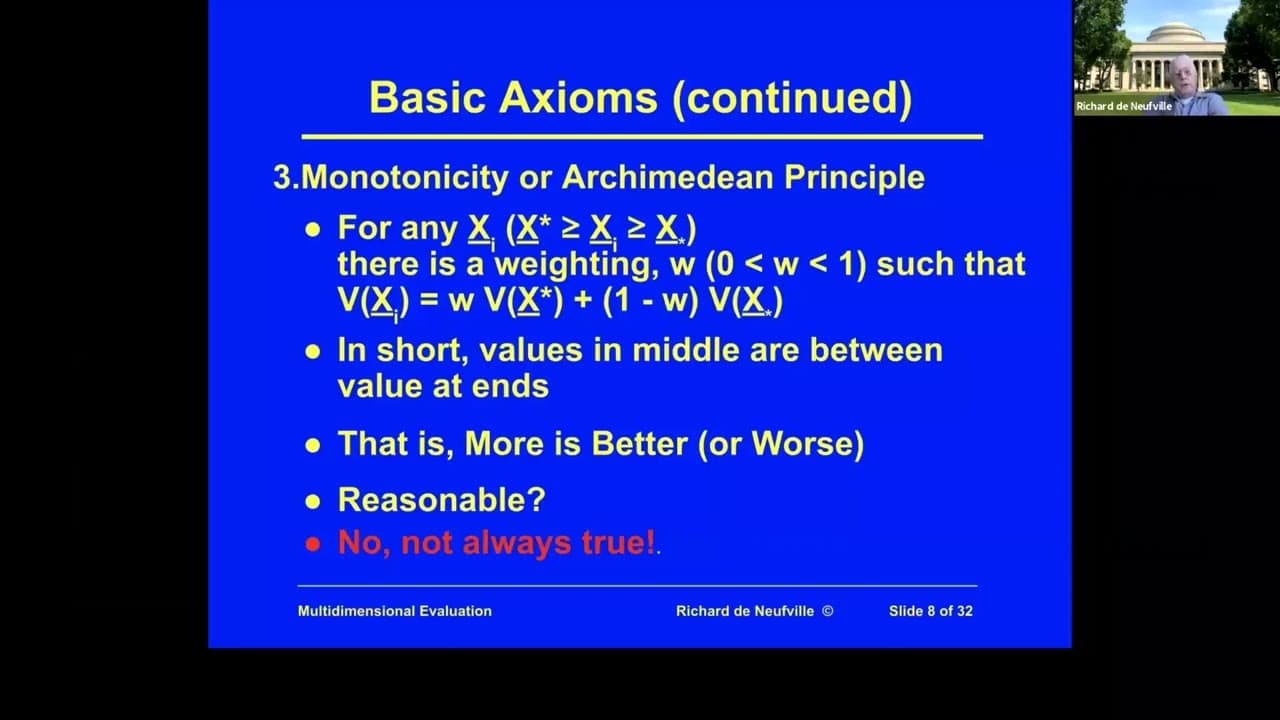
A valid value function requires three key conditions: completeness, transitivity, and the Archimedean principle. Completeness allows individuals to evaluate all choices, while transitivity maintains consistent preferences. The Archimedean principle states that the value of options must be proportionally positioned between the best and worst alternatives, which can complicate group decision-making.
Transcript
[SQUEAKING] [RUSTLING] [CLICKING] RICHARD DE NEUFVILLE: And so what are the conditions for a value function? That is, that the construct of a value function, one that is legitimate in size, meaningful and unambiguous, depends upon three axioms, three assumptions, if you wish, that you might have. And I'm going to go through them, but by going throu... Read More
Key Insights
- 👻 Individuals have preferences over all choices, allowing for a value function to be constructed.
- 🥹 Transitivity may not hold true for groups, making it difficult to establish a consistent value function.
- 👋 The Archimedean Principle ensures a proportional valuation between the best and worst options.
Install to Summarize YouTube Videos and Get Transcripts
Explore YouTube Video Summarizer or Get YouTube Transcript Extractor
Questions & Answers
Q: What conditions are required for a legitimate value function?
A legitimate, meaningful, and unambiguous value function depends on three assumptions: completeness, transitivity, and the Archimedean principle or monotonicity. Examining these assumptions also reveals situations in which constructing a value function is not possible.
Q: What does completeness mean in value function analysis?
Completeness means that a person can express a preference or evaluation across all choices, even without having considered every possibility beforehand. The evaluation may also be indifference, such as assigning equal value to strawberry and chocolate ice cream.
Q: Why is completeness necessary for a value function?
A value function requires choices to be evaluable. If a person cannot form preferences among the possible outcomes, a function cannot assign values over what happens.
Q: What does transitivity mean for preferences?
Transitivity means that if x1 is preferred to x2 and x2 is preferred to x3, then x1 must be preferred to x3. For example, someone who prefers strawberry ice cream to chocolate and chocolate to marshmallow is presumed to prefer strawberry to marshmallow.
Q: Does transitivity always hold for individuals?
Transitivity is generally treated as an acceptable assumption for individual decisions, but the transcript acknowledges exceptions under ambiguous or context-dependent conditions. It mentions the Ellsberg paradox, the Allais paradox, and psychological experiments in which framing can shift attention to different aspects of a choice.
Q: Why is transitivity problematic for groups?
A group's preferences may not be transitive because its members or factions can hold different values. Boards of directors, design teams, city councils, and business groups may therefore lack a consistent value function even when each individual has meaningful preferences.
Q: How can competing organizational values prevent consistent decisions?
The transcript describes company decisions as a tug of war among finance, marketing, and industrial groups. Because each group judges what makes sense from its own perspective, the company may lack a consistent value function for spending money or running the business.
Q: What does the Archimedean principle or monotonicity require?
It requires the value of an intermediate option to be some proportion of the best outcome plus the complementary proportion of the worst. Valuation may consistently rise or fall across the range, but it cannot repeatedly move up and down if the value function is to remain consistent.
Summary & Key Takeaways
-
The construct of a value function depends on three axioms: Completeness, Transitivity, and the Archimedean Principle.
-
Completeness means that individuals have preferences over all choices and can make evaluations.
-
Transitivity states that if x1 is preferred to x2 and x2 is preferred to x3, then x1 is preferred to x3. However, this may not hold true for groups.
-
The Archimedean Principle suggests that the value of something in between the best and worst must be a proportion of both extremes.
Read in Other Languages (beta)
Share This Summary 📚
Summarize YouTube Videos and Get Video Transcripts with 1-Click
Try YouTube Summary with ChatGPT & Claude or YouTube Transcript Generator
Explore More Summaries from MIT OpenCourseWare 📚


Summarize YouTube Videos and Get Video Transcripts with 1-Click
Try YouTube Summary with ChatGPT & Claude or YouTube Transcript Generator