5 Awesome Bubble Tricks You Can Do At Home | KiwiCo
TL;DR
Learn five bubble tricks with science explanations.
Transcript
Read and summarize the transcript of this video on Glasp Reader (beta).
Key Insights
- Creating a strong bubble solution involves mixing water, dish soap, and either light corn syrup or glycerin, which helps the bubbles stretch and grow larger without popping.
- A big bubble wand can be crafted using cotton string and dowels, allowing you to create large bubbles by dipping the wand into the super bubble solution.
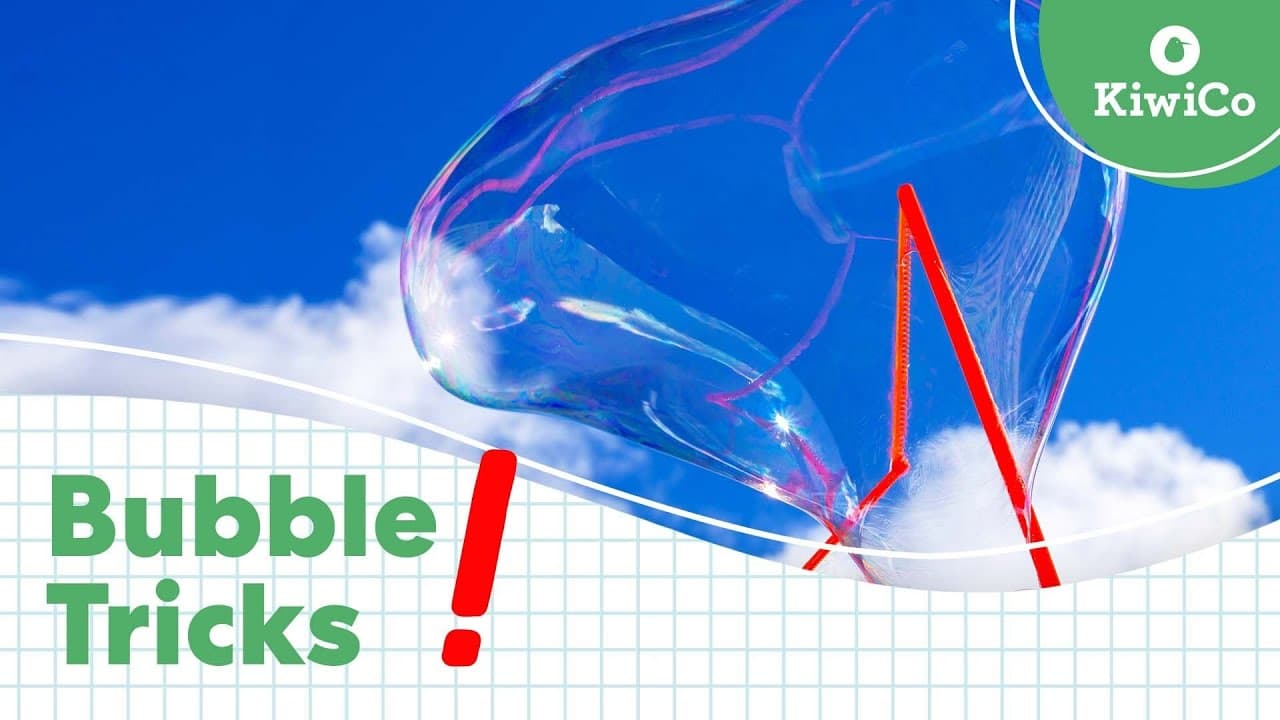
- Bubbles are naturally round due to the soap film minimizing its surface area, but with a straw and pipe cleaner structure, you can create a square bubble.
- You can make a hole in a bubble without popping it by using a structure made with straws and pipe cleaners, demonstrating the bubble film's tension properties.
- Bouncing bubbles off your hand is possible with a clean cotton glove, as the glove prevents contact with oils and dirt that would otherwise pop the bubble.
- Static electricity can be used to move bubbles without direct contact by rubbing a balloon on your head and bringing it close to the bubble.
- The science behind these tricks involves understanding surface tension, static electricity, and the properties of bubble films, making it both educational and entertaining.
- These bubble tricks are not only fun but also provide a hands-on learning experience about physics and chemistry, suitable for all ages.
Install to Summarize YouTube Videos and Get Transcripts
Explore YouTube Video Summarizer or Get YouTube Transcript Extractor
Questions & Answers
Q: What ingredients are needed to make a super bubble solution?
To make a super bubble solution, you need three cups of water, half a cup of liquid dish soap, and a quarter cup of either light corn syrup or glycerin. These ingredients are mixed together to create a bubble solution that is strong and stretchy, allowing for larger bubbles without popping.
Q: How can you create a big bubble wand?
To create a big bubble wand, cut two pieces of cotton string, one three feet long and the other one and a half feet long. Tie the long string to two dowels and the short string to the long string near the dowels. This creates a large loop that can be dipped into the bubble solution to blow big bubbles.
Q: Why are bubbles naturally round?
Bubbles are naturally round because the soap film tries to minimize its surface area while containing the same volume of air. A sphere is the shape with the smallest surface area for a given volume, which is why bubbles form in this shape. The surface tension of the soap film pulls the bubble into a spherical shape.
Q: How can you make a square bubble?
To make a square bubble, construct a cube frame using straws and pipe cleaners. Cut 12 straws to four inches in length and 12 pipe cleaners to eight inches. Slide the pipe cleaners into the straws and twist them together to form a cube. Dip the cube into the bubble solution and blow gently in the center to create a square bubble.
Q: How can you make a hole in a bubble without popping it?
To make a hole in a bubble without popping it, create a square frame using straws and pipe cleaners. Cut four straws to four inches and slide a pipe cleaner through each. Twist the ends to form a square. Dip the frame in bubble solution and use a pencil to pop the bubble film inside the square, creating a stable hole.
Q: How can you bounce bubbles off your hand?
Bouncing bubbles off your hand is possible by wearing a clean cotton glove. Bubbles pop when they come into contact with oils and dirt on your skin. The cotton glove prevents this contact, allowing you to bounce bubbles without them popping, as the glove provides a clean surface.
Q: How can you move bubbles without touching them?
You can move bubbles without touching them by using static electricity. Blow a bubble on a plate of bubble solution, then rub a balloon on your head to charge it. Bring the charged balloon close to the bubble, and the static electricity will push the electrons in the solution away, attracting the bubble and causing it to move.
Q: What educational value do these bubble tricks offer?
These bubble tricks offer educational value by teaching principles of physics and chemistry, such as surface tension, static electricity, and bubble film properties. They provide a hands-on learning experience that is both fun and informative, making complex scientific concepts accessible and engaging for learners of all ages.
Summary & Key Takeaways
-
KiwiCo designer Andy demonstrates five bubble tricks you can do at home, using simple materials and scientific principles. These tricks include creating large bubbles, making square bubbles, and moving bubbles with static electricity.
-
The video explains the science behind bubbles, such as why they are round and how to manipulate their shape and movement using various techniques. The tricks are easy to perform and offer a fun way to learn about physics.
-
Viewers are encouraged to try these tricks at home and share their creations on social media. KiwiCo offers a range of projects and subscriptions for different ages, making science and art accessible and enjoyable for everyone.
Read in Other Languages (beta)
Share This Summary 📚
Summarize YouTube Videos and Get Video Transcripts with 1-Click
Try YouTube Summary with ChatGPT & Claude or YouTube Transcript Generator
Explore More Summaries from KiwiCo 📚


Summarize YouTube Videos and Get Video Transcripts with 1-Click
Try YouTube Summary with ChatGPT & Claude or YouTube Transcript Generator