What Are Scattering States and Step Potentials?
TL;DR
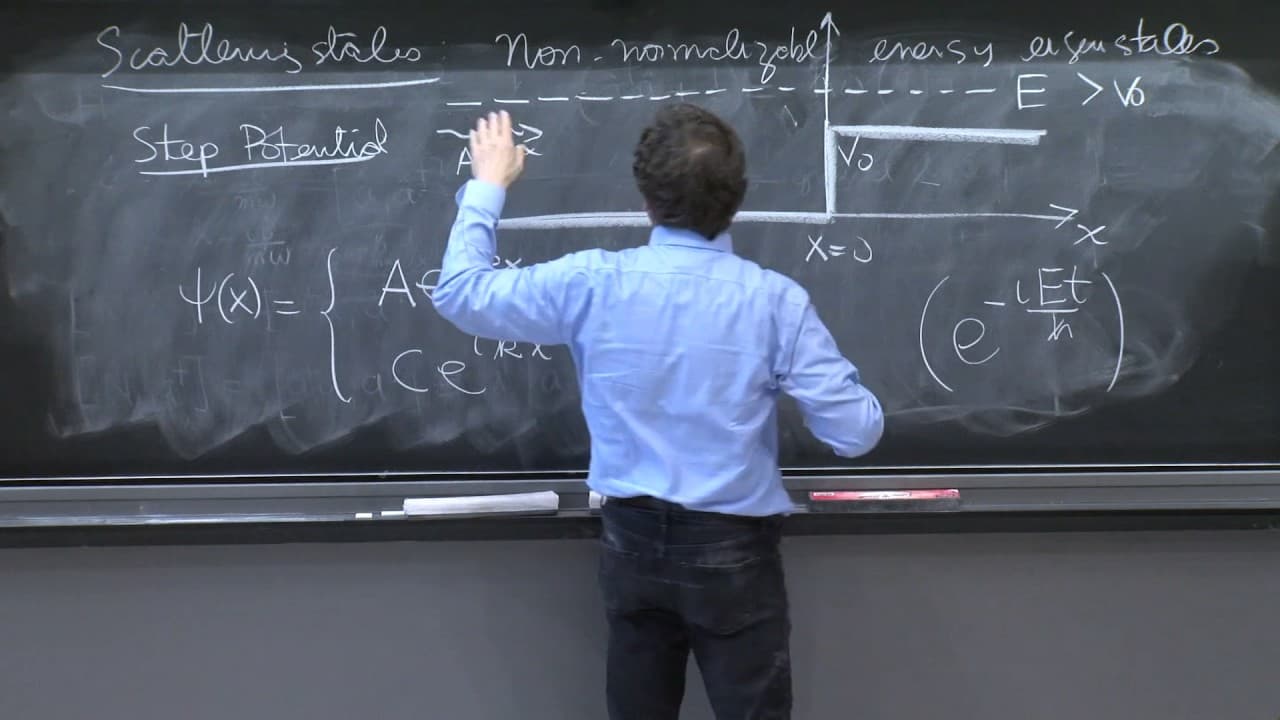
Scattering states are non-normalizable energy eigenstates that aid in the construction of wave packets. The step potential in quantum mechanics presents two scenarios based on the energy level: if the energy is lower than the potential, the solution decays exponentially; if higher, it resembles a right-moving wave, facilitating two distinct potential outcomes.
Transcript
PROFESSOR: Scattering states are energy eigenstates that cannot be normalized. And when you say this cannot be normalized, so what's the use of them? They don't represent particles. Well, it's like they e to the ipx over h bar, those infinite plane waves. Each one by itself cannot be normalized, but you can conserve wave packets that are normalized... Read More
Key Insights
- 👋 Scattering states in quantum mechanics are energy eigenstates that cannot be normalized but provide valuable intuition in constructing wave packets.
- 🗯️ The step potential in quantum mechanics creates two possibilities depending on the energy level: energy less than the potential results in a non-decaying function, while energy greater than the potential produces a wave moving to the right.
- 👋 The solution for the energy eigenstate involves different waves with different kinetic energy and momentum, and the wave function must be continuous at the boundary.
- ❓ Scattering states do not represent particles like bound states do, and they resemble the process of scattering.
Install to Summarize YouTube Videos and Get Transcripts
Explore YouTube Video Summarizer or Get YouTube Transcript Extractor
Questions & Answers
Q: What are scattering states in quantum mechanics?
Scattering states are energy eigenstates that cannot be normalized, but they provide valuable intuition in constructing wave packets. They represent the process of scattering.
Q: How do scattering states differ from bound states?
Scattering states cannot be normalized and do not represent particles, while bound states are normalizable and can represent particles. Scattering states are non-decaying energy eigenstates.
Q: What is the step potential in quantum mechanics?
The step potential is a sudden change in potential energy from 0 to a certain value at a specific position. It creates qualitatively two possibilities depending on the energy level.
Q: How is the solution for the energy eigenstate derived in the step potential?
The solution involves different waves with different kinetic energy and momentum. The wave function must be continuous at the boundary, and the coefficients A, B, and C can be determined by solving two equations and two unknowns.
Summary & Key Takeaways
-
Scattering states are energy eigenstates that cannot be normalized, but their intuition is valuable in constructing wave packets.
-
The step potential in quantum mechanics provides two possibilities: if the energy is less than the potential, the solution is a non-decaying function; if the energy is greater, the solution is a wave moving to the right.
-
The solution for the energy eigenstate involves different waves with different kinetic energies and momentum, and the wave function must be continuous at the boundary.
Read in Other Languages (beta)
Share This Summary 📚
Summarize YouTube Videos and Get Video Transcripts with 1-Click
Try YouTube Summary with ChatGPT & Claude or YouTube Transcript Generator
Explore More Summaries from MIT OpenCourseWare 📚


Summarize YouTube Videos and Get Video Transcripts with 1-Click
Try YouTube Summary with ChatGPT & Claude or YouTube Transcript Generator