GC 205 Calculus 1 Section 4.2
TL;DR
Explains linear approximation and error estimation in calculus.
Transcript
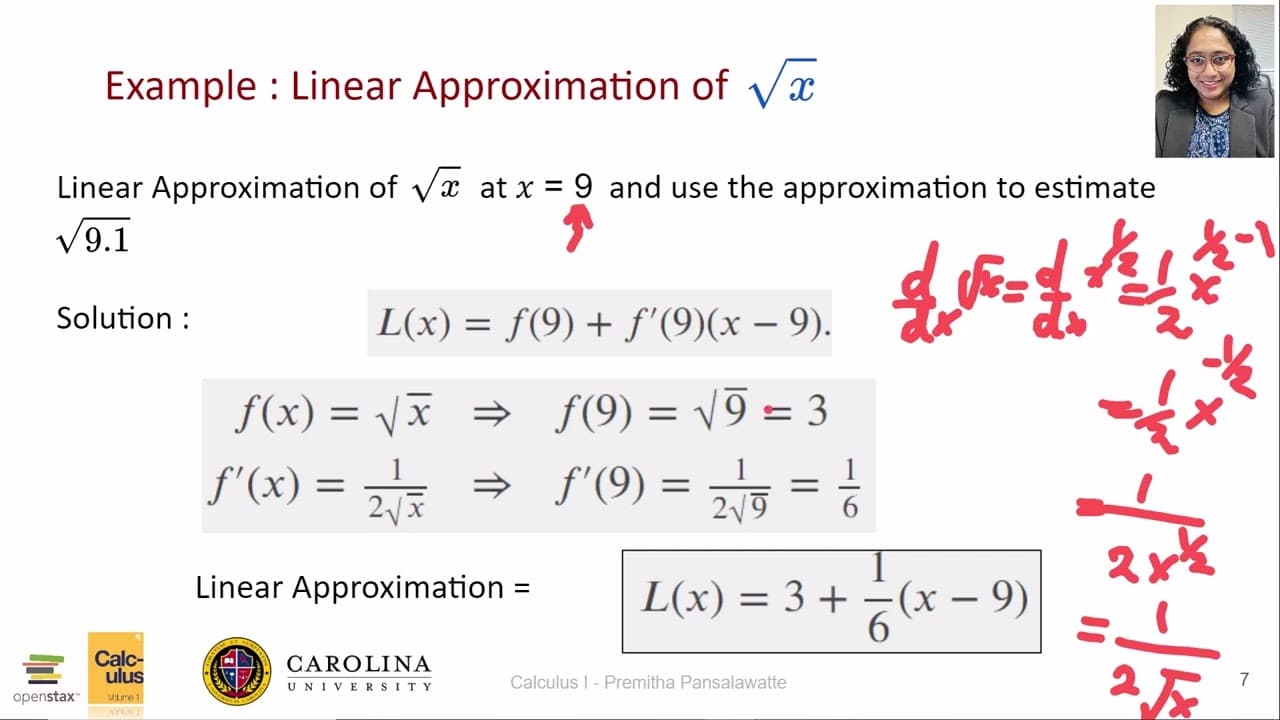
hello students welcome back to gc25 Calculus 1 this section is section 4.2 linear approximation of a function at a point let's look at what a linear approximation of a function at a point means consider a function f that is differentiable at a point x is equal to a the equation for the tangent line at x = a is y = f of a + frime of a * x - ... Read More
Key Insights
- Linear approximation involves using the tangent line at a point to estimate the value of a function near that point, providing a useful tool for understanding changes in the function's behavior.
- The accuracy of linear approximation decreases as the point of interest moves further from the point where the tangent line is calculated, highlighting the importance of proximity in these estimates.
- Differentials, represented by dy and dx, are used to approximate small changes in the function's output relative to small changes in input, providing a practical method for estimating errors.
- The concept of propagated error is crucial in experimental settings, as it helps estimate how measurement errors affect calculated quantities, such as using the radius to calculate the area of a circle.
- Relative and percentage errors provide context to absolute errors by comparing them to the size of the measured quantity, offering a more meaningful interpretation of measurement accuracy.
- The process of calculating propagated error using derivatives involves taking the derivative of the function and multiplying it by the measurement error, offering a systematic approach to error estimation.
- Volume errors in geometric calculations can be estimated using differentials, which helps in understanding the impact of measurement inaccuracies on computed volumes.
- Understanding the relationship between differentials and linear approximations is key to mastering error estimation in calculus, as it provides a foundation for more advanced mathematical concepts.
Install to Summarize YouTube Videos and Get Transcripts
Explore YouTube Video Summarizer or Get YouTube Transcript Extractor
Questions & Answers
Q: What is linear approximation in calculus?
Linear approximation in calculus is a method of estimating the value of a function near a given point using the tangent line at that point. This approximation is useful for understanding the behavior of the function close to the point of tangency and involves using the first derivative to determine the slope of the tangent line.
Q: How does the accuracy of linear approximation change with distance?
The accuracy of linear approximation decreases as the point of interest moves further from the point where the tangent line is calculated. This is because the tangent line only closely approximates the function near the point of tangency, and the approximation becomes less accurate as the distance increases.
Q: What are differentials and how are they used?
Differentials, represented by dy and dx, are used to approximate small changes in a function's output relative to small changes in input. They are particularly useful in estimating errors and understanding how changes in input affect the output, providing a practical method for error estimation in calculus.
Q: What is propagated error and why is it important?
Propagated error refers to the error that results in a calculated quantity due to measurement errors in the input values. It is important because it helps estimate how inaccuracies in measurements affect the final calculated result, which is crucial in experimental and practical applications.
Q: How can derivatives be used to calculate propagated error?
Derivatives can be used to calculate propagated error by taking the derivative of the function with respect to the input variable and multiplying it by the measurement error. This approach provides a systematic way to estimate the error in the output based on the error in the input.
Q: What is the significance of relative and percentage errors?
Relative and percentage errors provide context to absolute errors by comparing them to the size of the measured quantity. This comparison offers a more meaningful interpretation of measurement accuracy, as it shows how significant the error is relative to the overall size of the measurement.
Q: How are volume errors estimated using differentials?
Volume errors can be estimated using differentials by applying the derivative of the volume formula with respect to the measured dimension and multiplying by the measurement error. This method helps understand the impact of inaccuracies in measurements on the calculated volume, providing an estimate of the error.
Q: What is the relationship between differentials and linear approximations?
The relationship between differentials and linear approximations is that differentials provide a way to estimate small changes in a function's output, while linear approximations use tangent lines to estimate the function's behavior near a point. Both concepts are fundamental in error estimation and understanding function behavior in calculus.
Summary & Key Takeaways
-
This content covers the topic of linear approximation in calculus, explaining how tangent lines can be used to approximate the behavior of functions near specific points. The accuracy of these approximations depends on the proximity to the point of tangency.
-
Differentials are introduced as a method to estimate small changes in a function's output due to small input changes. This concept is essential for understanding error propagation in experimental and calculated quantities.
-
The content also discusses relative and percentage errors, which provide context to absolute errors by comparing them to the size of the measured quantity. Examples include estimating volume errors using differentials and understanding the impact of measurement inaccuracies.
Read in Other Languages (beta)
Share This Summary 📚
Summarize YouTube Videos and Get Video Transcripts with 1-Click
Try YouTube Summary with ChatGPT & Claude or YouTube Transcript Generator