Problem 2 based on Taylor's Series
TL;DR
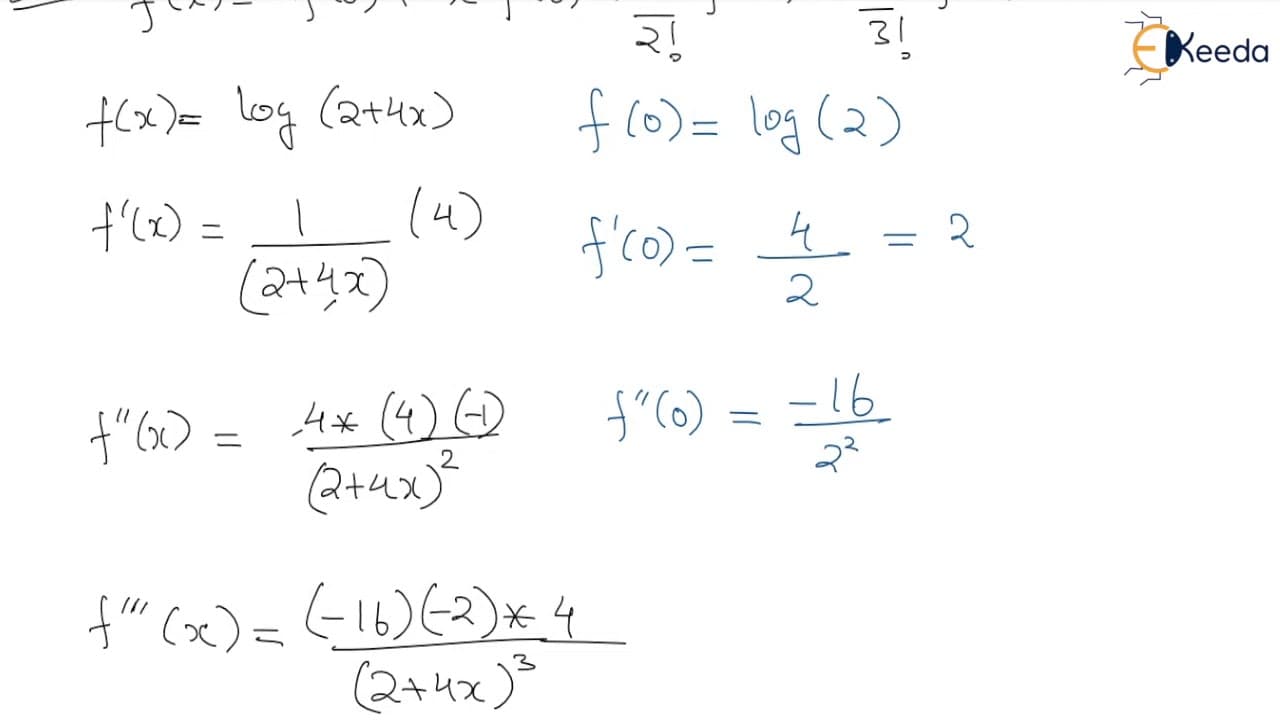
This video explains how to find the Taylor series expansion of the logarithmic function, specifically for f(x) = log(2) + 4x when x = 0.
Transcript
hello everyone in this session we'll see another question on taylor series expansion so let's say we have find the taylor series for f of x is equal to log of 2 plus 4 x about x equal to zero so again we have x equal to zero so the same expressions will have about x equal to 0 the expansion of f of x is f of 0 plus x times of f dash of 0 x square b... Read More
Key Insights
- 🔨 The Taylor series expansion is a powerful tool for approximating functions and simplifying complex calculations.
- 🆘 Differentiating the function f(x) step by step helps determine the coefficients in the expansion.
- 🍉 The accuracy of the approximation increases as more terms of the Taylor series are included.
- 🤝 The Taylor series expansion is particularly useful for dealing with functions that cannot be easily integrated or differentiated directly.
- 🏑 Taylor series expansions are widely used in various fields of science, engineering, and mathematics for solving practical problems.
- ❓ Finding the derivatives of a function is essential when determining the coefficients in the Taylor series expansion.
- 👻 The Taylor series expansion provides a polynomial representation of a function, allowing for easier manipulation and evaluation.
Install to Summarize YouTube Videos and Get Transcripts
Explore YouTube Video Summarizer or Get YouTube Transcript Extractor
Questions & Answers
Q: What is the purpose of finding the Taylor series expansion of a function?
The Taylor series expansion allows us to approximate a complicated function using a polynomial expression, making it easier to calculate values and handle complex mathematical operations.
Q: How do you determine the derivatives of the given function?
To find the derivatives, we apply the power rule and chain rule to the function f(x), simplifying each derivative expression until we reach the desired order.
Q: Can the Taylor series expansion be used to find precise values of a function?
The Taylor series expansion provides an approximation of the function around a specific point. To obtain more precise values, more terms of the expansion need to be included.
Q: What are higher-order terms in the Taylor series expansion?
Higher-order terms are the terms beyond the third derivative in the Taylor series expansion. These terms become smaller as the degree increases and are often omitted in some calculations or approximations.
Summary & Key Takeaways
-
The video demonstrates the process of finding the Taylor series expansion for the logarithmic function f(x) = log(2) + 4x around x = 0.
-
The first derivative of f(x) is 1/(2 + 4x), the second derivative is 2 + 4x^2, and the third derivative is 16/(2^3).
-
By substituting the derivatives at x = 0 into the Taylor series formula, the expansion of f(x) is log(2) + 2x - 2x^2 + (8/3)x^3 + higher-order terms.
Read in Other Languages (beta)
Share This Summary 📚
Summarize YouTube Videos and Get Video Transcripts with 1-Click
Try YouTube Summary with ChatGPT & Claude or YouTube Transcript Generator
Explore More Summaries from Ekeeda 📚


Summarize YouTube Videos and Get Video Transcripts with 1-Click
Try YouTube Summary with ChatGPT & Claude or YouTube Transcript Generator