Sweep circuit | Using Transistor switch | PDC | Lec-79
TL;DR
This video explains the operation of a sweep circuit using a bipolar junction transistor.
Transcript
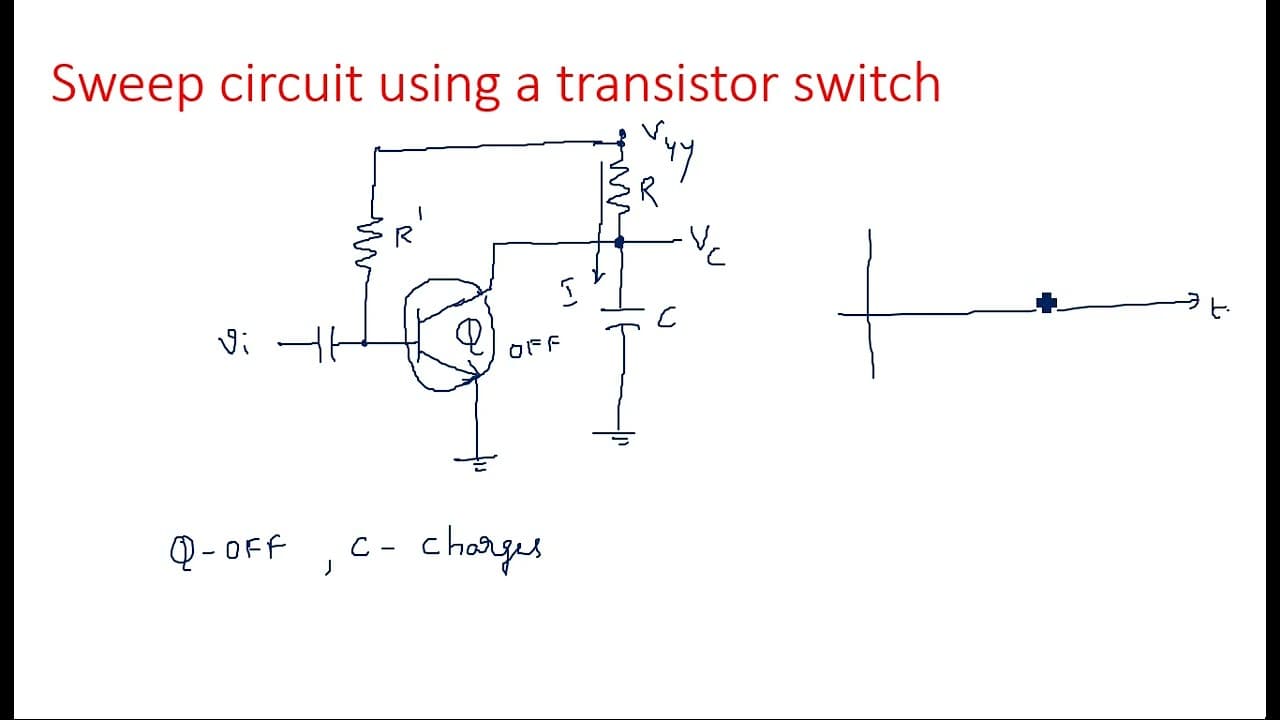
hi everyone in this video I am going to explain about sweep circuit using transistor Switcher so till now we have seen a sweep circuit which was made up of ugly ujt device uni-junction transistor now the same can also be obtained by using bipolar Junction transistor which is nothing but a BJT so the circuit consisting of a BJT bipolar Junction tran... Read More
Key Insights
- 🛟 The sweep circuit utilizes a BJT to achieve the functionality traditionally served by a UJT in similar applications.
- 😥 The point of transition between the charging and discharging phases is vital for the generation of the sawtooth waveform.
- ⚡ The relationship between the capacitor's voltage and the BJT's states (on/off) is pivotal to understanding the circuit's operation.
- ⛔ Resistors in the circuit provide biasing and limit current, ensuring proper function and protection of the BJT.
- ⚡ The output voltage is defined by the maximum voltage the capacitor can reach when fully charged.
- 🈂️ The timing aspects of charging and discharging can be manipulated through specific resistor and capacitor values, influencing the frequency of the sawtooth output.
- ❓ The concept of slope error and its calculation is essential for precise waveform generation in sweep circuits.
Install to Summarize YouTube Videos and Get Transcripts
Explore YouTube Video Summarizer or Get YouTube Transcript Extractor
Questions & Answers
Q: What is the main purpose of the sweep circuit discussed in the video?
The main purpose of the sweep circuit is to generate a sawtooth waveform, which is crucial for applications like oscillators and signal generators. The waveform is produced through the charging and discharging of a capacitor controlled by the on and off states of a bipolar junction transistor (BJT).
Q: How does the capacitor charge and discharge in the circuit?
In the circuit, when the BJT is in the off state, current flows through a resistor to the capacitor, allowing it to charge toward a maximum voltage. Conversely, when the transistor is on, it provides a low-resistance path, enabling the capacitor to discharge. This alternating charging and discharging creates the desired sawtooth waveform.
Q: What role does the input waveform play in the operation of the circuit?
The input waveform, which is derived from the output of a multivibrator, dictates the switching behavior of the BJT. As the input voltage fluctuates between high and low, it controls when the transistor turns on and off. This switching action directly influences the charging and discharging cycles of the capacitor, shaping the output waveform.
Q: Can this circuit work with different types of input waveforms?
Yes, the circuit can function with various input waveforms, including outputs from different types of multivibrators like astable or monostable configurations. The essential factor is that the input waveform effectively controls the BJT’s switching, allowing for the creation of a sawtooth or sweep waveform regardless of the input type.
Summary & Key Takeaways
-
The video focuses on constructing a sweep circuit with a bipolar junction transistor (BJT) and describes its operational principles including charging and discharging of a capacitor.
-
It details how the BJT alternatives between on and off states, affecting the output voltage to generate a sawtooth waveform, essential for various electronic applications.
-
Key components such as resistors, capacitors, and the input waveform from a multivibrator are discussed, showing their roles in the charging and discharging cycles of the circuit.
Read in Other Languages (beta)
Share This Summary 📚
Summarize YouTube Videos and Get Video Transcripts with 1-Click
Try YouTube Summary with ChatGPT & Claude or YouTube Transcript Generator