Section 2 W9 L1 P1 TU
TL;DR
Explains digital logic circuits, arithmetic operations, and data representation.
Transcript
as well okay so last time we uh introduced a little bit of uh concept about digital logic circuits and how can we design a simple one bit adder and from one bit Adder we extended that to 4bit Adder is that right and then we can extend it up to 64bit adder and that's going to help us to um sum up two operants is that right um each of them is... Read More
Key Insights
- Digital logic circuits can be designed to perform arithmetic operations such as addition and subtraction using binary representation, which is crucial for computer operations.
- A one-bit adder can be extended to perform operations on larger bit sizes, such as 4-bit or 64-bit operations, allowing for complex arithmetic calculations.
- Multiplication in digital circuits is achieved through repeated addition and shifting, which can be time-consuming but optimized using shortcuts like bit-shifting.
- Data in computers is represented in binary format, with the CPU processing data while RAM stores it, and other devices acting as input/output interfaces.
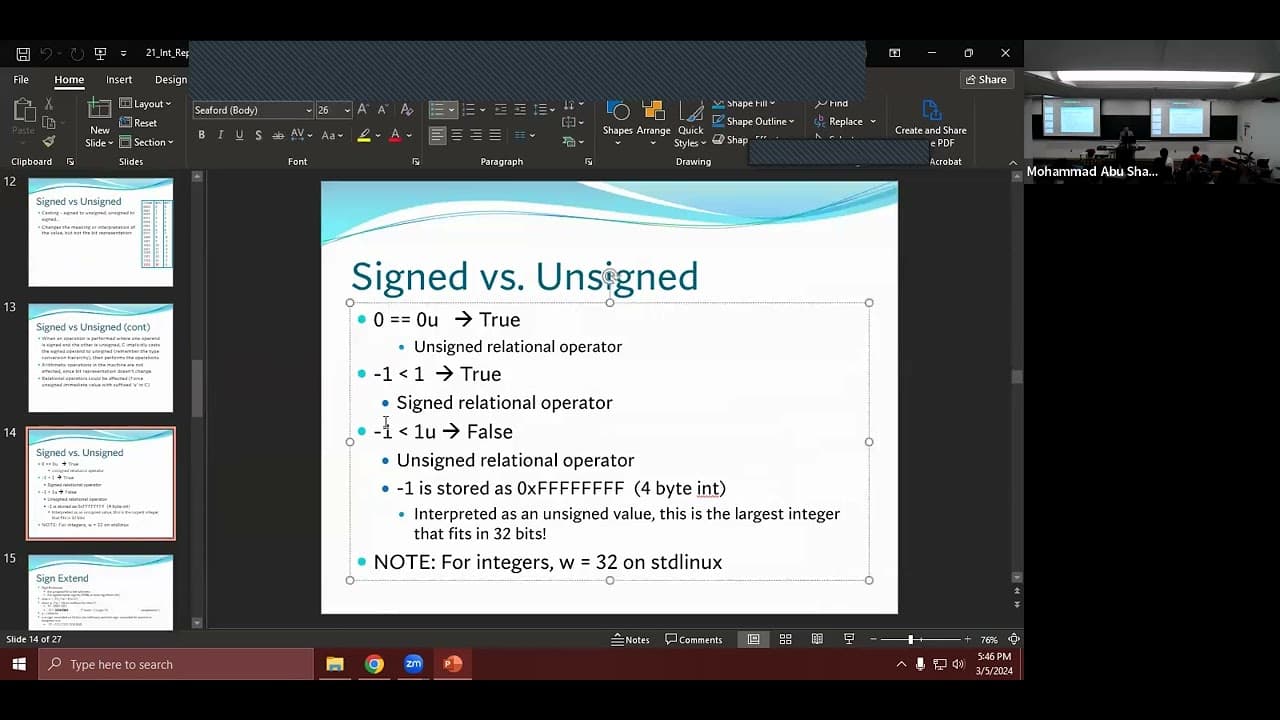
- Signed and unsigned numbers are represented differently in binary, affecting arithmetic operations and requiring careful handling to avoid errors.
- Overflow in arithmetic operations occurs when the result exceeds the representable range, detected using carry-out flags, and requires handling to ensure correct results.
- Negation in binary representation is performed using two's complement, which involves flipping bits and adding one, applicable to both signed and unsigned numbers.
- Rounding operations are essential for converting floating-point numbers to integers, with various methods available, including rounding to the nearest integer.
Install to Summarize YouTube Videos and Get Transcripts
Explore YouTube Video Summarizer or Get YouTube Transcript Extractor
Questions & Answers
Q: How is multiplication performed in digital circuits?
Multiplication in digital circuits is achieved through repeated addition and shifting of bits. For example, multiplying two 64-bit numbers requires shifting one of the numbers 64 times, which can be time-consuming. However, shortcuts like bit-shifting can optimize the process, such as shifting left to multiply by two, saving time and CPU resources.
Q: What is the significance of binary representation in computers?
Binary representation is crucial in computers as it forms the basis for data processing and storage. Computers, including the CPU and RAM, operate using binary data, where everything is represented as signals of voltage levels corresponding to binary bits. This representation enables computers to perform arithmetic operations, data manipulation, and logical processing efficiently.
Q: What is the role of the carry-out flag in arithmetic operations?
The carry-out flag plays a vital role in identifying overflow in arithmetic operations. When the result of an addition exceeds the representable range of the circuit, the carry-out flag is set, indicating an overflow. This flag helps prevent errors by alerting the system to handle the overflow condition, ensuring the accuracy of arithmetic operations in digital circuits.
Q: How are signed and unsigned numbers represented differently in binary?
Signed and unsigned numbers have different binary representations. Unsigned numbers range from 0 to a maximum positive value, while signed numbers use two's complement to represent both positive and negative values. In signed representation, the most significant bit indicates the sign, with '0' for positive and '1' for negative, dividing the number space into positive and negative ranges.
Q: What is two's complement, and how is it used for negation?
Two's complement is a method used for representing negative numbers in binary. It involves flipping all bits of a number and adding one to the result. This operation allows for easy negation of numbers in both signed and unsigned binary systems. Two's complement simplifies arithmetic operations, as it enables subtraction to be performed as addition of negative numbers.
Q: How does rounding work in floating-point numbers?
Rounding in floating-point numbers involves converting them to integers by approximating their value to the nearest whole number. Various rounding methods exist, such as rounding to the nearest integer, rounding up, or rounding down. The most common method is rounding to the nearest integer, where numbers are rounded to the closest whole number, considering fractional parts.
Q: What challenges arise with different data types in arithmetic operations?
Arithmetic operations involving different data types, such as signed and unsigned integers, can lead to errors if not handled correctly. The hardware lacks the capability to differentiate between data types, requiring unification through casting. Implicit or explicit casting ensures operands are of the same type, preventing errors and ensuring correct operation execution.
Q: Why is understanding data representation important in digital circuits?
Understanding data representation is crucial in digital circuits as it affects how data is processed and manipulated. Binary representation forms the basis for all operations, and incorrect representation can lead to errors. Awareness of how signed and unsigned numbers are represented, and how overflow is detected, allows for accurate arithmetic operations and prevents data loss or corruption.
Summary & Key Takeaways
-
Digital logic circuits are fundamental in performing arithmetic operations in computers. They can be designed to handle simple operations like addition and subtraction using binary representation. A one-bit adder serves as the basic building block, which can be extended to handle larger bit sizes for complex calculations.
-
Multiplication in digital circuits involves repeated addition and bit-shifting, but this can be optimized using shortcuts to save time and computational resources. Data in computers is represented in binary format, with the CPU processing data and RAM storing it, while other devices act as input/output interfaces.
-
Handling signed and unsigned numbers in binary requires careful consideration to avoid errors. Overflow occurs when results exceed representable ranges, detected using carry-out flags. Negation is achieved using two's complement, and rounding operations convert floating-point numbers to integers, with various methods available.
Read in Other Languages (beta)
Share This Summary 📚
Summarize YouTube Videos and Get Video Transcripts with 1-Click
Try YouTube Summary with ChatGPT & Claude or YouTube Transcript Generator