How To Memorize Every Major & Minor Chord On Piano
TL;DR
Learn major and minor chords in manageable groups to build a foundation for playing piano.
Transcript
major and minor chords are the most common useful and foundational chords to start learning first on piano you're going to end up using these in some way for pretty much whatever kind of music you want to play we need to start working towards getting these foundational chords completely fluent so you can find them and recognize them starting from a... Read More
Key Insights
- 🎹 Learning foundational chords: Major and minor chords are the most common and useful chords to start learning on the piano. Memorizing the 12 major chords and learning how to change them into minors can help simplify the learning process. It's important to recognize them as one shape, similar to how we read words as a whole.
- 👆 Finger technique: While finger usage can vary depending on the music, it's recommended to stick to either using fingers 1, 3, and 5 or 1, 2, and 4. Consistency in finger placement can help build fluency and speed.
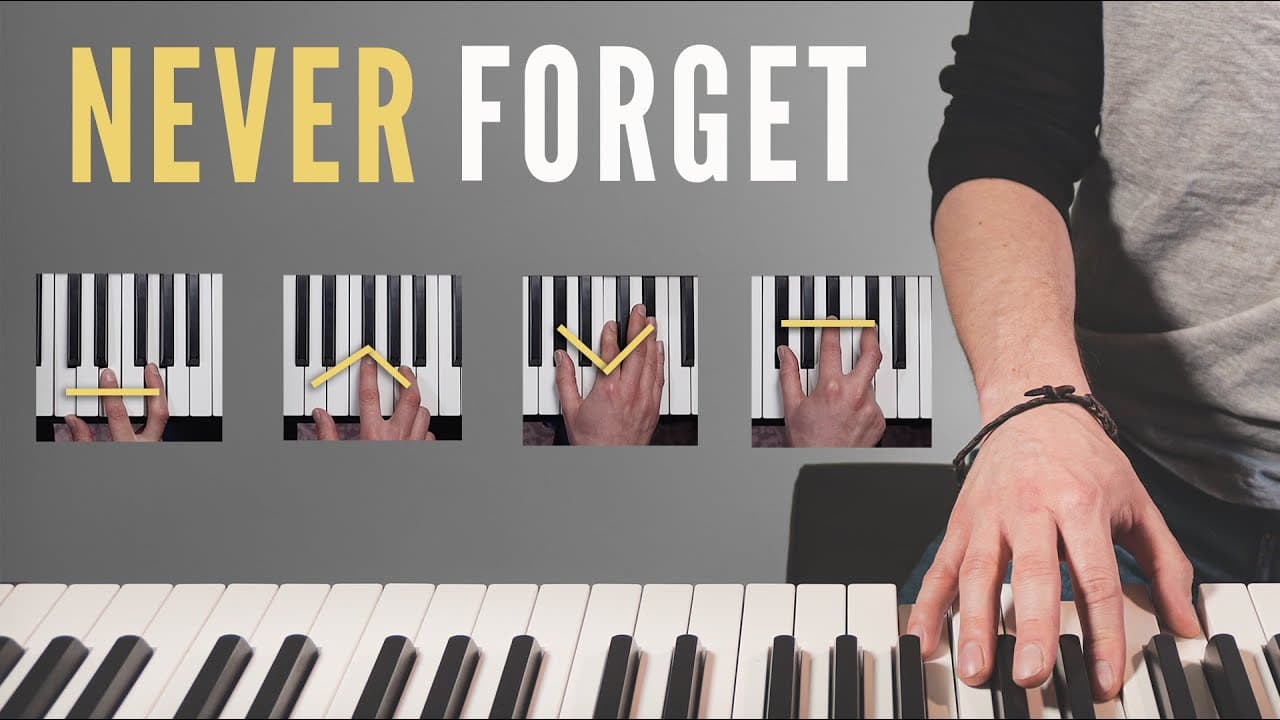
- 🌈 Three major chords with only white notes: C major, F major, and G major form the first group of chords. These chords can be visualized as triangle shapes with no black keys involved, making it easier for beginners to grasp.
- 🔺 Three major chords with a black note in the middle: D major, E major, and A major make up the second group. Although the shapes on the keyboard may look different, the spacing between the notes remains identical, creating a triangular shape.
- ⬜⬛⬜ Major chords with a black note on both ends: D flat major (or C sharp major), E flat major, and A flat major form this group. The middle note in these chords is a white key, resulting in an upside-down triangle shape when visualizing them.
- ⬛⬜⬛ Major chords with a white note in the middle: G flat major (or F sharp major), B flat major, and B major make up this group. These chords have a unique shape and are the only major chords that consist solely of black notes.
- 🔄 Transitioning between major and minor chords: To turn a major chord into a minor chord, lower the middle note by a half step. This simple adjustment allows for a smooth transition without the need to memorize additional chord shapes.
- 🎵 Practicing and expanding chord knowledge: Start by practicing one group of chords at a time, gradually increasing speed. Mixing different groups together and exploring different strategies, such as repetition, rhythm patterns, and metronome use, can help improve fluency. Using tactics like moving up in half steps or exploring the circle of fifths can help with practicing all 12 keys.
- 🧠 Continual improvement: Regularly review and practice foundational chords, especially when experiencing difficulty in application during actual music playing. Taking a few minutes a day to brush up on the fundamentals can help maintain and improve overall proficiency.
Install to Summarize YouTube Videos and Get Transcripts
Explore YouTube Video Summarizer or Get YouTube Transcript Extractor
Questions & Answers
Q: Why are major and minor chords important to learn on piano?
Major and minor chords are essential in playing a wide range of music genres on the piano. They serve as the foundational chords for many songs, making them crucial to learn.
Q: How can I memorize major and minor chords more easily?
To make memorization easier, group the chords by their shape and learn one group at a time. This approach breaks down the task into manageable chunks, making it more attainable.
Q: How can I recognize major and minor chords quickly?
By visualizing the shape of the chord and understanding the spacing between the notes, you can quickly recognize major and minor chords on the piano. Practice and familiarize yourself with the feel of these shapes to enhance recognition.
Q: Can I turn a major chord into a minor chord?
Yes, you can adjust a major chord and turn it into a minor chord by lowering the middle note by a half step. This simple adjustment creates a new sound and expands your chord repertoire without having to memorize additional chords.
Summary & Key Takeaways
-
Major and minor chords are foundational and commonly used on piano.
-
Organize chords into groups to make memorization easier.
-
Adjusting a major chord by lowering the middle note creates a minor chord.
Read in Other Languages (beta)
Share This Summary 📚
Summarize YouTube Videos and Get Video Transcripts with 1-Click
Try YouTube Summary with ChatGPT & Claude or YouTube Transcript Generator