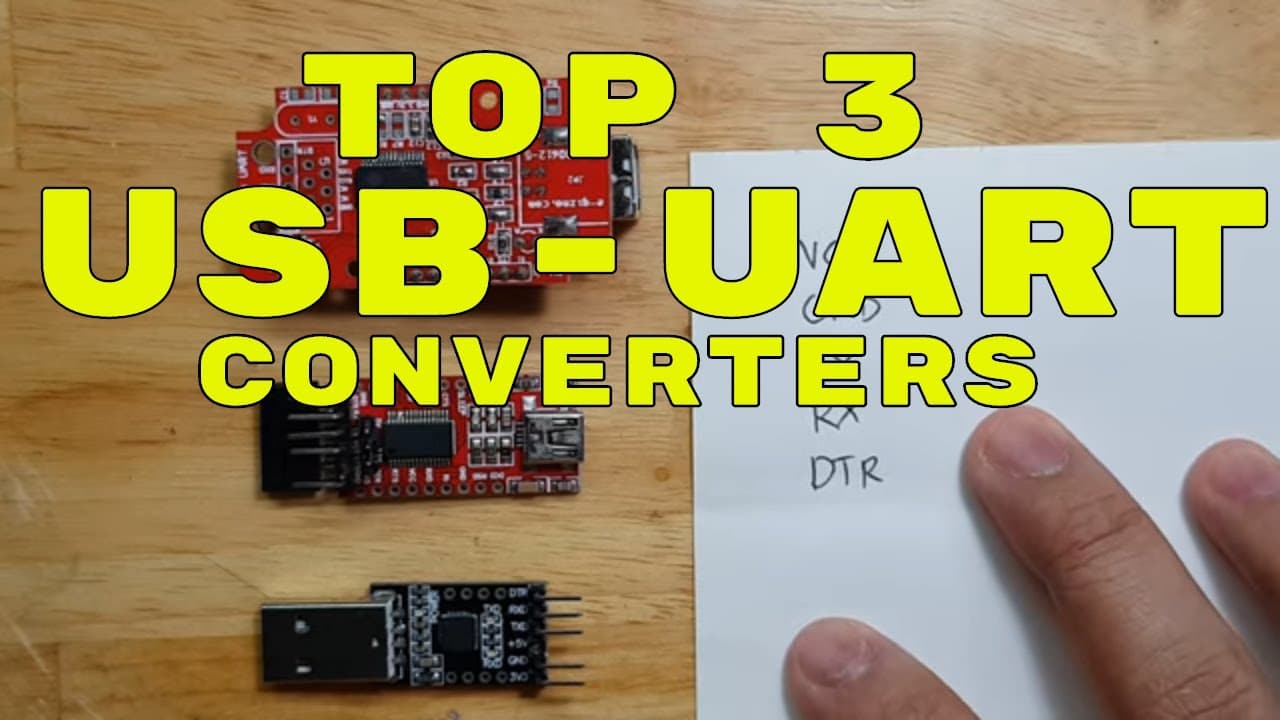
TOP 3 USB TO UART SERIAL CONVERTERS ADAPTER FOR DIY ELECTRONIC PROJECTS - PL2303, FT232RL and CP2101
TL;DR
Discusses three common USB to UART converters for DIY projects.
Transcript
Read and summarize the transcript of this video on Glasp Reader (beta).
Key Insights
- The video introduces three popular USB to UART converters: PL2303, FT232RL, and CP2101, highlighting their features and applications.
- PL2303 from Prolific offers multiple exposed pins for versatile application use, purchased from local stores.
- FT232RL from FTDI is favored for its flexibility, allowing selection between 5V and 3.3V operations via a jumper.
- CP2101 from Silicon Labs is noted for its integrated USB connector, making it ideal for Raspberry Pi projects.
- The critical pins for USB to UART converters include ground, TX, RX, VCC, and DTR, with specific functions for each.
- VCC pin can be set to either 5V or 3.3V, depending on the application requirements, enhancing adaptability.
- DTR pin is crucial for Arduino programming, facilitating automatic reset during programming to avoid manual intervention.
- The video emphasizes the importance of these converters in DIY projects involving Arduino, Raspberry Pi, ESP32, and ESP8266.
Install to Summarize YouTube Videos and Get Transcripts
Explore YouTube Video Summarizer or Get YouTube Transcript Extractor
Questions & Answers
Q: What are the three USB to UART converters discussed in the video?
The video discusses three USB to UART converters: PL2303 from Prolific, FT232RL from FTDI, and CP2101 from Silicon Labs. Each converter is highlighted for its unique features and suitability for various DIY electronic projects, such as those involving Arduino and Raspberry Pi.
Q: What is the significance of the VCC pin in these converters?
The VCC pin in USB to UART converters is significant because it allows users to select between 5V and 3.3V operation, depending on the specific requirements of the application. This flexibility makes the converters adaptable for different electronic projects, ensuring compatibility with various devices and components.
Q: How does the DTR pin facilitate Arduino programming?
The DTR pin facilitates Arduino programming by enabling automatic reset during the programming process. This pin, connected through a capacitor to the reset pin, eliminates the need for manual intervention, streamlining the programming process and making it more efficient for users working with Arduino boards.
Q: Why is the FT232RL converter favored by the presenter?
The presenter favors the FT232RL converter due to its flexibility in operation, particularly its ability to switch between 5V and 3.3V using a jumper. This adaptability, combined with its reliable performance, makes it a preferred choice for various DIY electronic applications, enhancing project versatility.
Q: What makes the CP2101 converter suitable for Raspberry Pi projects?
The CP2101 converter is suitable for Raspberry Pi projects because it features an integrated USB connector, which simplifies the connection process. This design makes it convenient and efficient for users, especially when working on compact or space-constrained projects involving Raspberry Pi.
Q: What are the critical pins on a USB to UART converter?
The critical pins on a USB to UART converter include ground, TX, RX, VCC, and DTR. Each pin serves a specific function: ground for grounding, TX and RX for data transmission and reception, VCC for voltage supply, and DTR for automatic reset during programming, particularly with Arduino boards.
Q: How does the video help makers working on DIY projects?
The video helps makers working on DIY projects by providing detailed information about three popular USB to UART converters, their features, and applications. It guides users on selecting the right converter based on project needs, ensuring efficient and effective development of electronic projects involving microcontrollers like Arduino and Raspberry Pi.
Q: What are the common applications for USB to UART converters?
Common applications for USB to UART converters include DIY electronic projects involving microcontrollers such as Arduino, Raspberry Pi, ESP32, and ESP8266. These converters are essential for establishing communication between computers and microcontrollers, enabling data transfer and programming, which are critical for project development and execution.
Summary & Key Takeaways
-
The video covers three widely-used USB to UART converters: PL2303, FT232RL, and CP2101, focusing on their features and applications for DIY electronics projects. Each converter has unique attributes, such as FT232RL's voltage selection and CP2101's integrated USB connector, making them suitable for various projects.
-
Key pins for these converters include ground, TX, RX, VCC, and DTR. VCC can be adjusted between 5V and 3.3V, while DTR aids in automatic resetting during Arduino programming. These features make the converters highly adaptable for different electronic applications.
-
The video serves as a guide for makers using USB to UART converters in projects involving Arduino, Raspberry Pi, and other microcontrollers. It highlights the importance of selecting the right converter based on project needs, ensuring efficient and effective electronic project development.
Read in Other Languages (beta)
Share This Summary 📚
Summarize YouTube Videos and Get Video Transcripts with 1-Click
Try YouTube Summary with ChatGPT & Claude or YouTube Transcript Generator