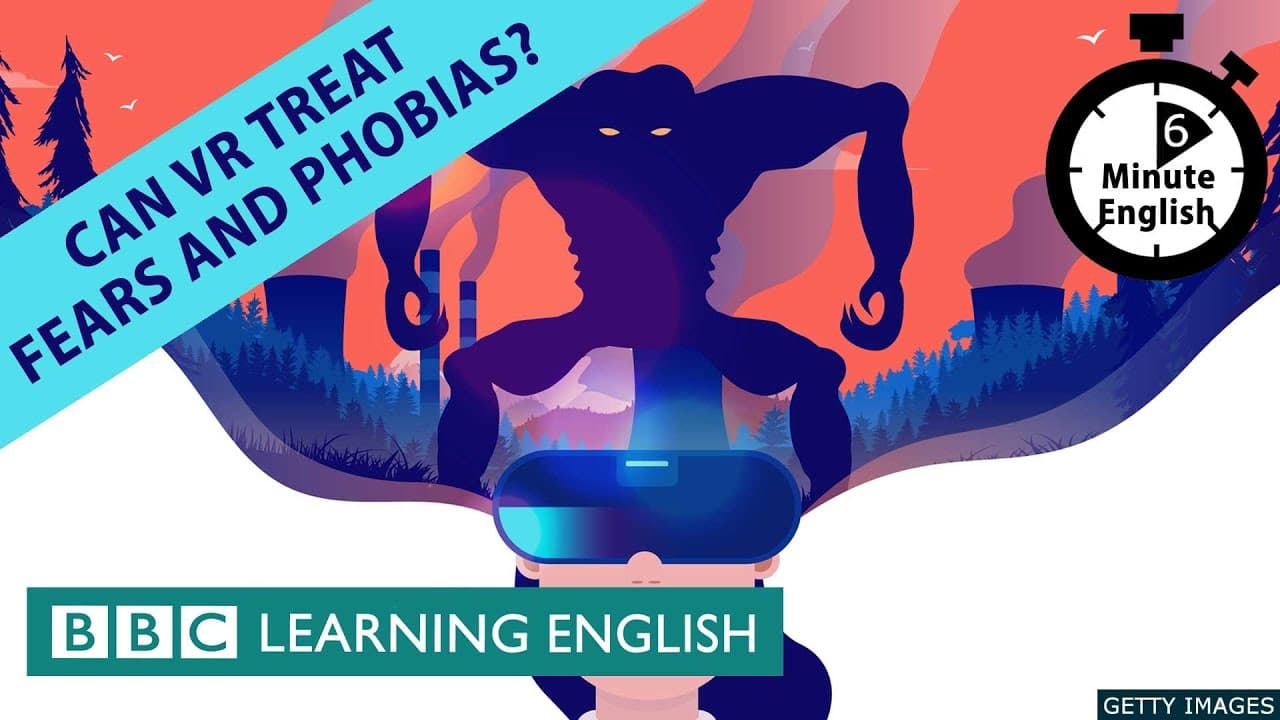
Can VR treat fears and phobias? - 6 Minute English
TL;DR
VR helps overcome phobias and addresses domestic violence issues.
Transcript
Hello. This is 6 Minute English from BBC Learning English. I'm Rob. And I'm Sam. Here at 6 Minute English, we love to chat about new technology. One of our favourite topics is VR or virtual reality, and the ways it's shaping life in the future. VR allows you to put on a headset and escape into a completely different world. In this programme, we'll ... Read More
Key Insights
- Virtual Reality (VR) is being used to address serious issues such as phobias and domestic violence, offering immersive experiences to help overcome these problems.
- Oxford VR's system helps individuals with acrophobia by simulating heights in a safe environment, gradually exposing them to higher elevations to reduce fear.
- VR experiences are intense and realistic, tricking the mind into reacting habitually, yet users know they are in a safe, simulated environment, aiding therapeutic outcomes.
- The concept of 'dropping your defenses' is crucial in VR therapy, allowing individuals to lower psychological barriers and engage with the experience for better results.
- In Barcelona, VR is used in prisons for 'virtual embodiment,' allowing offenders to experience situations from their victims' perspectives, increasing empathy and reducing recidivism.
- The 'virtual embodiment' project has shown success in reintegrating offenders back into society by making them experience abuse from a first-person perspective.
- VR's ability to provide novel experiences is pivotal in therapy, offering new and original ways to address psychological issues and behavior correction.
- The educational aspect of VR is highlighted through vocabulary teaching, enhancing understanding of terms like simulation, habitual, and novel in the context of VR technology.
Install to Summarize YouTube Videos and Get Transcripts
Explore YouTube Video Summarizer or Get YouTube Transcript Extractor
Questions & Answers
Q: How does Oxford VR help individuals with acrophobia?
Oxford VR helps individuals with acrophobia by creating a safe, simulated environment where users can gradually face their fear of heights. The system guides users through tasks that progressively increase in difficulty, such as taking an elevator to the top floor of a building or climbing a rope, allowing them to confront and reduce their fear safely.
Q: What is the concept of 'virtual embodiment' used in Barcelona prisons?
The 'virtual embodiment' concept used in Barcelona prisons involves using VR to allow offenders to experience situations from the perspective of their victims. By embodying the victims' experiences, offenders gain empathy and understanding of the impact of their actions, which helps in reducing recidivism and aiding their reintegration into society post-release.
Q: What role does the intensity of VR experiences play in therapy?
The intensity of VR experiences plays a crucial role in therapy by immersing users in realistic simulations that trigger habitual reactions. Despite knowing it's a simulation, the realistic nature of VR helps users confront their fears or behavioral issues in a controlled environment, making it an effective therapeutic tool for overcoming phobias and increasing empathy.
Q: How does VR help users 'drop their defenses' during therapy?
VR helps users 'drop their defenses' by providing a controlled, safe environment where they can lower their psychological barriers. Knowing they are not in real danger, users are more willing to engage with the experience, allowing them to confront fears or behavioral issues more openly and effectively, leading to better therapeutic outcomes.
Q: What is the impact of VR on increasing empathy among offenders?
VR has a significant impact on increasing empathy among offenders by allowing them to experience situations from their victims' perspectives. This immersive experience helps offenders understand the emotional and psychological impact of their actions, fostering empathy and reducing the likelihood of reoffending, thus aiding their reintegration into society.
Q: What makes VR a novel approach in therapy?
VR is a novel approach in therapy due to its ability to create immersive, realistic simulations that allow users to confront fears or behaviors in a safe environment. This innovative method offers new and original ways to address psychological issues, providing unique experiences that traditional therapy methods may not achieve.
Q: How does VR trick the mind into habitual reactions?
VR tricks the mind into habitual reactions by creating intense, realistic simulations that mimic real-life scenarios. Despite users being aware it's a simulation, the immersive nature of VR engages the mind's typical responses, allowing users to confront and work through their fears or behaviors as they would in real situations, aiding therapeutic progress.
Q: What educational benefits does VR offer in the context of language learning?
In the context of language learning, VR offers educational benefits by providing immersive environments where users can learn and practice vocabulary in context. By experiencing scenarios where terms like simulation, habitual, and novel are applied, users gain a deeper understanding and retention of language, enhancing their overall learning experience.
Summary & Key Takeaways
-
Virtual Reality (VR) is being utilized to address phobias and domestic violence by providing immersive experiences that help individuals confront and overcome these issues. By simulating real-life scenarios in a safe environment, VR aids in reducing irrational fears and increasing empathy among offenders.
-
Oxford VR's system helps individuals with acrophobia by gradually exposing them to simulated heights, allowing them to confront their fears safely. In Barcelona, VR is used in prisons to increase empathy among domestic violence offenders by having them experience situations from their victims' perspectives.
-
The immersive nature of VR tricks the mind into reacting habitually, yet users know they are in a safe simulation, aiding therapeutic outcomes. This novel approach enables users to drop psychological defenses, engage with the experience, and achieve better therapy results.
Read in Other Languages (beta)
Share This Summary 📚
Summarize YouTube Videos and Get Video Transcripts with 1-Click
Try YouTube Summary with ChatGPT & Claude or YouTube Transcript Generator
Explore More Summaries from BBC Learning English 📚

Summarize YouTube Videos and Get Video Transcripts with 1-Click
Try YouTube Summary with ChatGPT & Claude or YouTube Transcript Generator