What Is the Property of Group Homomorphisms?
TL;DR
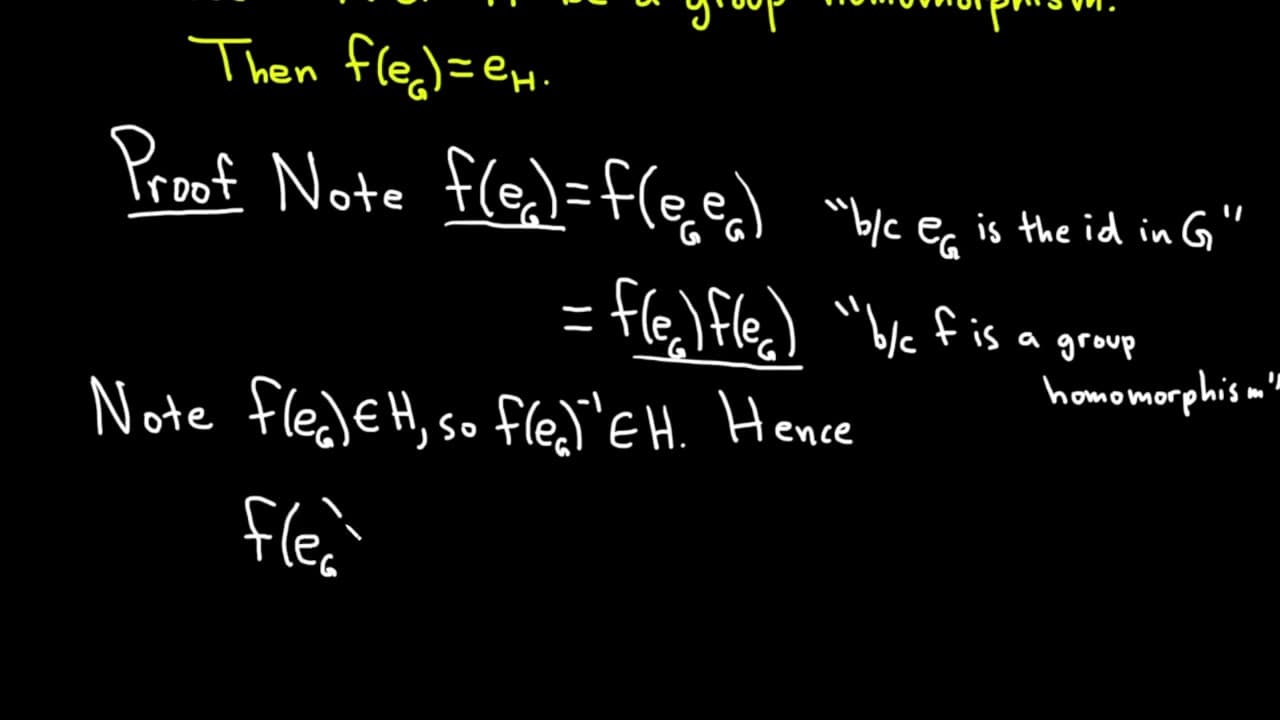
In a group homomorphism, the identity element from one group is always mapped to the identity element of the other group. This is proven by demonstrating that applying the homomorphism to the identity element in the first group yields the identity element in the second group, confirming a key property of homomorphisms.
Transcript
hello in this video we're going to do a proof we have a function f from g into H and we're told it is a group homomorphism and we're going to prove this equation here F of e sub G is equal to e sub H let me briefly explain this so by a group homomorphism we mean a map that has the property that's f of x y is equal to f of x times F of Y and this ha... Read More
Key Insights
- 🛀 The proof shows that a group homomorphism maps the identity element in G to the identity element in H.
- 👥 Basic group theory concepts are utilized in the proof.
- 👥 The proof highlights the importance of preserving the group structure in group homomorphisms.
- 👥 Inverse elements and the closure property of groups are crucial in the proof.
- ❓ Demonstrating all the steps in the proof provides a thorough understanding of each calculation.
- 💦 The video emphasizes the significance of writing down the reasoning and justifications in words during working on mathematical proofs.
- 🤩 Group homomorphisms exhibit a key property of mapping the identity element to the identity element.
Install to Summarize YouTube Videos and Get Transcripts
Explore YouTube Video Summarizer or Get YouTube Transcript Extractor
Questions & Answers
Q: What is a group homomorphism?
A group homomorphism is a function that preserves the group structure, meaning that the result of applying the function to the product of two elements is equal to the product of their images under the function.
Q: Why do we write F of EG as e sub G times e sub G?
To utilize the property of the identity element in G, which states that any element multiplied by the identity element results in the same element. Therefore, writing F of EG as e sub G times e sub G allows us to use this property in the proof.
Q: What is the significance of multiplying both sides by the inverse of F of EG?
The inverse exists because H is a group, and multiplying both sides by the inverse is a way to isolate F of EG on one side of the equation, allowing us to manipulate the elements and simplify the expression.
Q: Why is it important to show all the steps in the proof?
Showing all the steps helps understand the logic and reasoning behind each calculation. It ensures clarity and eliminates any confusion that may arise from skipping steps.
Summary & Key Takeaways
-
The video presents a proof for the equation: F of e sub G is equal to e sub H, where F is a group homomorphism, e sub G is the identity element in group G, and e sub H is the identity element in group H.
-
The proof utilizes basic group theory concepts and shows step-by-step calculations.
-
It concludes that group homomorphisms map the identity element to the identity element, establishing a key property of these mappings.
Read in Other Languages (beta)
Share This Summary 📚
Summarize YouTube Videos and Get Video Transcripts with 1-Click
Try YouTube Summary with ChatGPT & Claude or YouTube Transcript Generator
Explore More Summaries from The Math Sorcerer 📚


Summarize YouTube Videos and Get Video Transcripts with 1-Click
Try YouTube Summary with ChatGPT & Claude or YouTube Transcript Generator