What is the Double Marginalization Problem?
TL;DR
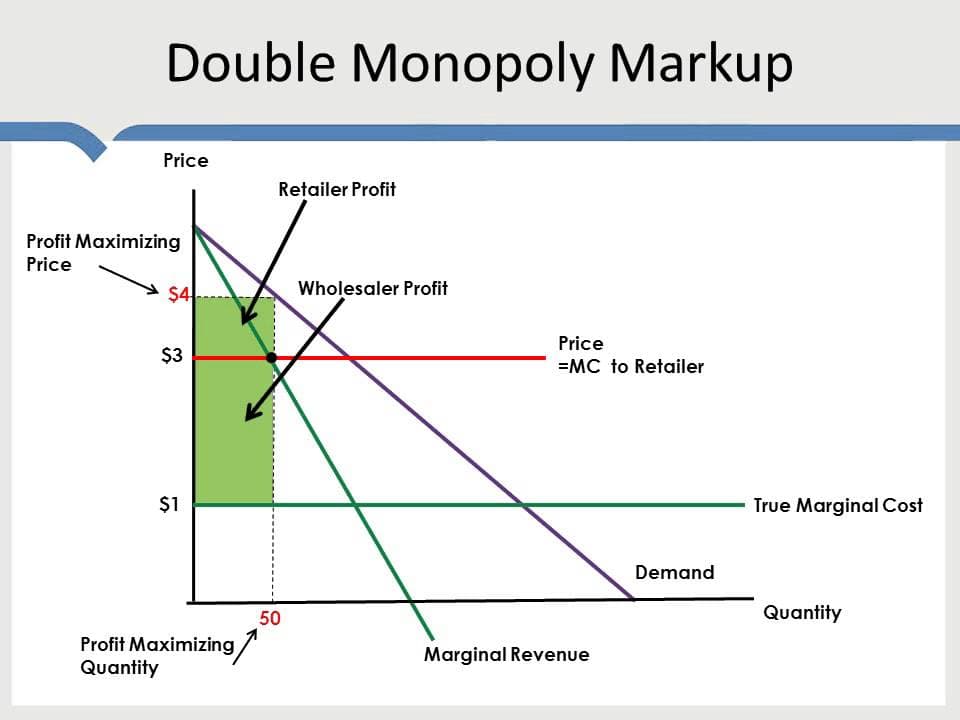
Double marginalization occurs when multiple monopolies in a supply chain set prices independently, leading to higher prices and reduced output than if a single monopoly controlled the entire chain. This inefficiency results in lower profits for the monopolies collectively and increased deadweight loss, making both monopolists and consumers worse off.
Transcript
today we deal with a classic problem in economics the double marginalization problem this has a lot of applications not just to development but also to industrial organization to Innovation Theory particularly about patents and to a lot of other different areas let's take a look we can get an intuitive understanding of the double marginalization Pr... Read More
Key Insights
- Double marginalization occurs when multiple monopolies in a supply chain set prices independently.
- This results in higher prices and reduced output compared to a single monopoly controlling the chain.
- Monopolists collectively earn lower profits due to uncoordinated pricing strategies.
- Consumers face higher prices and reduced availability of goods or services.
- Vertical integration of monopolies can improve social welfare by reducing prices and increasing output.
- Applications include industrial organization, innovation policy, and economic development.
- Monopolies in intermediate goods can significantly shrink economic output.
- Competitive markets in intermediate goods are crucial for economic growth and efficiency.
Install to Summarize YouTube Videos and Get Transcripts
Explore YouTube Video Summarizer or Get YouTube Transcript Extractor
Questions & Answers
Q: What is double marginalization?
Double marginalization is an economic problem that arises when multiple monopolies in a supply chain independently set prices. This leads to higher prices and reduced output compared to a scenario where a single monopoly controls the entire chain. The inefficiency results in lower total profits for the monopolists and increased deadweight loss, affecting both monopolists and consumers negatively.
Q: How does double marginalization affect prices?
Double marginalization causes prices to be higher than they would be if a single monopoly controlled the entire supply chain. Each monopoly in the chain sets its own price without considering the impact on other monopolies, leading to a cumulative increase in prices. This results in reduced consumer demand and lower overall output.
Q: Why is vertical integration beneficial in the context of double marginalization?
Vertical integration can be beneficial in the context of double marginalization because it allows a single entity to control multiple stages of the supply chain. This coordination can lead to lower prices and increased output, as the integrated monopoly can set prices that maximize overall profits rather than individual profits at each stage, improving social welfare.
Q: What are the implications of double marginalization for economic development?
In economic development, double marginalization can be particularly detrimental when it occurs in intermediate goods. Monopolies in these goods can significantly reduce economic output as their inefficiencies are propagated throughout the economy. Ensuring competitive markets in intermediate goods is crucial for economic growth and efficiency, highlighting the importance of policies that reduce monopolistic practices.
Q: How does double marginalization impact consumer welfare?
Double marginalization negatively impacts consumer welfare by resulting in higher prices and reduced availability of goods or services. As multiple monopolies independently set prices, the cumulative effect is that consumers face higher costs and less choice, leading to a decrease in consumer surplus and overall satisfaction.
Q: What role do monopolies in intermediate goods play in double marginalization?
Monopolies in intermediate goods play a significant role in double marginalization as they can have a more pronounced negative impact on the economy. Since intermediate goods are used to produce other goods, inefficiencies in their pricing and production can shrink economic output significantly, affecting multiple sectors and leading to broader economic inefficiencies.
Q: Can double marginalization be addressed through policy measures?
Yes, double marginalization can be addressed through policy measures that promote competition and reduce monopolistic practices. Policies that encourage vertical integration or facilitate competition in intermediate goods markets can help mitigate the problem. Ensuring competitive markets and reducing barriers to entry are crucial for minimizing inefficiencies and improving economic outcomes.
Q: What is the relationship between double marginalization and deadweight loss?
Double marginalization increases deadweight loss by creating inefficiencies in the market. As multiple monopolies independently set prices, the result is higher prices and reduced output, leading to a loss of economic efficiency. This deadweight loss represents the foregone consumer and producer surplus that could have been achieved under more efficient market conditions with coordinated pricing strategies.
Summary & Key Takeaways
-
Double marginalization is a problem where multiple monopolies in a supply chain independently set prices, leading to inefficiencies. This results in higher prices and lower output compared to a single monopoly controlling the entire chain. The inefficiency causes lower total profits for the monopolists and increased deadweight loss, negatively impacting both monopolists and consumers.
-
The problem is significant in areas like industrial organization, innovation policy, and economic development. Vertical integration of monopolies can mitigate the issue by reducing prices and increasing output, thereby improving social welfare. Monopolies in intermediate goods, in particular, can have a more pronounced negative impact on the economy.
-
Applications of the double marginalization problem highlight the importance of competitive markets in intermediate goods for economic growth. Monopolies in these areas can shrink economic output significantly. The problem underscores the need for policies that encourage competition and reduce inefficiencies in supply chains.
Read in Other Languages (beta)
Share This Summary 📚
Summarize YouTube Videos and Get Video Transcripts with 1-Click
Try YouTube Summary with ChatGPT & Claude or YouTube Transcript Generator
Explore More Summaries from Marginal Revolution University 📚


Summarize YouTube Videos and Get Video Transcripts with 1-Click
Try YouTube Summary with ChatGPT & Claude or YouTube Transcript Generator