NEET Physics Current Electricity : Multiple Choice Previous Years Questions MCQs 2
TL;DR
Understanding the relationship between potential differences and readings of voltmeters, calculating equivalent resistance, and determining the time needed for electroplating.
Transcript
Hello friends this video on neat current electricity is brought to you by exam fear.com no more fear from exam look at question number four a B and C are voltmeters of resistance R 1.5 R and 3 R so here a is a voltmeter of resistance R B has resistance 1.5 R and C has Resistance 3 R when some potential difference is applied between X and Y then the... Read More
Key Insights
- ❓ The potential differences across voltmeters in parallel are the same.
- 🔂 Equivalent resistance can be calculated by replacing parallel resistances or voltmeters with a single resistance.
- 👮 The current supplied by a battery can be determined using Ohm's law.
Install to Summarize YouTube Videos and Get Transcripts
Explore YouTube Video Summarizer or Get YouTube Transcript Extractor
Questions & Answers
Q: How can you determine the relationship between the potential differences of voltmeters A, B, and C in the circuit?
The potential differences across voltmeters A, B, and C are the same because B and C are in parallel. Thus, VA = VB = VC.
Q: How can you simplify the circuit and calculate the equivalent resistance?
By replacing voltmeters B and C with a single resistance (R parallel), which is equal to R, the circuit can be simplified, and the equivalent resistance can be calculated.
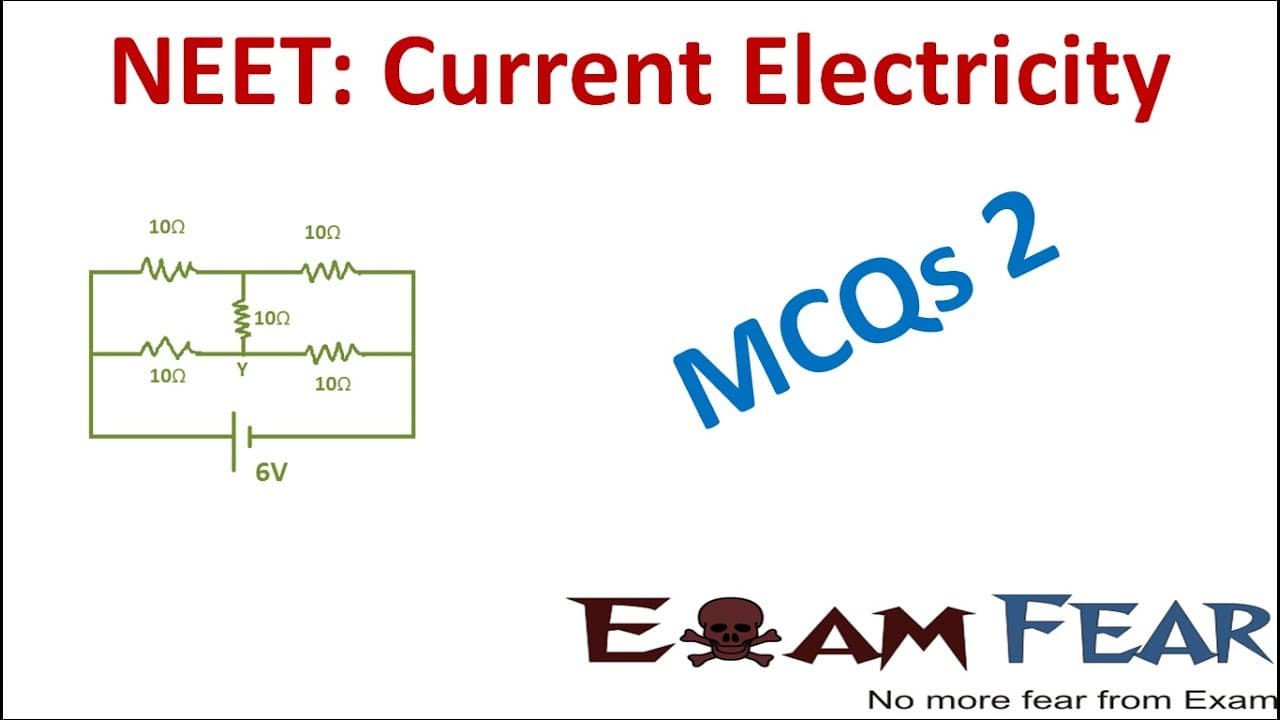
Q: In question number five, how is the current supplied by the battery calculated?
First, the equivalent resistance of the circuit is calculated by considering the Wheatstone Bridge arrangement. Then, using Ohm's law (I = V/R), the current is determined as 0.6 A.
Q: How is the time needed for electroplating calculated in question number six?
The weight of silver to be deposited is determined as 0.375 g. Using the electrochemical equivalent of silver (11.8 x 10^-7 kg/C), the current (0.8 A), and the formula t = m/(ECE * I), the time is calculated as 397 seconds or 6 minutes and 37 seconds.
Summary & Key Takeaways
-
The video explains the relationship between potential differences and voltmeter readings in a circuit with multiple voltmeters.
-
The concept of equivalent resistance is introduced, and the process of calculating it is shown.
-
The video also demonstrates how to calculate the time needed for electroplating a metal plate with a specific weight of silver.
Read in Other Languages (beta)
Share This Summary 📚
Summarize YouTube Videos and Get Video Transcripts with 1-Click
Try YouTube Summary with ChatGPT & Claude or YouTube Transcript Generator
Explore More Summaries from LearnoHub - Class 11, 12 📚




Summarize YouTube Videos and Get Video Transcripts with 1-Click
Try YouTube Summary with ChatGPT & Claude or YouTube Transcript Generator