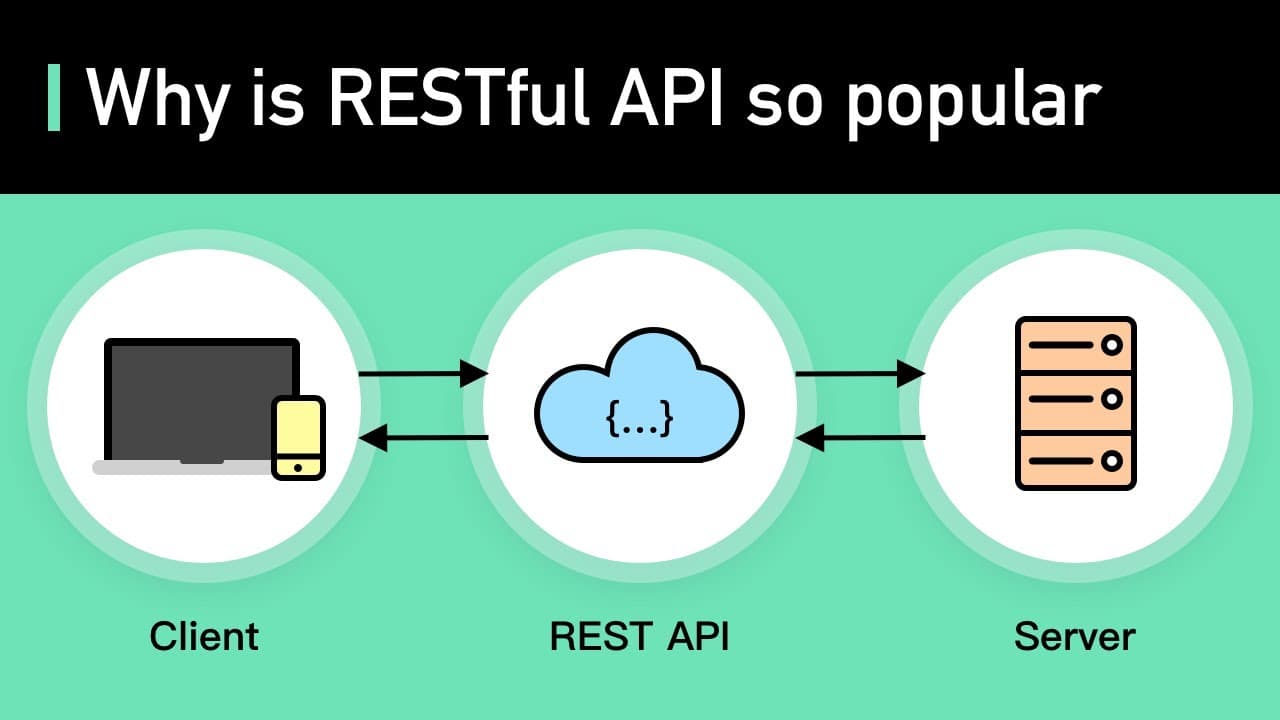
What Is REST API? Examples And How To Use It: Crash Course System Design #3
TL;DR
REST is a widely-used API standard for web communication.
Transcript
REST is the most common communication standard between computers over Internet. What is it? Why is it so popular? Let's take a look. API stands for Application Programming Interface. It is a way for two computers to talk to each other. The common API standard used by most mobile and web applications to talk to the servers is called... Read More
Key Insights
- REST is a popular API standard for communication between computers, especially for web and mobile applications, due to its simplicity and effectiveness.
- REST stands for REpresentational State Transfer and is a set of rules rather than a specification, making it flexible for developers.
- A RESTful API organizes resources into unique URIs, which are accessed using HTTP verbs like GET, POST, PUT, and DELETE.
- The CRUD operations (Create, Read, Update, Delete) are fundamental to RESTful APIs, with each operation corresponding to an HTTP verb.
- RESTful APIs should be stateless, meaning each request and response is independent, facilitating scalability and simplicity.
- Proper use of HTTP status codes in RESTful APIs helps clients understand the result of their requests, with codes indicating success, client errors, or server errors.
- Pagination and versioning are important aspects of RESTful APIs, ensuring efficient data handling and backward compatibility.
- While REST is widely used, other API options like GraphQL and gRPC are also popular and will be discussed in future content.
Install to Summarize YouTube Videos and Get Transcripts
Explore YouTube Video Summarizer or Get YouTube Transcript Extractor
Questions & Answers
Q: What is REST and why is it popular?
REST, or REpresentational State Transfer, is a set of rules for building web APIs. It is popular because it simplifies communication between computers, especially for web and mobile applications, by organizing resources into unique URIs and using standard HTTP methods for operations.
Q: How does a RESTful API organize resources?
A RESTful API organizes resources into a set of unique URIs, or Uniform Resource Identifiers. These URIs differentiate different types of resources on a server, allowing clients to interact with them using HTTP verbs like GET, POST, PUT, and DELETE.
Q: What is the significance of HTTP status codes in RESTful APIs?
HTTP status codes in RESTful APIs are crucial for indicating the outcome of a client's request. They inform the client whether the request was successful, encountered a client-side error, or faced a server-side issue, helping clients understand and handle responses appropriately.
Q: Why is statelessness important in RESTful APIs?
Statelessness in RESTful APIs is important because it ensures that each request and response cycle is independent of others. This simplifies the architecture, enhances scalability, and reduces the server's burden of maintaining session state, making applications easier to manage and deploy.
Q: What role do CRUD operations play in RESTful APIs?
CRUD operations—Create, Read, Update, Delete—are fundamental to RESTful APIs. Each operation corresponds to an HTTP verb: POST for creating, GET for reading, PUT for updating, and DELETE for removing resources. These operations provide a standardized way to interact with resources.
Q: How do pagination and versioning enhance RESTful APIs?
Pagination and versioning are essential for managing RESTful APIs efficiently. Pagination helps handle large datasets by breaking them into manageable chunks, while versioning ensures backward compatibility, allowing clients to transition smoothly between different API versions without disrupting services.
Q: What are some alternatives to REST for APIs?
Alternatives to REST for APIs include GraphQL and gRPC. GraphQL offers flexible queries and efficient data retrieval, while gRPC provides high-performance communication with support for multiple programming languages. These alternatives cater to specific needs and use cases beyond REST's capabilities.
Q: What makes a RESTful API 'well-behaved'?
A 'well-behaved' RESTful API adheres to principles like using proper HTTP status codes, being stateless, organizing resources by nouns, implementing pagination, and versioning. These practices ensure the API is reliable, scalable, and easy to use, providing a seamless experience for developers and clients.
Summary & Key Takeaways
-
REST is a widely adopted API standard that facilitates communication between computers, especially for web and mobile applications. It is not a specification but a set of rules that organize resources into unique URIs accessed via HTTP verbs.
-
RESTful APIs are characterized by CRUD operations, statelessness, and the use of HTTP status codes to indicate the success or failure of requests. This makes them scalable and easy to implement for developers.
-
Pagination and versioning are crucial for managing large datasets and ensuring backward compatibility in RESTful APIs. While REST is popular, other options like GraphQL and gRPC offer alternative solutions for specific needs.
Read in Other Languages (beta)
Share This Summary 📚
Summarize YouTube Videos and Get Video Transcripts with 1-Click
Try YouTube Summary with ChatGPT & Claude or YouTube Transcript Generator
Explore More Summaries from ByteByteGo 📚



Summarize YouTube Videos and Get Video Transcripts with 1-Click
Try YouTube Summary with ChatGPT & Claude or YouTube Transcript Generator