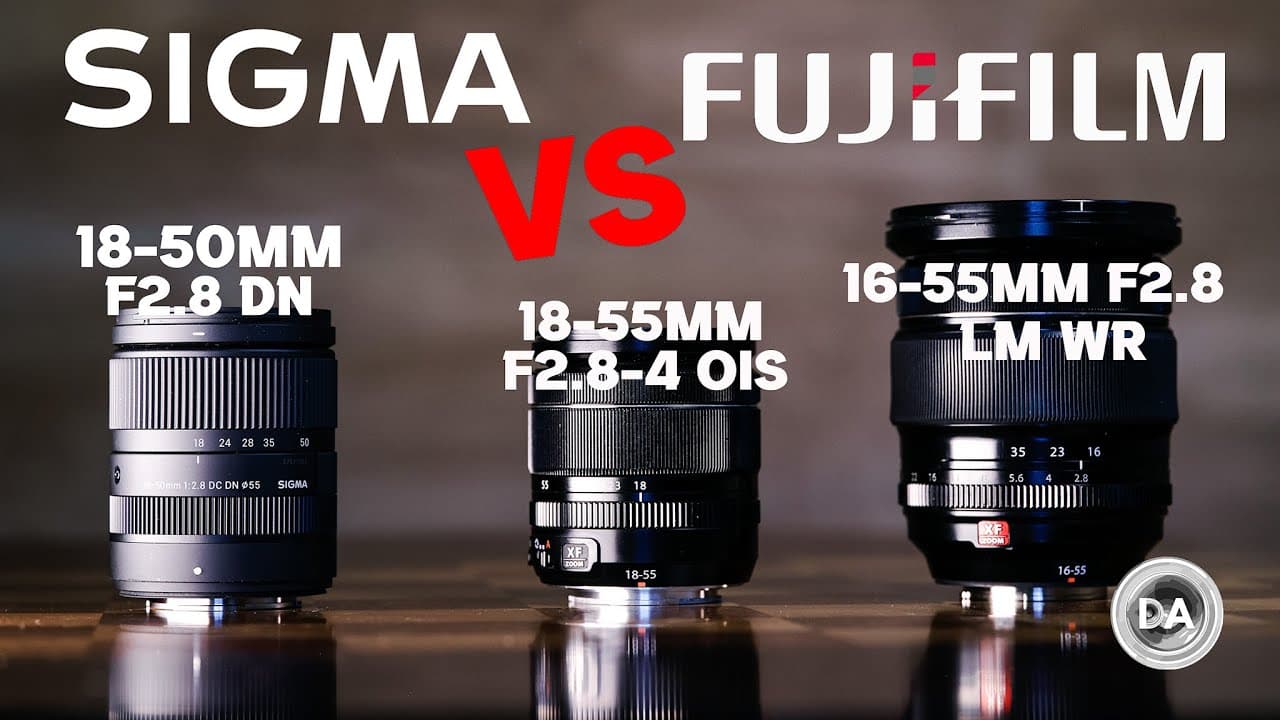
Sigma 18-50mm vs Fuji 16-55mm vs Fuji 18-55mm | Which Handles 40MP Best?
TL;DR
Sigma lens outperforms Fuji lenses on Fuji's 40MP sensor.
Transcript
Read and summarize the transcript of this video on Glasp Reader (beta).
Key Insights
- Fuji's 40MP sensor significantly impacts lens performance, revealing weaknesses in older lenses once considered sharp.
- The Sigma 18-50mm lens, despite its smaller size and lower price, offers the best optical performance on the 40MP sensor.
- Fuji's 16-55mm lens provides the best zoom range and professional build but is heavy and expensive.
- The Fuji 18-55mm lens, while compact and featuring optical stabilization, struggles with lower contrast and older autofocus technology.
- Sigma's lens excels in autofocus for stills, showing confidence and speed, outperforming Fuji's older linear motor technology.
- For video, Fuji's 16-55mm lens shows the least amount of warping during zoom but suffers from focus pulsing.
- The Sigma lens provides the best bokeh quality, with smoother out-of-focus areas compared to Fuji lenses.
- Fuji lenses show better control over chromatic aberration and vignetting, but the Sigma lens wins in overall image sharpness.
Install to Summarize YouTube Videos and Get Transcripts
Explore YouTube Video Summarizer or Get YouTube Transcript Extractor
Questions & Answers
Q: What is the main challenge presented by Fuji's new 40MP sensor?
Fuji's new 40MP sensor presents a challenge by revealing the limitations of older lenses that were previously considered sharp. The increased resolution demands higher optical performance, causing some lenses to fall short in sharpness and image quality compared to newer models.
Q: How does the Sigma 18-50mm lens compare to the Fuji lenses?
The Sigma 18-50mm lens outperforms the Fuji lenses in terms of optical performance on Fuji's 40MP sensor. It is the most modern lens, offering better autofocus for stills, superior image sharpness, and smoother bokeh, all while being more compact and affordable than its Fuji counterparts.
Q: What are the strengths of the Fuji 16-55mm lens?
The Fuji 16-55mm lens offers the best zoom range and a professional-grade build with full weather sealing. It has a fully functional aperture ring and performs well in controlling chromatic aberration and vignetting. However, it is the heaviest and most expensive lens in the comparison.
Q: Why might someone choose the Fuji 18-55mm lens?
Someone might choose the Fuji 18-55mm lens if they prioritize compact size and optical stabilization, especially if they use an older camera without in-body image stabilization. It can be a cost-effective option when purchased as part of a camera kit, although it struggles with lower contrast and older autofocus technology.
Q: How does autofocus performance differ between the lenses?
The Sigma 18-50mm lens offers the best autofocus performance for stills, with less pulsing and faster speed. In contrast, the Fuji lenses, despite having linear motors, show their age and have less confidence in focus acquisition. For video, the Fuji 16-55mm lens performs better, though all lenses show some limitations.
Q: What are the differences in video performance among the lenses?
In video performance, the Fuji 16-55mm lens shows the least warping during zoom but suffers from focus pulsing. The Fuji 18-55mm lens performs well in focus pulls but shows noticeable warping. The Sigma lens is stable for static shots but has visible steps in focus transitions and significant warping during zoom.
Q: Which lens offers the best bokeh quality?
The Sigma 18-50mm lens offers the best bokeh quality, providing smoother out-of-focus areas without any peculiarities in specular highlights. The Fuji 16-55mm lens has the busiest bokeh, while the Fuji 18-55mm lens produces smoother bokeh but with less blur due to its variable aperture.
Q: What are the potential future developments for Fuji lenses?
Future developments for Fuji lenses may include replacements for the aging Fuji zooms, as they are starting to show their limitations on higher resolution bodies. Rumors suggest a new 16-55mm f2.8-f4 lens is on the way, indicating Fuji's awareness of the need for more modern optics to handle the 40MP sensor.
Summary & Key Takeaways
-
Fuji's new 40MP sensor challenges older lenses, revealing their limitations in sharpness and overall image quality.
-
The Sigma 18-50mm lens, despite being the least expensive, offers superior optical performance and modern features.
-
Fuji's 16-55mm lens is ideal for those prioritizing zoom range and build quality, but it is heavy and costly.
Read in Other Languages (beta)
Share This Summary 📚
Summarize YouTube Videos and Get Video Transcripts with 1-Click
Try YouTube Summary with ChatGPT & Claude or YouTube Transcript Generator
Explore More Summaries from Dustin Abbott 📚
Summarize YouTube Videos and Get Video Transcripts with 1-Click
Try YouTube Summary with ChatGPT & Claude or YouTube Transcript Generator