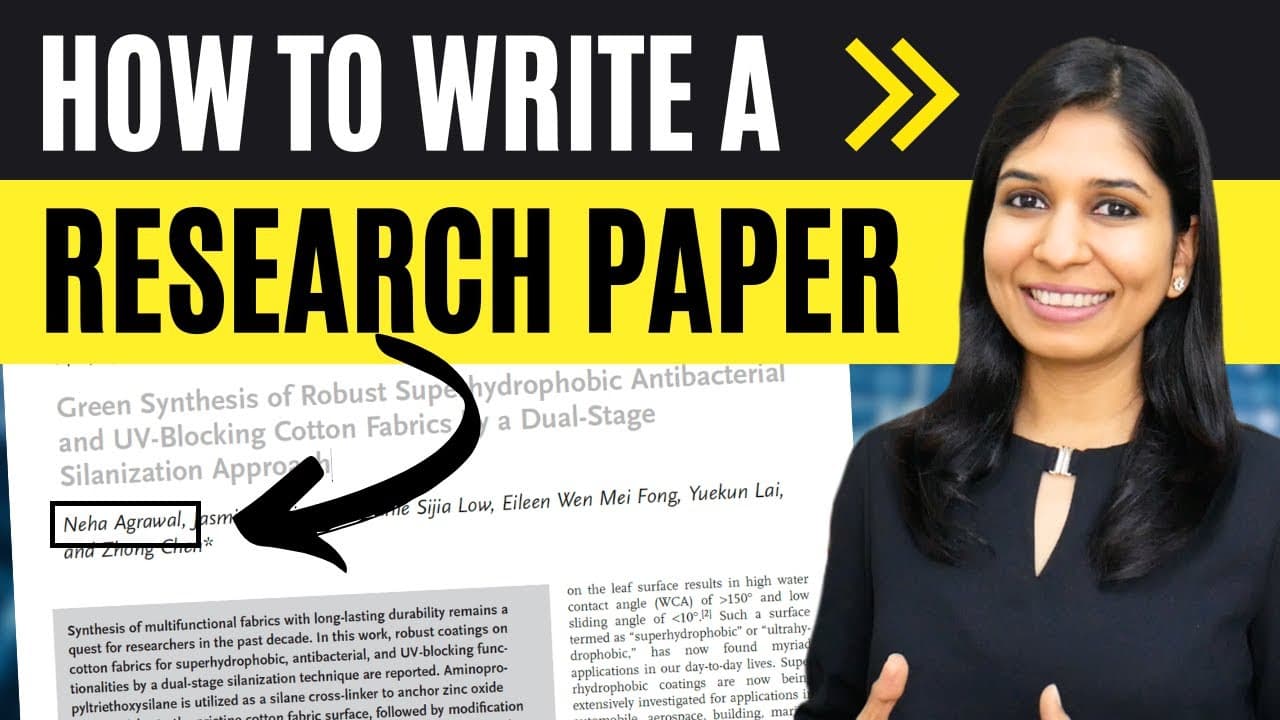
HOW TO WRITE A RESEARCH PAPER | Steps to writing a research paper | Research paper sections
TL;DR
Learn to write a research paper from start to finish.
Transcript
Read and summarize the transcript of this video on Glasp Reader (beta).
Key Insights
- Choosing a research topic is crucial and can be approached by consulting professors, reviewing university research areas, or identifying a research gap in existing literature.
- Conducting research involves experimental or theoretical work to arrive at novel findings that contribute to the field.
- A research paper follows a conventional structure: Introduction, Materials and Methods, Results and Discussion, and Conclusion, known as the IMRDC structure.
- The abstract is a concise summary of the research paper, highlighting key sections within a 250-300 word limit, influencing readers' decisions to read further.
- The introduction section provides background, existing evidence, research gap, objectives, and scope of the study, making a strong first impression.
- The materials and methods section describes the experimental process in detail, ensuring replicability and reliability of results.
- The results and discussion section presents data, interprets results, and discusses their significance in the context of current research.
- The conclusion section reiterates the study's objectives, reviews key findings, discusses broader applications, and suggests future research directions.
Install to Summarize YouTube Videos and Get Transcripts
Explore YouTube Video Summarizer or Get YouTube Transcript Extractor
Questions & Answers
Q: What is the first step in writing a research paper?
The first step in writing a research paper is choosing a research topic. This can be done by consulting professors for guidance, reviewing university research areas, or identifying a research gap in existing literature. It's essential to select a topic that is novel and contributes to the field.
Q: Why is the abstract important in a research paper?
The abstract is crucial because it serves as a concise summary of the entire research paper, highlighting the key sections: introduction, materials and methods, results and discussion, and conclusion. It helps readers decide whether to read the full paper and must be written within a 250-300 word limit.
Q: How are the introduction and conclusion sections interconnected?
The introduction and conclusion sections are interconnected because the introduction sets the stage by presenting the study's motivation, background, and research problem. The conclusion revisits these elements by summarizing the study's findings, implications, and contributions, creating a cohesive narrative that ties the paper together.
Q: What should be included in the materials and methods section?
The materials and methods section should include a detailed description of the experimental process, listing the materials used, step-by-step procedures, and any equipment or instruments employed. This section ensures the reliability of the research by allowing others to replicate the experiments and verify the results.
Q: What is the purpose of the results and discussion section?
The results and discussion section presents the data collected during the research, interprets the results, and discusses their significance in the context of current research. It explains what the data means and how it helps overcome the research gap, providing insights into the study's contributions to the field.
Q: How does the conclusion section contribute to a research paper?
The conclusion section contributes by reiterating the study's objectives, reviewing key findings, discussing broader applications and implications, and suggesting future research directions. It reminds readers of the research's purpose and achievements, providing closure and highlighting the study's impact on the field.
Q: Why is it important to provide references in a research paper?
Providing references is important because it gives credit to the sources and literature that informed the research. It demonstrates the paper's foundation on existing knowledge, enhances its credibility, and allows readers to verify and explore the cited information. Proper citation also avoids plagiarism and adheres to academic standards.
Q: What additional resources does Neha Agrawal offer for research writing?
Neha Agrawal offers a research writing course that delves into writing each section of a research paper, citing and referencing information, avoiding plagiarism, and choosing the right journal for publication. The course aims to enhance research writing skills, making participants more competitive for job opportunities and higher education.
Summary & Key Takeaways
-
This video by Neha Agrawal provides a comprehensive guide to writing a research paper, covering the process from choosing a topic to writing each section. The conventional structure of a research paper, known as IMRDC, is explained in detail, emphasizing the interconnectedness of its sections.
-
The importance of a well-written abstract and introduction is highlighted, as they set the stage for the rest of the paper. The video also discusses the significance of the materials and methods section in ensuring the reliability of the research through replicable experiments.
-
Neha Agrawal offers a research writing course for those interested in further learning. The video encourages viewers to explore additional resources and join the course to enhance their research writing skills and improve their chances of publication.
Read in Other Languages (beta)
Share This Summary 📚
Summarize YouTube Videos and Get Video Transcripts with 1-Click
Try YouTube Summary with ChatGPT & Claude or YouTube Transcript Generator
Explore More Summaries from WiseUp Communications 📚





Summarize YouTube Videos and Get Video Transcripts with 1-Click
Try YouTube Summary with ChatGPT & Claude or YouTube Transcript Generator