Duplexer | Balanced type | Radar Systems | Lec-65
TL;DR
This video explains balancer type duplexers and their function in separating transmitting and receiving signals.
Transcript
hi everyone in this video I am going to explain about second type of duplexer that is balancer type duplexer in the previous video I have explained the first type of duplexer which is known as Branch type duplexer so generally what do you mean by a duplexer what is the purpose of duplexer in the transmission line duplexer is used to separate or iso... Read More
Key Insights
- 📡 Duplexers are critical in systems where both transmission and reception share a single antenna to prevent interference.
- 🧪 Balancer type duplexers exclusively use TR tubes, making them distinct from branch type duplexers which utilize both TR and ATR tubes.
- ✋ Proper design of the duplexer is essential to ensure that high power signals do not compromise the sensitivity of receivers.
- 📡 Waveguides in duplexers facilitate the efficient transfer of signals while maintaining separation between transmitted and received signals.
- 🤩 The short slot hybrid junction in balancer duplexers plays a key role in coupling power between different waveguides.
- 🧪 By utilizing specialized components like TR tubes, duplexers can effectively isolate signals, improving overall communication quality.
- 💦 Understanding the mechanics of duplexers is vital for engineering students and professionals working in telecommunications.
Install to Summarize YouTube Videos and Get Transcripts
Explore YouTube Video Summarizer or Get YouTube Transcript Extractor
Questions & Answers
Q: What is a duplexer, and what purpose does it serve in transmission lines?
A duplexer is a microwave device designed to separate or isolate transmitting signals from receiving signals when using a single antenna for both functions. It ensures that powerful transmission signals do not damage sensitive receivers, allowing for efficient communication.
Q: What are the two types of duplexers mentioned in the content?
The two types of duplexers discussed are Branch type duplexers and Balancer type duplexers. Each type utilizes TR and ATR tubes but differs in construction and signal processing mechanisms, with balancer type duplexers focusing on using TR tubes exclusively.
Q: How do TR and ATR tubes function within a duplexer?
TR and ATR tubes are gas discharge components that respond to high-powered signals. When exposed to such signals, TR tubes behave like short circuits, preventing excess power from damaging sensitive receivers and ensuring that only the appropriate signals pass through during transmission and reception.
Q: Describe the construction and function of the balancer type duplexer.
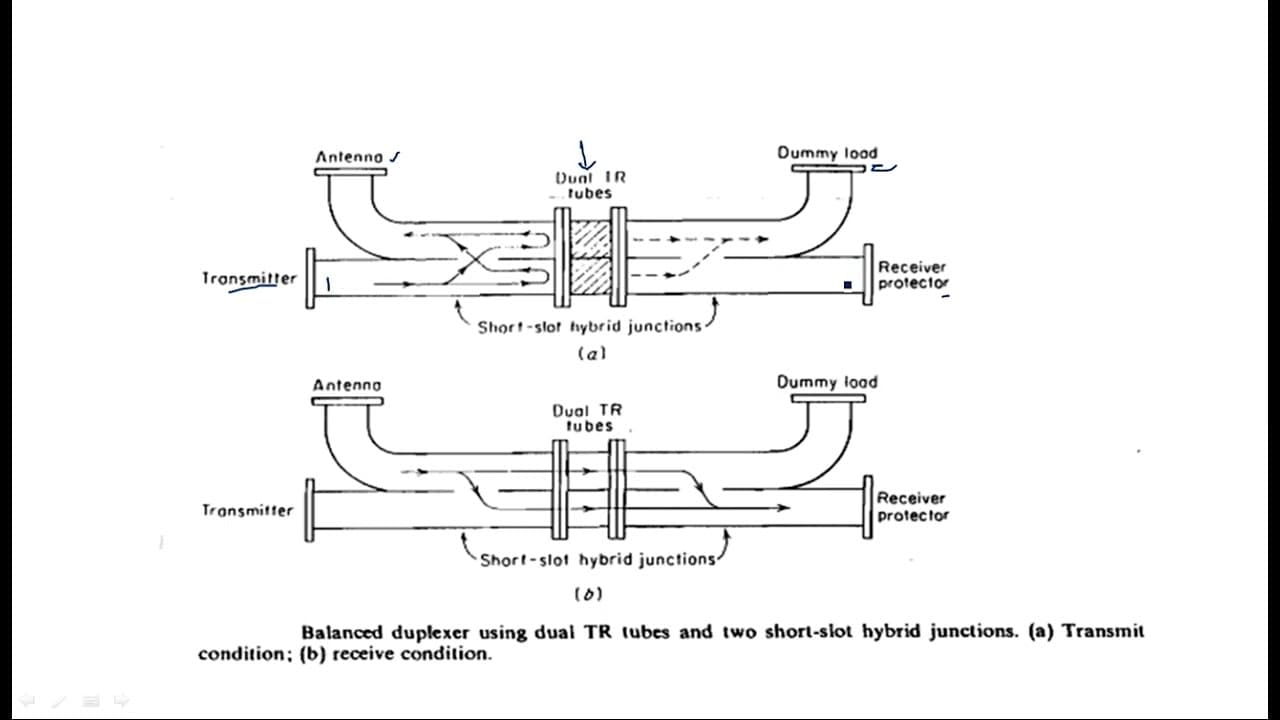
A balancer type duplexer consists of two waveguides coupled via a short slot hybrid junction. It has four ports, connecting a transmitter, antenna, receiver protector, and dummy load. This arrangement facilitates the separation of transmitting and receiving signals without interference while maintaining signal integrity.
Q: What happens during transmission in a balancer type duplexer?
During transmission, high power signals from the transmitter interact with TR tubes, which act as short circuits to prevent excess energy from reaching the receiver. The power is reflected back and directed towards the antenna, ensuring effective transmission while safeguarding the receiver.
Q: How do weak signals during reception manage to reach the receiver in a balancer type duplexer?
During reception, the antenna collects weak signals, which travel in a forward direction. Since the TR tubes do not fire due to low power, they act as open circuits. This allows weak signals to pass through to the receiver while avoiding disruption from transmitted signals.
Summary & Key Takeaways
-
The balancer type duplexer isolates transmitting and receiving signals using specialized TR tubes, ensuring efficient communication without damaging sensitive receivers.
-
It comprises four ports connected to a transmitter, antenna, receiver protector, and dummy load, utilizing waveguides to couple power effectively during transmission and reception.
-
During transmission, high power signals are diverted from receivers through short circuits created by TR tubes, while during reception, weak signals are allowed to pass through to the receiver.
Read in Other Languages (beta)
Share This Summary 📚
Summarize YouTube Videos and Get Video Transcripts with 1-Click
Try YouTube Summary with ChatGPT & Claude or YouTube Transcript Generator