L04.2 The Counting Principle
TL;DR
The counting principle and permutations are basic but powerful tools for solving counting problems.
Transcript
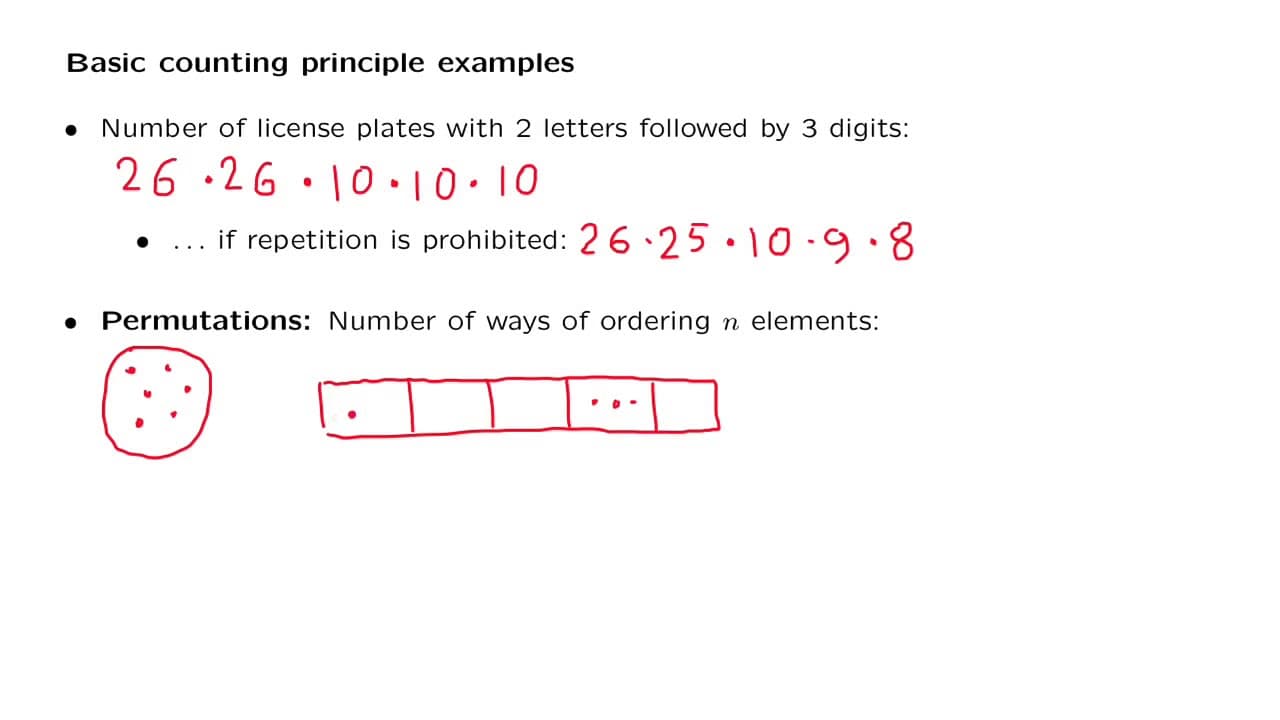
In this segment we introduce a simple but powerful tool, the basic counting principle, which we will be using over and over to deal with counting problems. Let me describe the idea through a simple example. You wake up in the morning and you find that you have in your closet 4 shirts, 3 ties, and 2 jackets. In how many different ways can you get dr... Read More
Key Insights
- 🔨 The counting principle is a powerful tool for solving counting problems by multiplying the number of choices at each stage.
- 👷 Understanding permutations is important for solving problems that involve arranging elements or constructing subsets.
- #️⃣ Factorial notation (n!) is used to denote the product of integers from 1 to n, which represents the number of permutations.
Install to Summarize YouTube Videos and Get Transcripts
Explore YouTube Video Summarizer or Get YouTube Transcript Extractor
Questions & Answers
Q: What is the counting principle?
The counting principle is a simple concept that involves multiplying the number of choices at each stage to find the total number of possibilities. It is a useful tool for solving counting problems.
Q: How can the counting principle be applied to the example of outfit combinations?
In the example, the number of outfit combinations is found by multiplying the number of choices for the shirt (4), the tie (3), and the jacket (2). This gives a total of 24 possible combinations.
Q: What is a permutation?
A permutation involves arranging elements in a set or constructing a subset. It is often denoted using factorial notation (n!), where n represents the number of elements or choices.
Q: How can permutations be calculated using factorial notation?
The number of permutations can be calculated by taking the product of all integers from 1 to n. This is represented by n!, which equals the total number of permutations.
Summary & Key Takeaways
-
The counting principle is a simple tool used to solve counting problems and involves multiplying the number of choices at each stage.
-
In the example given, choosing a shirt, tie, and jacket, the number of outfit combinations is found by multiplying the number of choices at each stage.
-
Permutations involve arranging elements in a set or constructing a subset, and the number of permutations can be found using factorial notation.
Read in Other Languages (beta)
Share This Summary 📚
Summarize YouTube Videos and Get Video Transcripts with 1-Click
Try YouTube Summary with ChatGPT & Claude or YouTube Transcript Generator
Explore More Summaries from MIT OpenCourseWare 📚



Summarize YouTube Videos and Get Video Transcripts with 1-Click
Try YouTube Summary with ChatGPT & Claude or YouTube Transcript Generator