Introduction to Business Statistics: Lesson #1
TL;DR
A primer on statistics, covering key concepts and types.
Transcript
Read and summarize the transcript of this video on Glasp Reader (beta).
Key Insights
- Statistics can be both a noun and a verb, but in this context, it is used as a verb to describe the process of collecting, organizing, and interpreting data to make decisions.
- Descriptive statistics involve organizing, summarizing, and presenting data in a meaningful way, using measures like mean, median, and mode to describe data sets.
- Inferential statistics allow predictions and decisions about a population based on a sample, such as estimating the average age of students from a college sample.
- The population refers to the entire group, while a sample is a subset of that population, often selected randomly for analysis.
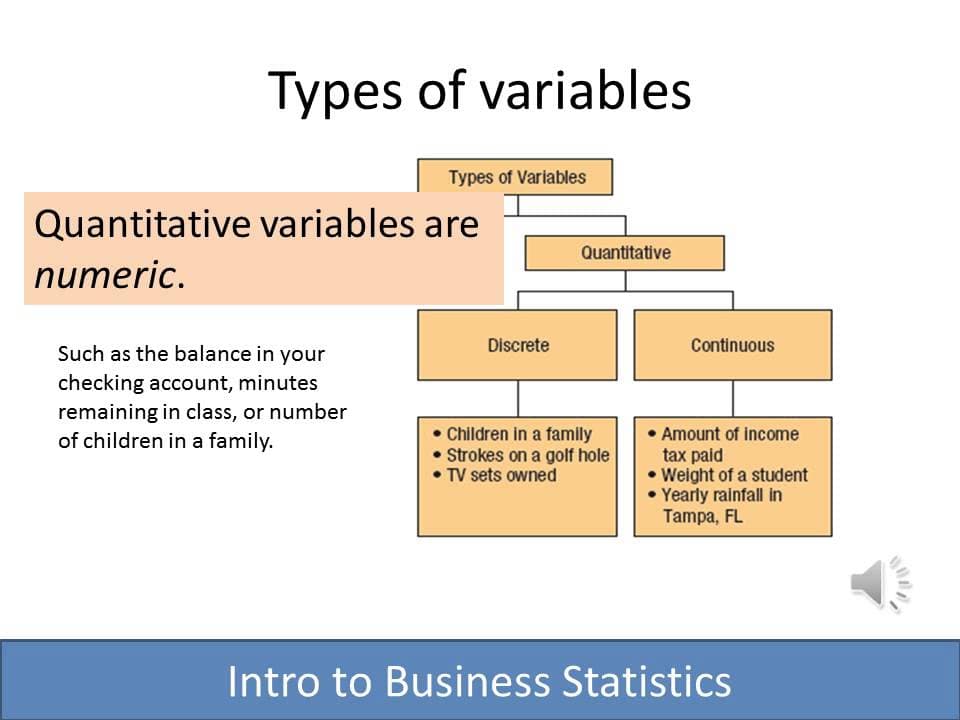
- Variables in statistics can be qualitative or quantitative, with qualitative variables being non-numeric and quantitative variables being numeric.
- Quantitative variables are further divided into discrete variables, which are whole numbers, and continuous variables, which can take any value within a range.
- There are four levels of measurement for quantitative variables: nominal, ordinal, interval, and ratio, each with distinct characteristics and applications.
- Understanding the differences between variable types and measurement scales is crucial for effective statistical analysis and interpretation.
Install to Summarize YouTube Videos and Get Transcripts
Explore YouTube Video Summarizer or Get YouTube Transcript Extractor
Questions & Answers
Q: What is the primary focus of descriptive statistics?
Descriptive statistics focus on organizing, summarizing, and presenting data in a meaningful way. It involves using measures like mean, median, and mode to describe and interpret data sets, providing a clear overview of the data's characteristics without making predictions.
Q: How are inferential statistics different from descriptive statistics?
Inferential statistics differ from descriptive statistics as they involve making predictions and decisions about a population based on a sample. While descriptive statistics summarize and describe data, inferential statistics use samples to make broader generalizations and inferences about the entire population.
Q: What are qualitative variables, and how are they used in statistics?
Qualitative variables are non-numeric and describe characteristics or categories, such as gender or feelings about a college. While they don't lend themselves easily to numerical analysis, some can be converted into numeric values for limited statistical analysis, such as assigning numbers to gender categories.
Q: Can you explain the difference between discrete and continuous variables?
Discrete variables are quantitative variables that take on whole numbers, such as the number of children in a family. Continuous variables, on the other hand, can take any value within a range, like the weight of an item, allowing for more precise measurement and analysis.
Q: What are the four levels of measurement for quantitative variables?
The four levels of measurement for quantitative variables are nominal, ordinal, interval, and ratio. Nominal involves classification without inherent order, ordinal involves ranked order, interval has meaningful differences between values, and ratio includes a true zero point, allowing for a full range of mathematical operations.
Q: How does the concept of population differ from a sample in statistics?
In statistics, a population refers to the entire group of individuals or items being studied, while a sample is a subset of that population selected for analysis. Samples are used to make inferences about the population without studying every member, often chosen randomly to ensure representativeness.
Q: Why is it important to understand variable types and measurement scales?
Understanding variable types and measurement scales is crucial for effective statistical analysis and interpretation. Different types and scales determine the appropriate statistical methods and tools, ensuring accurate analysis and meaningful conclusions, especially when dealing with complex data sets in research and decision-making.
Q: What role do surveys play in statistical analysis?
Surveys play a significant role in statistical analysis by collecting data on various variables from a sample of the population. They help gather information on characteristics like age, number of siblings, and credits taken, serving as a basis for both descriptive and inferential statistics to understand and make decisions about the population.
Summary & Key Takeaways
-
This lesson introduces statistics as a process for collecting, organizing, and interpreting data to make informed decisions. It highlights the importance of descriptive statistics in summarizing data and inferential statistics in making predictions about populations.
-
The course covers the distinction between qualitative and quantitative variables, explaining how qualitative variables are non-numeric while quantitative variables are numeric and can be discrete or continuous.
-
Four levels of measurement for quantitative variables are discussed: nominal, ordinal, interval, and ratio. Each level has unique characteristics and applications, emphasizing the importance of understanding these differences for statistical analysis.
Read in Other Languages (beta)
Share This Summary 📚
Summarize YouTube Videos and Get Video Transcripts with 1-Click
Try YouTube Summary with ChatGPT & Claude or YouTube Transcript Generator
Explore More Summaries from Luther Maddy - Helping Humans Learn 📚

Summarize YouTube Videos and Get Video Transcripts with 1-Click
Try YouTube Summary with ChatGPT & Claude or YouTube Transcript Generator