What Are the Steps to Fabricate a PMOS Transistor?
TL;DR
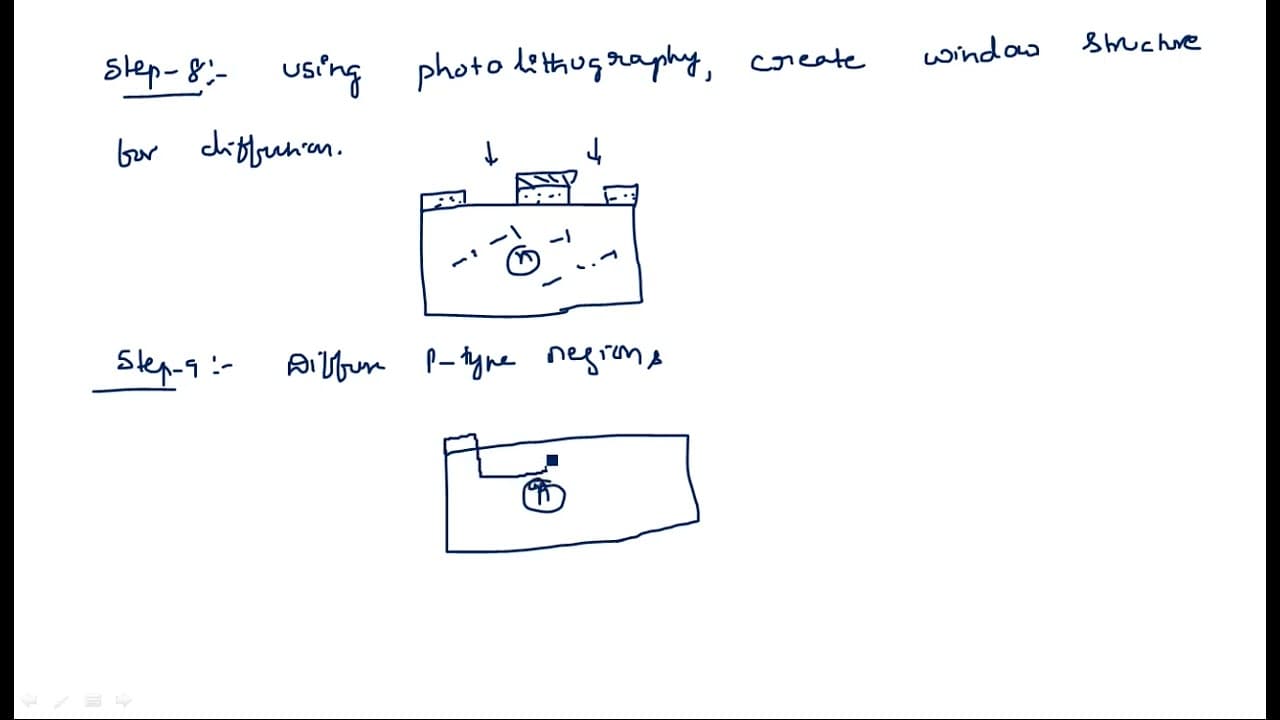
The fabrication of a PMOS transistor begins with an n-type substrate and involves several key steps: oxidation to create a silicon dioxide layer, photolithography for patterning, and the introduction of P-type regions through diffusion. The final steps include depositing polysilicon and metal layers to establish electrical contacts, forming a complete PMOS transistor.
Transcript
hi everyone in this video I am going to explain about the fabrication steps involved in the creation of pmos transistor in the previous video I have explained how to create the nmos transistor this video is for recreational PMS transistor so the first one step one so what type of transistor we are creating like a pmos transistor means opposite is t... Read More
Key Insights
- 🅰️ PMOS transistors are manufactured using an n-type substrate, which is critical for their operation.
- ❓ The fabrication process includes oxidation to create insulating layers and photolithography for precise patterning.
- 🅰️ The introduction of P-type regions is accomplished through diffusion, enabling the unique functionality of PMOS devices.
- ❓ Multiple oxidation techniques are employed throughout the process, emphasizing their importance in different layers.
- 🤘 The uniform application of metal layers is essential for establishing functional contacts in a transistor.
- ❓ The intricate steps of the fabrication highlight the careful engineering required in semiconductor manufacturing.
- ❓ Understanding these processes is fundamental in advancing technology in electronic and computing devices.
Install to Summarize YouTube Videos and Get Transcripts
Explore YouTube Video Summarizer or Get YouTube Transcript Extractor
Questions & Answers
Q: Why is an n-type substrate used for fabricating a PMOS transistor?
An n-type substrate is utilized in PMOS fabrication as it provides the necessary electrical characteristics for the operation of the transistor. PMOS transistors require a substrate that can effectively support the growth and doping of P-type regions. This opposite characteristic allows PMOS to operate on holes as charge carriers, contrasting with NMOS, which uses electrons.
Q: What are the differences between thin oxidation and thick oxidation processes?
Thin oxidation typically involves creating a silicon dioxide layer of about 0.1 micrometers, whereas thick oxidation results in a thicker layer, around 1 micrometer. Thin oxidation is often used to create gate oxides due to its capacitance characteristics, while thick oxidation is used for insulation purposes. The choice between the two depends on the device requirements and intended electrical properties.
Q: How does photolithography play a role in the fabrication process?
Photolithography is vital in the fabrication of PMOS transistors as it allows for precise patterning of the silicon substrate. By applying a photoresist layer and exposing it to ultraviolet rays through a mask, certain areas can be hardened while others remain soft. This selective etching enables the creation of intricate structures necessary for defining active device regions and connections.
Q: What is the significance of the diffusion step in creating P-type regions?
The diffusion step is crucial in introducing P-type doping agents into the n-type substrate to form P-type regions. By introducing trivalent impurities, the conductivity type of the silicon substrate is altered, allowing carriers (holes) to form and enhancing the transistor's functionality. This step ensures that the PMOS device can function effectively by establishing the required P-N junctions.
Q: Why is the final step of metal deposition important?
The final step of depositing the metal layer is essential for creating electrical contacts to connect the PMOS transistor to other components in a circuit. The metal layers serve as contacts for the source, gate, and drain, facilitating external connections and ensuring reliable performance in integrated circuits. Without these metal contacts, the PMOS transistor could not interact with other devices.
Summary & Key Takeaways
-
The video details the fabrication of PMOS transistors, beginning with using an n-type substrate essential for the process.
-
The steps include oxidation to create an SiO2 layer, layering photoresist, and utilizing photolithography techniques for patterning.
-
Further steps involve the application of polysilicon, diffusion of P-type regions, and the final metal layer deposition for connections.
Read in Other Languages (beta)
Share This Summary 📚
Summarize YouTube Videos and Get Video Transcripts with 1-Click
Try YouTube Summary with ChatGPT & Claude or YouTube Transcript Generator