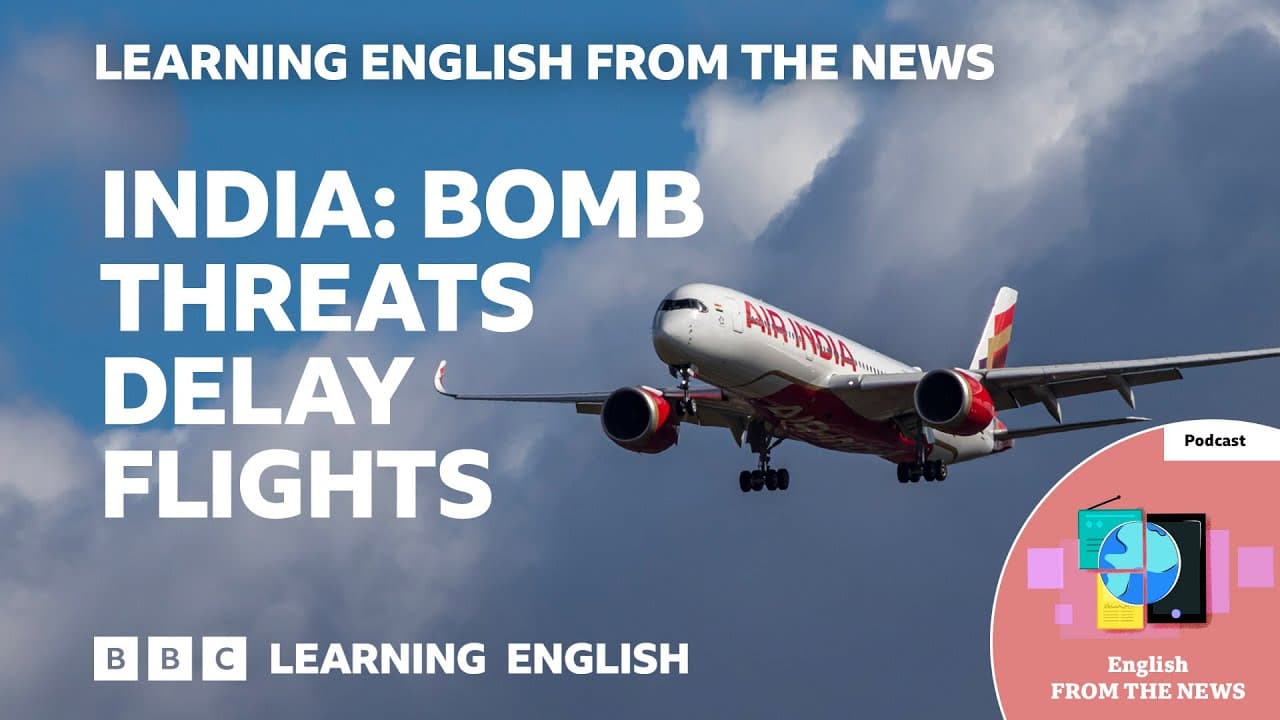
India: Bomb threats delay flights: BBC Learning English from the News
TL;DR
Fake bomb threats cause chaos for airlines and passengers.
Transcript
From BBC Learning English, this is Learning English from the News, our podcast about the news headlines. In this programme, a rise in fake bomb threats on planes. Hello, I'm Georgie and I'm Pippa. In this programme, we look at one big news story and the vocabulary in the headlines that will help you understand it. You can find all the vocabulary an... Read More
Key Insights
- There has been a significant increase in hoax bomb threats, primarily targeting Indian airlines, causing major disruptions globally.
- Hoax bomb threats force flights to land at incorrect locations or return, creating chaos for passengers and financial losses for airlines.
- The Royal Air Force had to quickly respond to a bomb threat on a flight from Mumbai to Heathrow, illustrating the seriousness of such threats.
- The term 'scramble' is used in military contexts to describe rapid deployment, but it also has broader meanings related to quick, urgent movement.
- Airlines are experiencing financial losses and a decline in customer goodwill due to the repeated false threats, leading to widespread frustration.
- The expression 'see red' is used metaphorically to describe intense anger, often used in contexts where someone is visibly upset.
- In response to the threats, Indian authorities are considering legal changes, including placing perpetrators on a no-fly list.
- The government is 'mulling' over potential law changes, indicating a careful consideration of how to effectively address the issue.
Install to Summarize YouTube Videos and Get Transcripts
Explore YouTube Video Summarizer or Get YouTube Transcript Extractor
Questions & Answers
Q: What impact have hoax bomb threats had on airlines?
Hoax bomb threats have caused airlines to experience significant disruptions, as flights are forced to land at incorrect locations or return to their origin. This results in financial losses due to the costs associated with these disruptions, as well as a decline in customer goodwill, as passengers face delays and inconvenience.
Q: How did the Royal Air Force respond to a bomb threat on a flight?
In response to a bomb threat on a flight from Mumbai to Heathrow, the Royal Air Force quickly deployed Typhoon fighters. This action, described by the term 'scrambled,' involved the urgent and rapid movement of military aircraft to address the threat, demonstrating the seriousness with which such threats are treated.
Q: What does the expression 'see red' mean in the context of the article?
The expression 'see red' is used metaphorically to describe intense anger. In the context of the article, it refers to the frustration and anger of airlines as they face repeated false bomb threats, leading to financial losses and a decline in customer trust. The phrase is often used to indicate a visible and immediate reaction of anger.
Q: What measures are Indian authorities considering to address the issue of hoax bomb threats?
Indian authorities are considering legal reforms to address the issue of hoax bomb threats. One proposed measure is to place individuals who make fake threats on a no-fly list, preventing them from traveling by plane in the future. This reflects a broader effort to deter such activities and reduce their impact on airline operations.
Q: What does the term 'scramble' mean in a military context?
In a military context, the term 'scramble' refers to the rapid deployment of aircraft in response to a threat or emergency. It involves quickly moving planes into specific positions to address the situation. The term can also be used more broadly to describe any urgent and hurried movement, often in response to an immediate need.
Q: How have airlines been financially impacted by the hoax bomb threats?
Airlines have been financially impacted by hoax bomb threats due to the costs associated with flight disruptions. These include the expenses of rerouting flights, addressing passenger needs, and conducting security checks. Additionally, the repeated threats have led to a loss of customer goodwill, further affecting the airlines' financial standing and reputation.
Q: What is meant by the government 'mulling' over law changes?
When the government is described as 'mulling' over law changes, it means they are carefully considering and evaluating potential legal reforms to address the issue of hoax bomb threats. The process involves thorough deliberation and analysis to determine the most effective measures to implement, reflecting the complexity and seriousness of the problem.
Q: What are some broader meanings of the word 'scramble'?
Beyond its military usage, 'scramble' can describe any quick, urgent movement, often in a disorganized or hurried manner. It can refer to people rushing to achieve a goal, such as scrambling for a sale item. Additionally, 'scrambled' can describe things that are mixed up or difficult to understand, like scrambled eggs or scrambled radio signals.
Summary & Key Takeaways
-
A surge in fake bomb threats has caused significant disruptions for airlines, especially those in India, leading to financial losses and passenger inconvenience. The threats are primarily communicated through emails and anonymous social media accounts, forcing flights to land at incorrect locations or return to their origin.
-
The Royal Air Force had to intervene in a recent incident involving a flight from Mumbai to Heathrow, highlighting the serious nature of these threats. The term 'scramble' is used in this context to describe the urgent deployment of military aircraft in response to the threat.
-
The Indian government is considering legal reforms to address the issue, including the possible implementation of a no-fly list for those making fake threats. This reflects the broader impact of these hoaxes on airline operations and customer trust, as airlines experience both financial and reputational damage.
Read in Other Languages (beta)
Share This Summary 📚
Summarize YouTube Videos and Get Video Transcripts with 1-Click
Try YouTube Summary with ChatGPT & Claude or YouTube Transcript Generator
Explore More Summaries from BBC Learning English 📚
Summarize YouTube Videos and Get Video Transcripts with 1-Click
Try YouTube Summary with ChatGPT & Claude or YouTube Transcript Generator