Leadership Theories Top 10
TL;DR
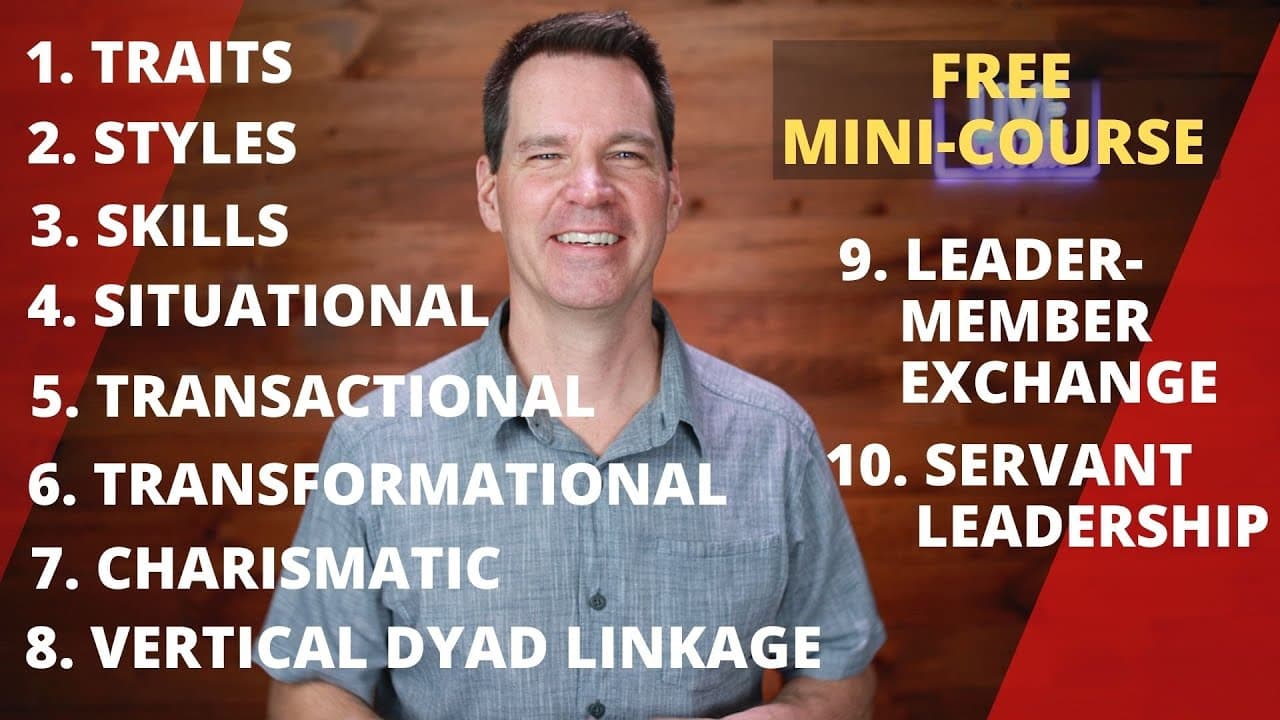
Overview of ten influential leadership theories in chronological order.
Transcript
- We're going to look at 10 of the most respected leadership theories out there. This is like a free mini course. What I've done is taken a string of individual videos I've already posted, I'm patching them together to put these different models and theories in one place so that you can see the development, the arc i... Read More
Key Insights
- The trait approach to leadership explores the idea that certain inherent traits make individuals natural leaders, though the list of traits varies across studies.
- Leadership styles such as autocratic, democratic, and laissez-faire influence group dynamics and effectiveness, with democratic styles generally preferred.
- Behavioral approaches focus on task and relationship behaviors, emphasizing the balance between production and people-oriented skills.
- Situational leadership adapts leadership style based on followers' readiness, considering factors like skill and motivation.
- Transactional leadership is based on exchanges between leaders and followers, focusing on rewards and punishments to achieve compliance.
- Transformational leadership aims to inspire and motivate followers to achieve higher levels of performance and personal development.
- Charismatic leadership involves leaders with a compelling charm and influence, which can be both positive and negative depending on intent.
- Leader-member exchange theory examines the quality of relationships between leaders and followers, impacting productivity and job satisfaction.
Install to Summarize YouTube Videos and Get Transcripts
Explore YouTube Video Summarizer or Get YouTube Transcript Extractor
Questions & Answers
Q: What is the trait approach to leadership?
The trait approach to leadership suggests that certain inherent traits, such as intelligence and self-confidence, make individuals natural leaders. This approach has been studied since the early 1900s, but the list of traits varies across different studies, leading to some criticism about its consistency and applicability.
Q: How do leadership styles impact group dynamics?
Leadership styles, including autocratic, democratic, and laissez-faire, significantly affect group dynamics and effectiveness. Democratic leadership is generally preferred as it fosters collaboration and engagement, whereas autocratic leadership can lead to aggression and turnover. Laissez-faire leadership offers autonomy but may result in low productivity if not managed properly.
Q: What is situational leadership?
Situational leadership, developed by Hersey and Blanchard, adapts a leader's style based on the readiness of their followers. It considers factors like skill and motivation, recommending varying levels of task and relationship communication to effectively guide followers through different situations.
Q: What distinguishes transformational leadership?
Transformational leadership is characterized by leaders who inspire and motivate followers to achieve higher levels of performance and personal development. They engage the entire person, addressing both lower and higher-level needs, and aim to transform followers into leaders themselves through creativity, vision, and empowerment.
Q: How does charismatic leadership differ from transformational leadership?
Charismatic leadership involves leaders with a compelling charm and influence, often inspiring loyalty and enthusiasm among followers. However, unlike transformational leadership, charismatic leadership can have a dark side, where leaders may prioritize personal gain over the well-being of their followers, leading to unethical outcomes.
Q: What is the leader-member exchange theory?
Leader-member exchange (LMX) theory focuses on the quality of relationships between leaders and followers. High-quality LMX relationships result in numerous benefits, such as increased productivity and job satisfaction, while low-quality relationships can lead to dissatisfaction and reduced performance.
Q: What is servant leadership?
Servant leadership is a philosophy that emphasizes serving others as the primary goal of leadership. It contrasts with traditional leadership by prioritizing the development and well-being of followers, fostering collaboration, trust, and empathy to enhance organizational effectiveness.
Q: How do transactional and transformational leadership compare?
Transactional leadership focuses on exchanges between leaders and followers, using rewards and punishments to achieve compliance. In contrast, transformational leadership seeks to inspire and motivate followers to exceed expectations, fostering personal growth and development beyond transactional exchanges.
Summary & Key Takeaways
-
This content provides a comprehensive analysis of ten major leadership theories, tracing their development and impact on organizational studies. Each theory is explored in detail, highlighting its unique contributions and criticisms.
-
The analysis includes leadership styles such as autocratic, democratic, and laissez-faire, as well as approaches like transformational and transactional leadership, offering insights into their practical applications.
-
Theories like servant leadership and leader-member exchange emphasize relational dynamics, focusing on the quality of interactions between leaders and followers to enhance organizational effectiveness.
Share This Summary 📚
Summarize YouTube Videos and Get Video Transcripts with 1-Click
Try YouTube Summary with ChatGPT & Claude or YouTube Transcript Generator
Explore More Summaries from Communication Coach Alexander Lyon 📚



Summarize YouTube Videos and Get Video Transcripts with 1-Click
Try YouTube Summary with ChatGPT & Claude or YouTube Transcript Generator