15.2.7 Worked Examples: Beta Junkyard
TL;DR
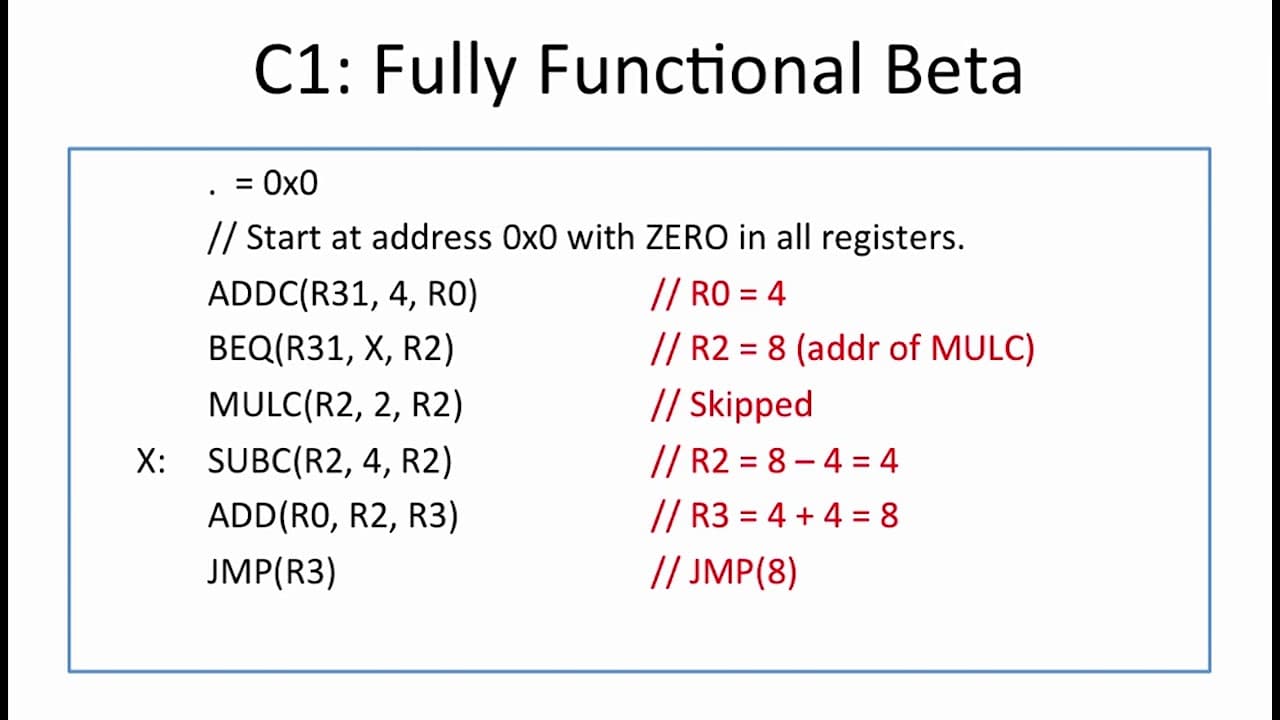
This analysis explores the behavior of four categories of discarded 5-stage pipelined Betas and how they execute a given test program.
Transcript
For this problem, assume that you have discovered a room full of discarded 5-stage pipelined betas. These betas fall into four categories. The first is completely functional 5-stage Betas with full bypass and annulment logic. The second are betas with a bad register file. In these betas, all data read directly from the register file is zero. Note t... Read More
Key Insights
- 🦥 The discarded 5-stage pipelined Betas fall into four categories: fully functional with bypass and annulment logic, bad register file, without bypass paths, and without annulment of branch delay slots.
- 🏆 The test program is designed to determine the category of each Beta based on the JMP address observed during execution.
- 👻 Bypass paths enable efficient data access by allowing instructions to retrieve values directly from other pipeline stages.
- 📁 A Beta with a bad register file reads zero values directly from the register file but obtains correct values via bypass paths.
- 🫠 Betas without bypass paths can result in stale values being read by instructions if the dependent instructions have not completed updating the register.
- 🦥 Betas without annulment of branch delay slots execute instructions after the branch instruction, affecting the values in registers.
- 🏆 The test program utilizes these differences in behavior to identify the category of each discarded Beta.
Install to Summarize YouTube Videos and Get Transcripts
Explore YouTube Video Summarizer or Get YouTube Transcript Extractor
Questions & Answers
Q: How does the test program help determine the category of the discarded Betas?
By single-stepping through the program and noting the address loaded by the final JMP instruction, we can identify the category based on the observed behavior and differences compared to a fully functional Beta.
Q: What is the purpose of bypass paths in the Betas?
Bypass paths allow instructions to directly access the correct values from other pipeline stages, bypassing the need to read from the register file. This enhances efficiency and minimizes delays.
Q: How does a Beta with a bad register file affect the program execution?
In this case, any data read directly from the register file will be zero. However, if the data is accessed via a bypass path, the correct value will be obtained.
Q: Why does a Beta without bypass paths result in stale values being read?
Without bypass paths, instructions might read stale values from the register file for their source operands. This occurs when the instructions updating the register have not completed by the time the dependent instruction reads the value.
Summary & Key Takeaways
-
There are four categories of discarded 5-stage pipelined Betas: fully functional with bypass and annulment logic, bad register file, without bypass paths, and without annulment of branch delay slots.
-
A test program is used to single-step through each Beta chip and determine its category by noting the address that the final JMP instruction loads into the PC.
-
The behavior of the program differs based on the category of the Beta chip, with differences in the values read from the register file and bypass paths.
Read in Other Languages (beta)
Share This Summary 📚
Summarize YouTube Videos and Get Video Transcripts with 1-Click
Try YouTube Summary with ChatGPT & Claude or YouTube Transcript Generator
Explore More Summaries from MIT OpenCourseWare 📚



Summarize YouTube Videos and Get Video Transcripts with 1-Click
Try YouTube Summary with ChatGPT & Claude or YouTube Transcript Generator