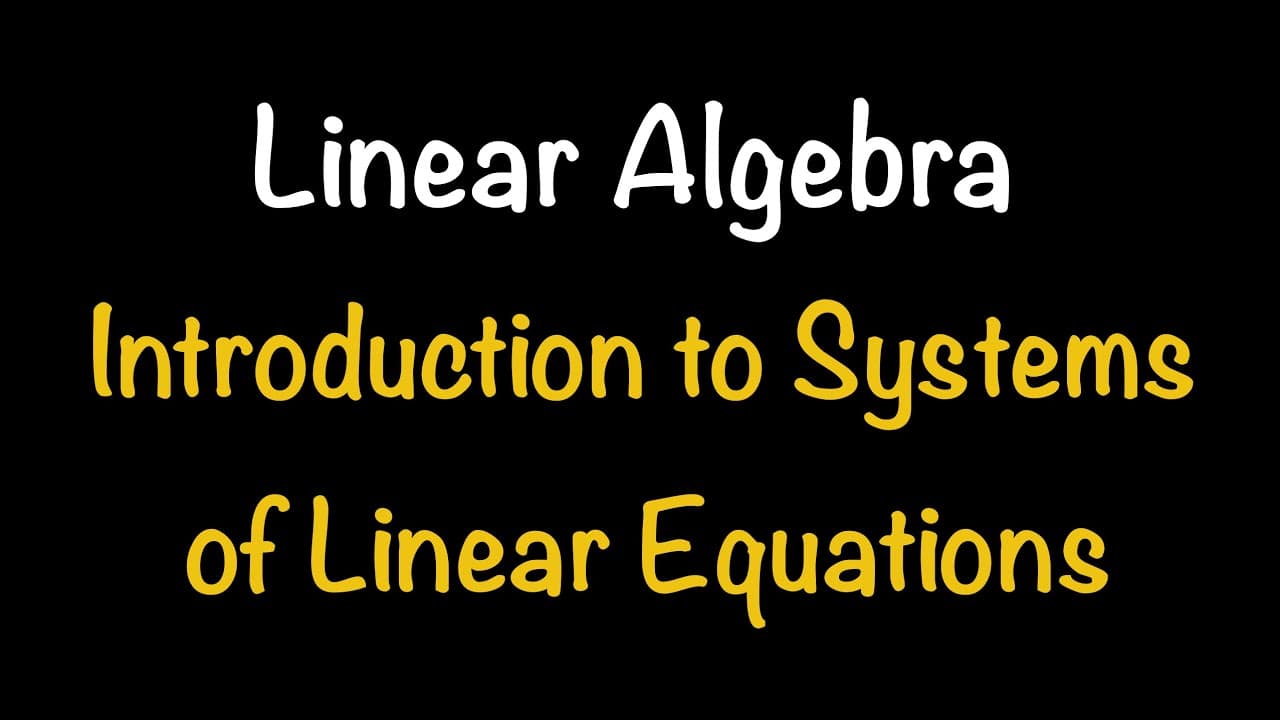
Linear Algebra: Introduction to Systems of Linear Equations (Section 1.1) | Math with Professor V
TL;DR
Introduction to systems of linear equations using Gaussian elimination.
Transcript
welcome to math tv with professor v this video lecture is for linear algebra section 1.1 on introduction to systems of linear equations if you're an algebra or pre-calculus student this video is not for you i'll link other videos i have on my channel on solving systems of linear equations here um but this is for advanced calculus st... Read More
Key Insights
- Linear equations in n variables are expressed with coefficients and a constant term, all as real numbers.
- A system of linear equations is consistent if it has at least one solution, otherwise it is inconsistent.
- Consistent systems can have exactly one solution or infinitely many solutions, while inconsistent systems have none.
- Row echelon form is achieved by manipulating systems to have a stair-step pattern with leading coefficients of one.
- Gaussian elimination involves rewriting systems using row operations to achieve row echelon form.
- Operations allowed in Gaussian elimination include interchanging rows, multiplying by non-zero constants, and adding multiples of rows.
- A system with a zero row equating to zero indicates infinite solutions, while zero equating to a non-zero indicates no solutions.
- Determining values for variables like k can help identify when a system becomes inconsistent or has no solutions.
Install to Summarize YouTube Videos and Get Transcripts
Explore YouTube Video Summarizer or Get YouTube Transcript Extractor
Questions & Answers
Q: What is a linear equation in n variables?
A linear equation in n variables has the form a1x1 + a2x2 + ... + anxn = b, where coefficients a1, a2, ..., an and constant b are real numbers. The variables x1, x2, ..., xn are raised to the first power, making the equation linear.
Q: What defines a consistent system of linear equations?
A system of linear equations is considered consistent if it has at least one solution. This means that the equations do not contradict each other, and there exists a set of values for the variables that satisfies all the equations simultaneously.
Q: How can you determine if a system has infinite solutions?
A system has infinite solutions if, during Gaussian elimination, you obtain a row where all variable coefficients are zero, resulting in a true statement like 0 = 0. This indicates that the system doesn't restrict the variable values to a single solution set.
Q: What is the row echelon form in linear equations?
Row echelon form is a simplified version of a system of linear equations where each leading coefficient (the first non-zero number from the left in a row) is 1, and all entries below each leading coefficient are zero, forming a stair-step pattern.
Q: What operations are used in Gaussian elimination?
In Gaussian elimination, you can interchange two equations, multiply an equation by a non-zero constant, or add a multiple of one equation to another. These operations help transform the system into row echelon form, facilitating easier solution finding.
Q: How do you identify an inconsistent system?
An inconsistent system is identified when, during Gaussian elimination, you derive a false statement such as 0 = 5. This indicates that no set of variable values can satisfy all the equations simultaneously, meaning the system has no solutions.
Q: What is the significance of the leading coefficient in a system?
The leading coefficient is the first non-zero number in a row of a system of equations. It is significant because, in row echelon form, it should be 1, and all numbers below it should be zero, simplifying the process of solving the system.
Q: How can the value of a constant affect the solution of a system?
The value of a constant, like k, can affect whether a system is consistent or inconsistent. By adjusting constants, you can manipulate the system to produce either a true or false statement during Gaussian elimination, determining the existence of solutions.
Summary & Key Takeaways
-
This video introduces systems of linear equations, focusing on advanced calculus students and their understanding of consistency in solutions.
-
Key concepts include defining linear equations, consistent versus inconsistent systems, and using Gaussian elimination to solve these systems.
-
The process of Gaussian elimination is explained, including operations like row interchange and multiplication to achieve row echelon form.
Read in Other Languages (beta)
Share This Summary 📚
Summarize YouTube Videos and Get Video Transcripts with 1-Click
Try YouTube Summary with ChatGPT & Claude or YouTube Transcript Generator
Explore More Summaries from Math with Professor V 📚
Summarize YouTube Videos and Get Video Transcripts with 1-Click
Try YouTube Summary with ChatGPT & Claude or YouTube Transcript Generator