Negative clamper | Pulse Digital Circuits | Lec-34
TL;DR
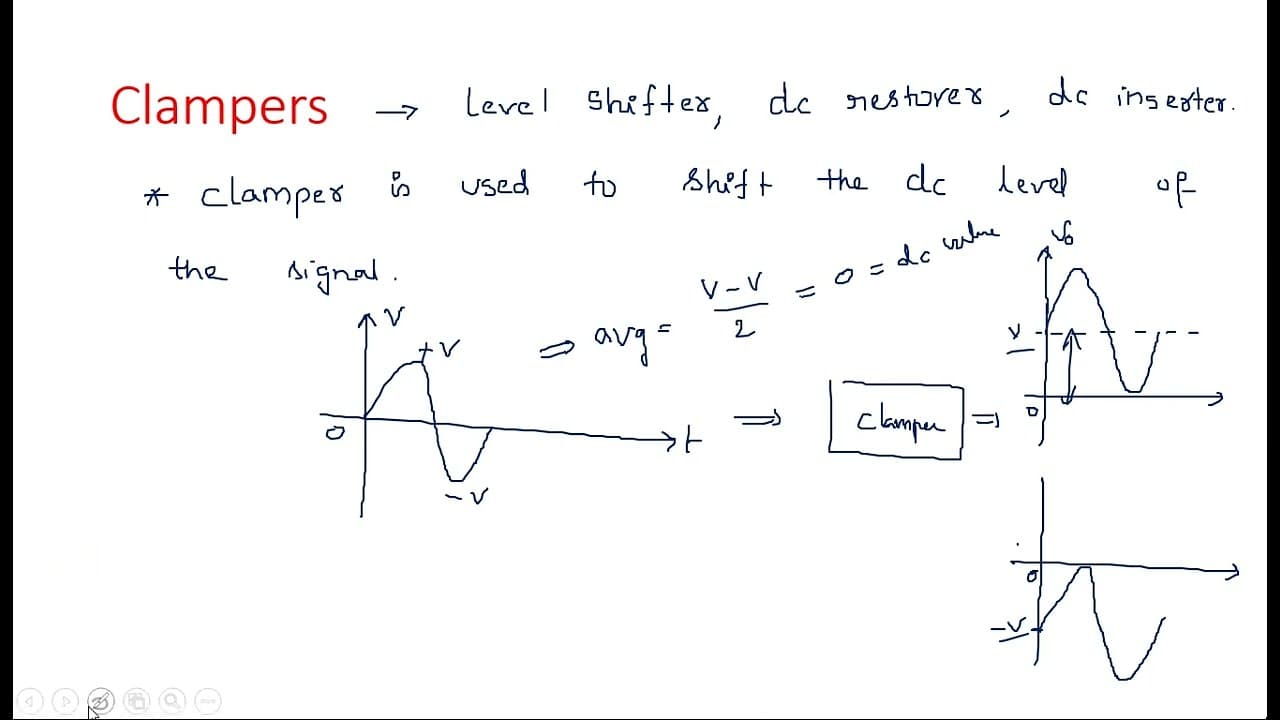
Clampers shift the DC level of signals, with positive and negative variations.
Transcript
hi students in this video I am going to start the next non-linear view shaping concept which is nothing but clampers okay previously we have seen several types of Clippers that is the first part of non-linear wave shaping in the second part of nonlinear view shaping you are going to learn about clampers so clampers are nothing but we can say crampe... Read More
Key Insights
- 🧘 Clampers serve as pivotal elements for modifying the DC position of input signals in electronic applications.
- 👻 Negative clampers shift signals downward, allowing outputs to reflect lower DC levels for appropriate processing.
- 🎨 The function and operation of clampers are deeply influenced by the arrangement of diodes and capacitors in the circuit design.
- 📡 Understanding both ideal and practical responses of clamper circuits is essential for effective signal processing in various electronic systems.
- 📡 The average value calculation of a signal is crucial for understanding how clampers affect output values.
- ❓ Practical implementation of clamper circuits often includes additional components like resistors to address transient responses.
- 🎮 The video differentiates between types of clampers and their specific functions, providing clarity on their operational distinctions.
Install to Summarize YouTube Videos and Get Transcripts
Explore YouTube Video Summarizer or Get YouTube Transcript Extractor
Questions & Answers
Q: What role do clampers play in electronic circuits?
Clampers function as level shifters or DC restorers, modifying the DC level of input signals. They can adapt signals to required operating ranges, allowing engineers to work with AC signals whose DC levels are not suitable for their intended applications.
Q: How do positive and negative clampers differ?
Positive clampers shift an input signal's DC level upward, while negative clampers move it downward. This differential behavior enables diverse applications in signal processing, ensuring that output signals can conform to specific voltage requirements.
Q: What components are essential for constructing a clamper circuit?
A clamper circuit typically consists of a diode and a capacitor. The diode controls current flow, while the capacitor stores and releases charge, enabling the shifting of the input signal’s DC level effectively during operation.
Q: What is the primary function of the diode in a negative clamper?
In a negative clamper, the diode allows current to flow when there is sufficient voltage difference, creating a pathway for the capacitor to charge to the maximum negative peak. This operation facilitates the downward shifting of the DC level in the output signal.
Q: How is the average DC level of a sinusoidal signal calculated?
The average DC level of a sinusoidal signal can be calculated using the formula V_avg = (V_peak - V_negative_peak) / 2, leading to zero for an unshifted AC signal. When passed through a clamper, it typically results in a shifted non-zero average value.
Q: What happens to output signals in practical clamper circuits?
In practical clamper circuits, transient responses may occur before the output stabilizes at steady-state. This behavior contrasts with ideal calculations, as it showcases the time delay in capacitor charging and the circuit's eventual ability to maintain the desired output voltage.
Summary & Key Takeaways
-
The video introduces clampers as a component of non-linear wave shaping, serving as DC level shifters or restorers in electronic circuits.
-
It distinguishes between positive and negative clampers, explaining how each shifts an input signal’s DC level in opposite directions.
-
The construction of negative clampers includes essential components such as a diode and capacitor, with details on their operational characteristics and practical circuit implementations.
Read in Other Languages (beta)
Share This Summary 📚
Summarize YouTube Videos and Get Video Transcripts with 1-Click
Try YouTube Summary with ChatGPT & Claude or YouTube Transcript Generator