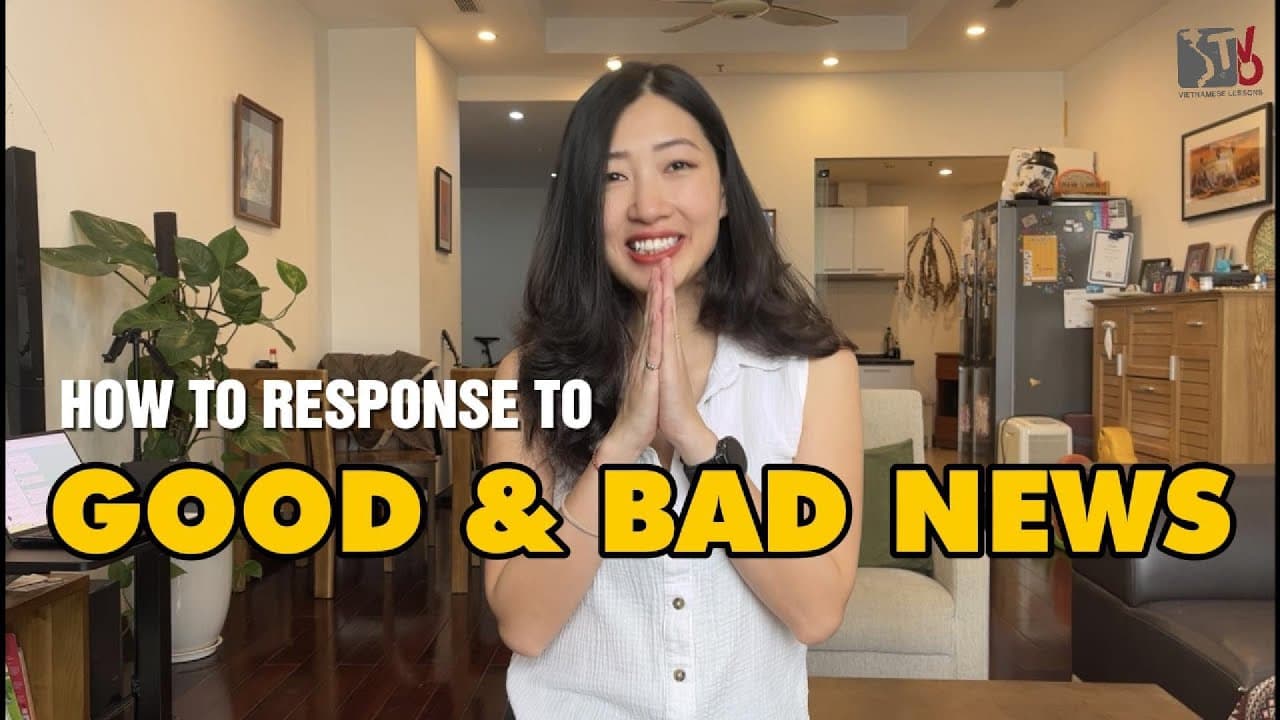
How to respond to good and bad news in Vietnamese | Learn Vietnamese with TVO
TL;DR
Learn to respond to good and bad news in Vietnamese.
Transcript
Have you ever found yourself in the situation when a local shares a news with you and you really want to be enthusiastic about the good news or empathetic about the bad news, but your limited vocabulary only allows you to respond with or every single time? Well, don't worry. This video won't fix that. Next time someone shares a new with you, you wi... Read More
Key Insights
- The video teaches how to respond to both good and bad news in Vietnamese, enhancing conversational skills.
- For good news, use facial expressions, express surprise, add exclamations, and ask follow-up questions to show interest.
- The word 'chúc mừng' is used similarly to 'congratulations' in English for significant achievements.
- For bad news, such as someone passing away, use the phrase 'chia buồn' to express shared sadness.
- Facial expressions and surprise are also important when responding to everyday bad news, similar to good news.
- The video content is based on a request from a patron, highlighting an interactive learning approach.
- Tieng Viet Oi offers additional resources like worksheets, private lessons, and more for patrons.
- The video is ideal for those looking to improve their Vietnamese language skills in everyday conversations.
Install to Summarize YouTube Videos and Get Transcripts
Explore YouTube Video Summarizer or Get YouTube Transcript Extractor
Questions & Answers
Q: What is the main focus of the video content?
The main focus of the video is to teach viewers how to respond appropriately to both good and bad news in Vietnamese. It aims to enhance conversational skills by providing practical expressions and techniques, moving beyond the basic responses that learners might be accustomed to.
Q: How does the video suggest responding to good news?
The video suggests using facial expressions, expressing surprise, adding exclamations, and asking follow-up questions to show genuine interest when responding to good news. For significant achievements, the phrase 'chúc mừng,' equivalent to 'congratulations' in English, is recommended.
Q: What are the recommended responses for bad news?
For bad news, such as someone passing away, the phrase 'chia buồn' is recommended to express shared sadness. For more common bad news, similar techniques as responding to good news are advised, including facial expressions, surprise, and follow-up questions to show empathy.
Q: What additional resources does Tieng Viet Oi offer to patrons?
Tieng Viet Oi offers additional resources to patrons, including access to extra practice materials, worksheets, and monthly private lessons. Patrons can also request topics for future video lessons, making the learning experience more interactive and tailored to their needs.
Q: Why was this video topic chosen?
This video topic was chosen based on a request from one of Tieng Viet Oi's patrons. This reflects the organization's commitment to providing content that meets the specific interests and needs of their learners, ensuring a more personalized and engaging learning experience.
Q: What is the significance of facial expressions in responding to news?
Facial expressions play a crucial role in responding to both good and bad news, as they help convey genuine emotions and reactions. By using appropriate facial expressions, learners can better express happiness, surprise, empathy, or sadness, making their interactions more authentic and effective.
Q: How does Tieng Viet Oi enhance language learning?
Tieng Viet Oi enhances language learning by providing practical, communication-based lessons that focus on real-life scenarios. They offer a variety of resources, interactive lessons, and patron-driven content to cater to different learning preferences and help learners improve their Vietnamese communication skills effectively.
Q: What benefits do patrons receive from Tieng Viet Oi?
Patrons of Tieng Viet Oi receive several benefits, including access to exclusive video content, practice materials, worksheets, and private lessons. They also have the opportunity to influence future video topics, making their learning experience more personalized and engaging, and allowing them to focus on areas they find most relevant.
Summary & Key Takeaways
-
This video lesson by Tieng Viet Oi teaches viewers how to appropriately respond to good and bad news in Vietnamese, going beyond the basic 'chúc mừng.' It emphasizes the importance of facial expressions, surprise, and follow-up questions to convey genuine reactions.
-
For significant achievements, 'chúc mừng' is the go-to phrase. For bad news, especially the passing of someone, 'chia buồn' is used to express shared sadness. The video also touches on how to handle more common news with appropriate expressions.
-
The content was requested by a patron, showcasing Tieng Viet Oi's interactive approach to language teaching. The organization offers various resources and lessons to help learners improve their Vietnamese communication skills effectively.
Read in Other Languages (beta)
Share This Summary 📚
Summarize YouTube Videos and Get Video Transcripts with 1-Click
Try YouTube Summary with ChatGPT & Claude or YouTube Transcript Generator
Explore More Summaries from Tieng Viet Oi - Vietnamese Lessons 📚

Summarize YouTube Videos and Get Video Transcripts with 1-Click
Try YouTube Summary with ChatGPT & Claude or YouTube Transcript Generator